
Letters to a Friend, Written to Mrs. Ezra S. Carr, 1866-1879
John Muir
THE CLASSIC COLLECTION · 1908
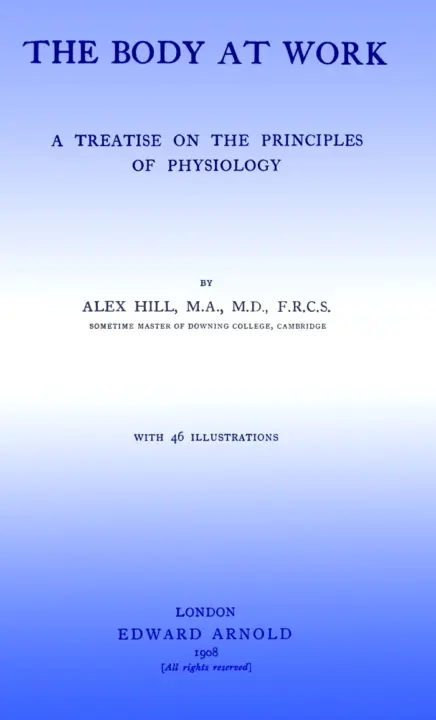
"The Body at Work: A Treatise on the Principles of Physiology" by Alex Hill is a scientific publication written in the early 20th century. The work discusses the various functions and interdependencies of physiological processes in living organisms, emphasizing the study of life and its manifestations rather than just anatomical structures. Hill aims to address the complexities of physiology in an accessible manner for readers unfamiliar with the foundational sciences. The opening of the treatise introduces the field of physiology, establishing it as the science concerned with the activities and functions of living beings. Hill contrasts physiology with anatomy, emphasizing that the former focuses on understanding how the body operates and responds to stimuli as opposed to merely detailing its structural components. He argues that the physiologist's role evolves through observational experimentation, leading to inferences about bodily functions, a process that historically highlights the interplay between living systems and their underlying structures. This section sets the stage for an exploration of life forms and their complex functionalities throughout the text.
Introduction adapted from the source catalogue; source summaries may be automatically generated.
Free to read · English · 172,268 words · No account needed
MAKE TIME FOR A GOOD BOOK
On by default. Untick to stop anonymous reading totals. Each page counts after 10 seconds in view. How this works.
Anonymous counting is on unless you have switched it off.
Nasal chambers, air warmed in, 166
Negroes, their long heels, 285
Nerve, conduction in, theory of, 282
degeneration, 326
electrical phenomena, 279
indefatigable, 282
regeneration, 326
structure, 296
Nerves, depressor, 237
experiment of crossing, 327
fifth, 316
of heart, 239
of intestines, 426
protopathic and critical systems of, 425
secretory, of the salivary glands, 109
splanchnic, 236
superior laryngeal, 178
vagus, 104
vaso-motor, 239
Nerve-cells last throughout life, 148
limitations of their functions, 321
store of energy in, 320
transfer of impulses from cell to cell, 177, 300
their relation to muscle-fibres, 274
varying size of, 295, 322
Nerve-centres, 176
Nerve-force, improper use of expression, 281
Nerve-impulses, distribution in grey matter, 305
reinforcement of, 320
resistance to, at synapses, 306
Nerve-nets, pericellular, 301, 319
Nervous system, neuronic and extra-neuronic conduction, 310
phylogeny of, 332
Neuro-fibrillæ, 298
Neurone, origin of term, 293
transmission of current by, 328
various types of, 296, 323
Night-blindness, 378
Nissl’s bodies, source of nervous energy, 320
Nitric oxide, combination with hæmoglobin, 186
Nitrogenous equilibrium, 150
food, stimulating effect of, 157
waste, 210
Nœud vital of Flourens, 176
Normal diet, 151
Normal salt-solution, 82
Nucleo-proteins, source of uric acid, 215
Odours, classification of, 366
Œdema, or dropsy, 42
Olfactory membrane, structure, 366
Optic nerve, number of fibres, 378
Organ of Corti, structure, 415
theory of function, 417
Organs that have lost their prime functions, 87
Orientation, sense of, 335
Osmosis, 40, 128, 201
cause of muscular contraction, 235
Osteoblasts, bone-forming cells, 32
Osteoclasts, bone-eating cells, 65
Oxygen, amount required per diem, 166
carried by red blood-corpuscles, 66
Pain, influence of, upon action, 359
referred from viscera to surface of body, 316
relation to sensation, 313, 425
theory of, 312, 425
Pancreas, structure, 116
Pancreatic juice, constitution, 116
fat-splitting ferment of, 133
Papillæ of the tongue, various forms of, 97
Parathyroids, 86
Pepsin, digestive action, 115
Peptone prevents coagulation of blood, 77
Pericellular nerve-nets, 301
Perspiration, cools the surface of the body, 236
repressed during fever, 257
Peyer’s patches of lymph-follicles in intestine, 53
Phagocytes, germ-eating leucocytes, 60
consumption of red blood-corpuscles by, 82
Phosphenes, developed by pressure on eyeball, 383
Phosphorescence, cause of, 291
Phrenology, 343
Pictures, suggestion of solidity in, 401
Pineal body, phylogeny, 334
Pituitary body, 93
Plants, anæsthetized by ether, 12, 24
their metabolism, 15
their respiration, 24
Pleura, lining membrane of chest, 172
Pleurisy, pain of, 313
Pleuritic fluid, absorption of, 223
Pneumonia, changes in lung during, 169
Portal system of bloodvessels, 80
regulator of vascular tone, 236
Power of muscles, 285
Precipitins formed in blood, 19
Proteins, absorption by alimentary canal, 145
chemical constitution, 6
dietetic value, 157
fate after absorption, 212
Protopathic nerves, 425
Protoplasm, arrangement in cells, 30
constitution, 7
Huxley’s definition, 6
Pulse, cause of, 244
records of, 245
variations, 247
Purgatives, theory of action, 128
Purkinje-cells of cerebellum, 303, 340
shadows of retinal vessels, 375
Pus, origin of, from leucocytes, 57
Pyramids of cortex of great brain, 346
Your reading position is saved on this browser. Take it to another device with a library code. Reading pages adapt to text, rather than matching a printed edition.
BEHIND THE BOOK
This eBook is for the use of anyone anywhere in the United States and most other parts of the world at no cost and with almost no restrictions whatsoever. You may copy it, give it away or re-use it under the terms of the Project Gutenberg License included with this eBook or online at www.gutenberg.org. If you are not located in the United States, you will have to check the laws of the country where you are located before using this eBook. Read the source licence.
The original source file, including credits and licence, is retained by this library. Request an original-format copy at no charge. Please include the book title and Project Gutenberg identifier #63089.
KEEP YOUR CURIOSITY GOING
John Muir

Asa Gray
Asa Gray

Florence Nightingale
Elizabeth Robins Pennell
Denison Olmsted