
Letters to a Friend, Written to Mrs. Ezra S. Carr, 1866-1879
John Muir
THE CLASSIC COLLECTION · 1908
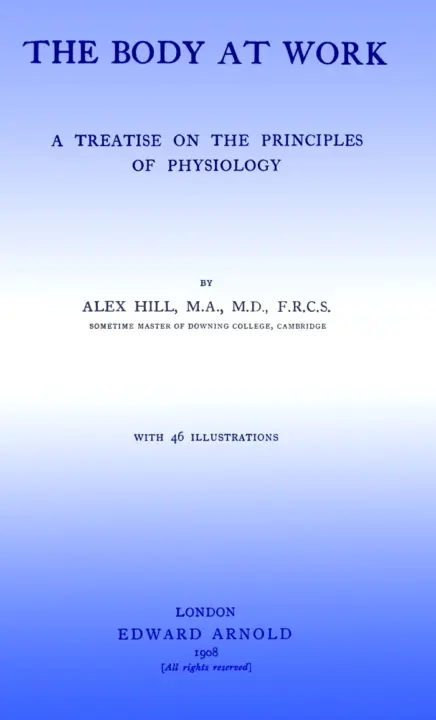
"The Body at Work: A Treatise on the Principles of Physiology" by Alex Hill is a scientific publication written in the early 20th century. The work discusses the various functions and interdependencies of physiological processes in living organisms, emphasizing the study of life and its manifestations rather than just anatomical structures. Hill aims to address the complexities of physiology in an accessible manner for readers unfamiliar with the foundational sciences. The opening of the treatise introduces the field of physiology, establishing it as the science concerned with the activities and functions of living beings. Hill contrasts physiology with anatomy, emphasizing that the former focuses on understanding how the body operates and responds to stimuli as opposed to merely detailing its structural components. He argues that the physiologist's role evolves through observational experimentation, leading to inferences about bodily functions, a process that historically highlights the interplay between living systems and their underlying structures. This section sets the stage for an exploration of life forms and their complex functionalities throughout the text.
Introduction adapted from the source catalogue; source summaries may be automatically generated.
Free to read · English · 172,268 words · No account needed
MAKE TIME FOR A GOOD BOOK
On by default. Untick to stop anonymous reading totals. Each page counts after 10 seconds in view. How this works.
Anonymous counting is on unless you have switched it off.
The facility with which the constituents of blood pass out to the lymph, and the constituents of lymph pass into the blood, depends upon the condition of the walls of the capillary vessels. Water and substances dissolved in water might pass through the wall of a capillary vessel in either of three ways—by filtration, by osmosis, or by secretion. A filter is a porous barrier, which allows water and all substances dissolved in water to traverse it. The solution passes through unchanged in composition. Only solid particles are kept back. The rapidity with which fluid passes through a filter varies as the difference between the pressure on the one side and the pressure on the other. A membrane does not allow of filtration. Water and things dissolved in water pass through it by osmosis. Some things it will not allow to pass; such, for example, as gum, mucin, white of egg. To others it offers resistance in varying degrees. Most of the things that can diffuse through a membrane are capable of crystallization; but the membrane exercises some control over the passage of even crystallizable substances when in solution. If a membranous tube containing water in which proteins, sugar, and various salts are dissolved is hung in a basin of pure water, the proteins remain in the tube; the sugar and the salts pass through its wall into the surrounding water. But they pass at different rates. Those of small molecular weight pass more quickly than those whose molecule is heavy. After a time a condition of equilibrium is established. No more salts pass out of the tube. If now the contents of the tube and the contents of the basin are analysed, it will be found that the tube contains all the proteins, some of the sugar, and some of each of the salts, although not in the proportions in which they were present at the commencement of the experiment. The water in the basin contains some sugar and some of each of the salts, but not in the same proportions in which they are found in the tube. As a matter of fact, the same number of molecules would be present, per unit volume, on each side of the membrane—in the tube and in the basin. In this respect the percentage composition of the two solutions would be the same. But some of the molecules being heavy, others light, the weight of salts which unit volume of the solution in the tube would contain would not be the same as the weight of salts in unit volume of the solution in the basin. A membrane exerts a discriminating action on the substances which pass through it. Secretion is osmosis in disguise. It may be even filtration in disguise. A gland-cell (like an amœba) takes things up and passes them out without regard to their osmotic equivalent. It seems to exercise a choice. It seems to act in disregard of the laws both of filtration and of osmosis. So, at least, it appears to us when we are looking at the result in ignorance of what has happened inside the living cell. The passage from blood to lymph and vice versa through the wall of a capillary vessel is in certain situations or at certain times a mere process of filtration; at others a process of restricted filtration. If the wall is behaving as a perfect membrane, it is a process of diffusion, or osmosis. It seems unnecessary to regard it, in any case, as a process of secretion. The more widely the capillaries are dilated, the less resistance do they offer to exudation. The narrower their calibre, the greater is the restraint which they place on the escape or entrance of fluid. When the skin of the palm of the hand is not sufficiently thick to protect the soft tissues beneath it from the injurious effects of the prolonged pressure of an oar or an axe, the capillary vessels of the under-skin dilate; more lymph transudes; the skin is raised up as a blister. The same thing happens when the capillaries are dilated and paralyzed by scalding water. The fluid of a blister has much the same constitution as blood-plasm, except that it contains less proteid substance. These results might be regarded as purely mechanical—the direct effects of pressure or heat upon the membranous capillary wall. But the “vital” element is more important. The capacity of endothelium to act as a barrier depends upon its nutritive condition—its vital integrity, as it might be termed; which no doubt in the last resort means its chemical relation to the fluids which bathe it. Now and again blebs, like blisters, are formed on the skin—the herpes which appears about the mouth; urticaria, which is more generally distributed; and various other cutaneous disorders. Frequently a connection can be traced between these eruptions and the consumption of a particular food. An attack of urticaria results not uncommonly from eating lobster, mussels, rook-pie, or some few other articles of diet. Various things—bad fish, for example—may produce the same effect; but shell-fish have an especially evil reputation. If extract of lobster or of mussels be injected into the blood of an animal, the amount of lymph which leaves the blood is markedly increased. The extract acts as a poison upon the endothelium of the capillary walls. It increases its permeability in all conditions in which lymph escapes in undue quantity from the blood-stream, or escapes more rapidly than it is absorbed; the nutritive condition of the endothelium is disturbed. Its unusual permeability is due in part, no doubt, to the dilatation of the capillary tube, the stretching of its membranous wall; but it is due also to the diminished vigour of the endothelial cells. They have lost to a certain extent their capacity for holding their edges in perfect apposition.
Your reading position is saved on this browser. Take it to another device with a library code. Reading pages adapt to text, rather than matching a printed edition.
BEHIND THE BOOK
This eBook is for the use of anyone anywhere in the United States and most other parts of the world at no cost and with almost no restrictions whatsoever. You may copy it, give it away or re-use it under the terms of the Project Gutenberg License included with this eBook or online at www.gutenberg.org. If you are not located in the United States, you will have to check the laws of the country where you are located before using this eBook. Read the source licence.
The original source file, including credits and licence, is retained by this library. Request an original-format copy at no charge. Please include the book title and Project Gutenberg identifier #63089.
KEEP YOUR CURIOSITY GOING
John Muir

Asa Gray
Asa Gray

Florence Nightingale
Elizabeth Robins Pennell
Denison Olmsted