
Letters to a Friend, Written to Mrs. Ezra S. Carr, 1866-1879
John Muir
THE CLASSIC COLLECTION · 1908
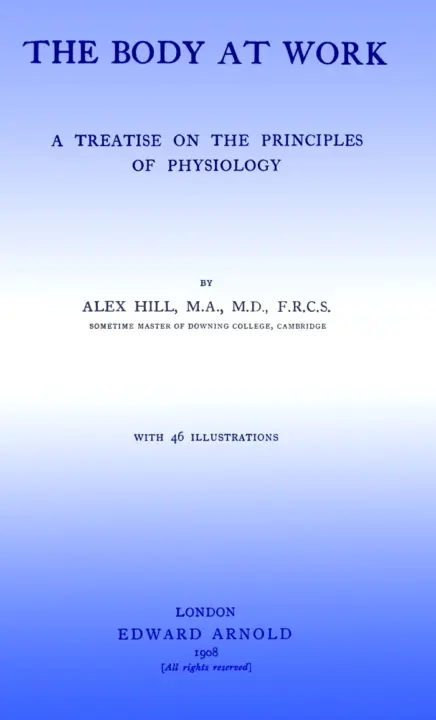
"The Body at Work: A Treatise on the Principles of Physiology" by Alex Hill is a scientific publication written in the early 20th century. The work discusses the various functions and interdependencies of physiological processes in living organisms, emphasizing the study of life and its manifestations rather than just anatomical structures. Hill aims to address the complexities of physiology in an accessible manner for readers unfamiliar with the foundational sciences. The opening of the treatise introduces the field of physiology, establishing it as the science concerned with the activities and functions of living beings. Hill contrasts physiology with anatomy, emphasizing that the former focuses on understanding how the body operates and responds to stimuli as opposed to merely detailing its structural components. He argues that the physiologist's role evolves through observational experimentation, leading to inferences about bodily functions, a process that historically highlights the interplay between living systems and their underlying structures. This section sets the stage for an exploration of life forms and their complex functionalities throughout the text.
Introduction adapted from the source catalogue; source summaries may be automatically generated.
Free to read · English · 172,268 words · No account needed
MAKE TIME FOR A GOOD BOOK
On by default. Untick to stop anonymous reading totals. Each page counts after 10 seconds in view. How this works.
Anonymous counting is on unless you have switched it off.
Point A in the right retina is associated by experience with point a in the left, and point B with b. These are termed corresponding points, because they are similarly stimulated in binocular vision. The mind, therefore, judges that it receives the same information from each pair of corresponding points. The position of corresponding points will be understood if the right retina is imagined as put inside the left, precautions being taken to make the yellow spots coincide, and to avoid twisting the retinal cups in taking them out of the eyeballs. Great care is taken to maintain the points in correspondence during the various movements of the two eyeballs. In addition to the four recti muscles which move the eyeball upwards, downwards, to right and left, two oblique muscles give it the requisite amount of rotation. We have learned to give the same value to the impulses from two corresponding points. But under changed conditions the correspondence changes. When a squint develops in childhood, it follows one of two courses; either the obliquity of one of the eyeballs increases until it looks towards the nose, and its images cease to interfere with the images in the dominant eye—they are ignored by the mind—or a fresh correspondence is established between points in the oblique eye and points in the eye which looks straight forward. If we are severely critical, we find, from a study of the form of the eyeball, that it is impossible that the same rods and cones should occupy corresponding points in different positions of focus and with different degrees of convergence of the eyeballs. To permit of this the retinal cups would need to change in shape. But again mechanical correspondence is of little consequence. In the light of experience the mind judges that points correspond. When we are gazing at a flat surface, the mind judges that corresponding points are giving it similar information. It does not see a flower on a wall-paper twice as bright or twice as red with two eyes as with one. If the eyes are normal, the impression received through the two is precisely the same as the impression received through either singly. But when we are looking at solid objects, the image on one retina is not the same as the image on the other. One eye sees farther round the object on the one side, the other on the other; and it is just this disparity in the pictures, aided by the feeling that the eyes are converging, that gives the impression of solidity. Correspondence of points, on the other hand, is not necessarily sufficient by itself to convince the mind that the pictures presented by the two eyes are identical. When a flat triangle such as this is regarded with the two eyes, its black lines fall on corresponding points; but the figure is associated in the mind with other sensations—sensations of movement and touch. Notwithstanding the identity of the retinal images, the mind tries to see them as disparate. The figure troubles the eyes. At one moment the meeting-point of the three central lines projects forwards, at the next it recedes. That similarity of retinal images counts for something is shown by closing one eye. The uncertainty of shape of the figure is rendered more troublesome. It changes still more rapidly from convex to concave. When the point seems to be in front of the page, the accommodation of the eyes is adjusted for nearness; when behind the page, for greater distance. But the illusion that the object occupies three dimensions is not dependent upon the sense of contraction of the ciliary muscle. When the paper is moved towards the eye, its centre recedes; it is left behind until the ciliary muscle has had time to contract. When it is moved away from the eye, it projects until the ciliary muscle has had time to relax. Accommodation follows judgment, not judgment accommodation. The mind is extremely suspicious of the veracity of its newsagents. Disparateness of images, convergence of the eyeballs, shifting of accommodation for the various levels of an object in space, should be indisputable evidence of solidity or of hollowness. Conversely, the absence of either factor should be conclusive proof of flatness. But the mind does not trust to isolated sensations; it looks for associations of sensations. When the finger hints, “I could touch that sharp point,” it is useless for the eye to aver that there is no point to be touched.
Your reading position is saved on this browser. Take it to another device with a library code. Reading pages adapt to text, rather than matching a printed edition.
BEHIND THE BOOK
This eBook is for the use of anyone anywhere in the United States and most other parts of the world at no cost and with almost no restrictions whatsoever. You may copy it, give it away or re-use it under the terms of the Project Gutenberg License included with this eBook or online at www.gutenberg.org. If you are not located in the United States, you will have to check the laws of the country where you are located before using this eBook. Read the source licence.
The original source file, including credits and licence, is retained by this library. Request an original-format copy at no charge. Please include the book title and Project Gutenberg identifier #63089.
KEEP YOUR CURIOSITY GOING
John Muir

Asa Gray
Asa Gray

Florence Nightingale
Elizabeth Robins Pennell
Denison Olmsted