
Letters to a Friend, Written to Mrs. Ezra S. Carr, 1866-1879
John Muir
THE CLASSIC COLLECTION · 1908
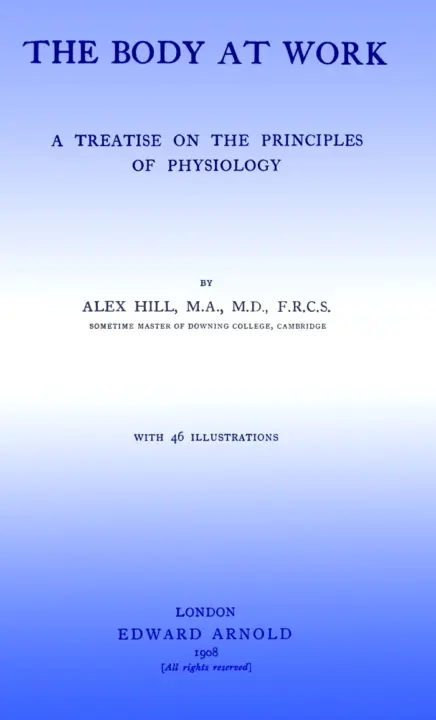
"The Body at Work: A Treatise on the Principles of Physiology" by Alex Hill is a scientific publication written in the early 20th century. The work discusses the various functions and interdependencies of physiological processes in living organisms, emphasizing the study of life and its manifestations rather than just anatomical structures. Hill aims to address the complexities of physiology in an accessible manner for readers unfamiliar with the foundational sciences. The opening of the treatise introduces the field of physiology, establishing it as the science concerned with the activities and functions of living beings. Hill contrasts physiology with anatomy, emphasizing that the former focuses on understanding how the body operates and responds to stimuli as opposed to merely detailing its structural components. He argues that the physiologist's role evolves through observational experimentation, leading to inferences about bodily functions, a process that historically highlights the interplay between living systems and their underlying structures. This section sets the stage for an exploration of life forms and their complex functionalities throughout the text.
Introduction adapted from the source catalogue; source summaries may be automatically generated.
Free to read · English · 172,268 words · No account needed
MAKE TIME FOR A GOOD BOOK
On by default. Untick to stop anonymous reading totals. Each page counts after 10 seconds in view. How this works.
Anonymous counting is on unless you have switched it off.
The anatomical unit of structure is the cell. Cells are the bricks of which the body is built. Some are large, others small, as befits the part which they take in the construction of the body. If the tissue be merely a supporting tissue, connective tissue, cartilage, bone, its cells are uniform in size and small. If it have functions to perform which in some cases are carried out best by small cells, in other cases by large ones, the cells are adapted in size to the work that they have to do. Of the various kinds of wandering cells, some—the bone-forming cells (osteoblasts), for example—are small; others—the bone-eating cells (osteoclasts)—relatively large. Nerve-cells, like telephone exchanges, are large or small according to the size of the area which each supplies.
All animals of complex organization, from starfishes and sea-urchins to Man, are inhabited by =motile cells=. In addition to the bricks which enter into the construction of its fabric, each fixed in its place and definitely united to its neighbours, the animal contains leucocytes which wander through its tissue-spaces or float down the streams of lymph or blood. We are disposed to speak of these wanderers as inhabitants of the body, to distinguish them from the elements which enter into the construction of their habitation. It is difficult to avoid the temptation of describing the body as a habitation. Allegorical as Aristotle’s distinction between body and soul—between the habitation and that which inhabits—may seem, when contrasted with the exact language of modern science, it would save many a periphrasis if we might still use the monosyllable “soul.” The fixed tissues constitute a unity, bound together by nerves. The work done by glands and muscles is done in response to directions conveyed by nerves. It is impossible to say where the control of the nerves ceases—to point out any fixed tissue which is not co-ordinated with other tissues, nor susceptible to the influence of the environment as impressed upon the central nervous system, through the medium of sense-organs. The fixed tissues constitute a habitation for the “soul.” They share in a common life. The wandering cells are as independent of control as the parasites which occasionally find entrance into the body. Each must have a soul of its own in Aristotle’s sense. Like parasites, they carry on all the business of nutrition, respiration, cell division, without reference to the needs of the fixed tissues. They take what they require from the lymph as it leaves the intestines loaded with the products of digestion; they take it from the lymph in the tissue-spaces; they take it from the blood. When nutriment or oxygen runs short, they do not share the privations of the fixed tissues. Only indirectly is their well-being affected by that of the body as a whole; only accidentally is the death of the body the occasion of their death. The same might be said of such parasites as the “blood-worms” of Egypt, or the trypanosomes (the cause of “sleeping sickness”) of Equatorial Africa. Occasionally, in the rare disease lymphocythæmia leucocytes multiply exceedingly, not, apparently, in response to a call for their presence in large numbers, but in defiance of the needs of the economy, and with baneful results. To the indispensable services which wandering cells render, frequent reference will be made. In the present connection, and while we are searching for the principles of construction of the animal body, it would be desirable, if we could do so, to define the status of wandering cells. If they entered the body from without, they would be parasites of commensal type, intruders who share in the food and shelter of the body in return for service. But they do not enter from without. They are cells of the growing body which, detaching themselves from the cells which are forming tissues, assume a wandering life. They are not to be recognized in the embryo until development is considerably advanced. Their origin is far from clear, but histologists believe that, although they are not recognizable as wandering cells in the earliest stages of growth, they, or rather their parent cells, are set apart at a very early date. Probably they are not formed in the embryo proper, but in the “extra-embryonic area,” from which they emigrate into the embryo. In this sense they come in from outside. But, after all, the extra-embryonic area equally with the embryo is a product of the ovum. Looking at the body as a whole, we recognize a common life, a soul in Aristotle’s sense, which inhabits the framework of fixed tissues; and at the same time we see a multitude of independent cells, each an organism in itself, produced, like amœbæ, from similar independent cells by cell division, absorbing the body-fluids, consuming invading germs and fragments of decaying tissues, dying, disintegrating, in their turn absorbed. Wandering cells are autonomous in the largest sense.
Your reading position is saved on this browser. Take it to another device with a library code. Reading pages adapt to text, rather than matching a printed edition.
BEHIND THE BOOK
This eBook is for the use of anyone anywhere in the United States and most other parts of the world at no cost and with almost no restrictions whatsoever. You may copy it, give it away or re-use it under the terms of the Project Gutenberg License included with this eBook or online at www.gutenberg.org. If you are not located in the United States, you will have to check the laws of the country where you are located before using this eBook. Read the source licence.
The original source file, including credits and licence, is retained by this library. Request an original-format copy at no charge. Please include the book title and Project Gutenberg identifier #63089.
KEEP YOUR CURIOSITY GOING
John Muir

Asa Gray
Asa Gray

Florence Nightingale
Elizabeth Robins Pennell
Denison Olmsted