
Letters to a Friend, Written to Mrs. Ezra S. Carr, 1866-1879
John Muir
THE CLASSIC COLLECTION · 1908
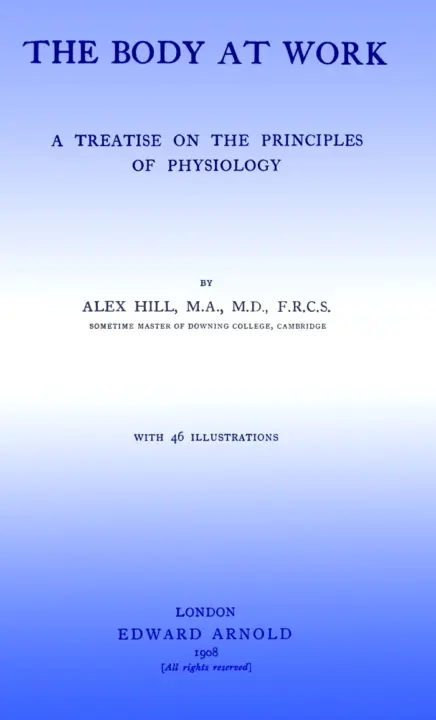
"The Body at Work: A Treatise on the Principles of Physiology" by Alex Hill is a scientific publication written in the early 20th century. The work discusses the various functions and interdependencies of physiological processes in living organisms, emphasizing the study of life and its manifestations rather than just anatomical structures. Hill aims to address the complexities of physiology in an accessible manner for readers unfamiliar with the foundational sciences. The opening of the treatise introduces the field of physiology, establishing it as the science concerned with the activities and functions of living beings. Hill contrasts physiology with anatomy, emphasizing that the former focuses on understanding how the body operates and responds to stimuli as opposed to merely detailing its structural components. He argues that the physiologist's role evolves through observational experimentation, leading to inferences about bodily functions, a process that historically highlights the interplay between living systems and their underlying structures. This section sets the stage for an exploration of life forms and their complex functionalities throughout the text.
Introduction adapted from the source catalogue; source summaries may be automatically generated.
Free to read · English · 172,268 words · No account needed
MAKE TIME FOR A GOOD BOOK
On by default. Untick to stop anonymous reading totals. Each page counts after 10 seconds in view. How this works.
Anonymous counting is on unless you have switched it off.
As the nervous system grows, the axons of its neurones acquire their fatty (myelin) sheaths in the order in which they come into functional activity. The passage through them of impulses is the stimulus which leads to the deposition of fat. The study of the progress of myelination enabled the anatomist Flechsig to ascertain the situation within the brain of the tracts of fibres related to the several senses, and hence the traffic of the areas of the cortex to which they go. Glistening white streaks appear successively in the pulpy yellowish-pink substance of the interior of the brain. At the time of birth all the fibres which enter or leave the cerebral hemispheres have acquired their myelin sheaths. In the baby’s brain the sense-organs have established all their connections with the cortex. No new fibres will appear in the nerves of the eye, the ear, or the other sense-organs, nor will their end-stations in the cortex be further multiplied. (The use of the expression “end-stations” is legitimate so far as sensations are concerned; notwithstanding that all sensory impulses are retransmitted by neurones in the cerebro-spinal axis.) But the cortex is very far from having finished its growth. It contains a large amount of embryonic tissue, which gradually spreads outwards from the developed areas into the surrounding unoccupied zones. The taking up of new territory, and the consequent increase in the size of the brain, is continued into adult life. The study of progressive myelination enabled Flechsig to divide the cortex into “sensory centres,” and intervening “association-zones”; although, doubtless, the difference in function between the portions which receive sensations direct and the portions in which the products of sensation are worked up is one of degree, and not of kind.
The structure of the cortex is not quite the same in sensory and association areas; but it is everywhere so far from showing the diagrammatic simplicity which characterizes the cortex of the cerebellum as to make it difficult to summarize the modifications which distinguish its various regions. To a considerable extent its elements shade one into the other, differing in size and in orientation rather than in form. Commonly it is described as divisible into five layers: (1) A thin superficial layer, containing cells of various forms and fibres derived from the cells of the deeper strata. Some of the cells are pluripolar, possessing several axons which run parallel with the surface. Their destination is unknown. They do not appear to form baskets like the cells of the molecular layer of the cerebellum. The dendrites of pyramidal cells extend into this layer. (2) The layer of small pyramids; cells with a branching apical process, root-like dendrites from the basal angles of the pyramid, and an axon which sinks into the white matter. (3) Granules. Carmine or other nuclear stains show that small cells are present in very large numbers, especially in the sensory areas; but since they are not, like the granules of the cerebellum, coloured by the chrome-silver method, their form and the disposition of their axons are unknown. (4) Large pyramids exactly similar in form to the small ones. Their apical processes are very thorny. Their axons give off several collaterals. Pyramids are the most conspicuous elements in the cortex. Properly speaking, they do not occur in layers, but are scattered throughout its whole thickness, although their cell-bodies are not seen in either its most superficial or its deepest strata. The largest are those of which the axons either descend into the spinal cord or pass to a very distant region of the cortex. They are found singly or in small clusters in the deeper levels. (5) Polymorphous cells, some of them pyramids lying on their sides, or even directing their axons towards the surface; some fusiform or irregular cells; some Golgi-cells (p. 340). The axons of pyramids enter the white matter, and many fibres from the white matter radiate towards the surface between the pyramids; but the way in which afferent, sensory fibres are connected with the collecting processes, dendrites, of the pyramids is not known. We have already referred to thorns, and to the possible nerve-net (p. 301). Sheets of tangential fibres also occur in the cortex. A particularly distinct sheet divides the granules in the visual cortex into two strata. In sections of this region the sheet of fibres appears as a white line, distinctly visible without a lens.
Your reading position is saved on this browser. Take it to another device with a library code. Reading pages adapt to text, rather than matching a printed edition.
BEHIND THE BOOK
This eBook is for the use of anyone anywhere in the United States and most other parts of the world at no cost and with almost no restrictions whatsoever. You may copy it, give it away or re-use it under the terms of the Project Gutenberg License included with this eBook or online at www.gutenberg.org. If you are not located in the United States, you will have to check the laws of the country where you are located before using this eBook. Read the source licence.
The original source file, including credits and licence, is retained by this library. Request an original-format copy at no charge. Please include the book title and Project Gutenberg identifier #63089.
KEEP YOUR CURIOSITY GOING
John Muir

Asa Gray
Asa Gray

Florence Nightingale
Elizabeth Robins Pennell
Denison Olmsted