
Letters to a Friend, Written to Mrs. Ezra S. Carr, 1866-1879
John Muir
THE CLASSIC COLLECTION · 1908
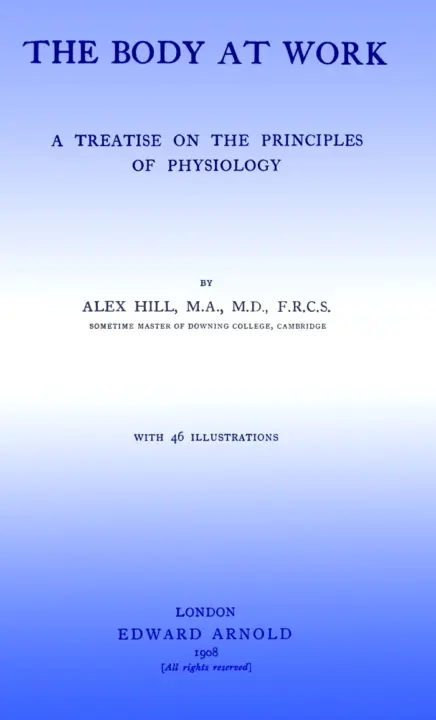
"The Body at Work: A Treatise on the Principles of Physiology" by Alex Hill is a scientific publication written in the early 20th century. The work discusses the various functions and interdependencies of physiological processes in living organisms, emphasizing the study of life and its manifestations rather than just anatomical structures. Hill aims to address the complexities of physiology in an accessible manner for readers unfamiliar with the foundational sciences. The opening of the treatise introduces the field of physiology, establishing it as the science concerned with the activities and functions of living beings. Hill contrasts physiology with anatomy, emphasizing that the former focuses on understanding how the body operates and responds to stimuli as opposed to merely detailing its structural components. He argues that the physiologist's role evolves through observational experimentation, leading to inferences about bodily functions, a process that historically highlights the interplay between living systems and their underlying structures. This section sets the stage for an exploration of life forms and their complex functionalities throughout the text.
Introduction adapted from the source catalogue; source summaries may be automatically generated.
Free to read · English · 172,268 words · No account needed
MAKE TIME FOR A GOOD BOOK
On by default. Untick to stop anonymous reading totals. Each page counts after 10 seconds in view. How this works.
Anonymous counting is on unless you have switched it off.
It is difficult to think of pain as travelling along nerves in the form of rhythmic impulses, similar to those which produce in consciousness the effects which we have distinguished as sensations. A few lines above we stated that no impulses which affect consciousness normally travel up the vagus or the sympathetic nerve, limiting the term “impulse,” perhaps unjustifiably. The vagus conveys an influence which enters our experience, as hunger. Probably other states of feeling for which we have no names, which resemble pain and hunger and their opposites, are set up through the agency of visceral nerves.
Fifty years ago attention was called to the difficulty of finding pain-paths amongst the white tracts (nerve-fibres) of the spinal cord. It is as difficult to point them out now as it was then; but the inference that pain travels up the grey matter has given way to the “neurone theory”; under a misapprehension as the writer holds. Pain travels slowly. If one happens to notice a person who unsuspiciously touches a hot surface, one observes that an interval elapses between contact of his finger with the iron and the exclamation with which he “relieves his feelings.” It amounts to more than a second—if the iron is not very hot, to several seconds—whereas the “reaction-time” for touch is only one-seventh of a second. The slowness of movement of pain through the nervous system can on the neurone theory be explained only on the hypothesis that it travels from link to link along a very long chain of very short neurones. That pain is a state of the grey matter rather than a succession of impulses, and that (within the cerebro-spinal axis) the state is transmitted through an extra-neuronic medium, seems a simpler explanation.
The state set up in the segment of the cord in which afferent fibres, conveying pain from viscera, embouch affects its conductivity. It subdues reflex action through the segment, and at the same time facilitates or reinforces the transmission of sensory impulses towards the seat of consciousness. This shows itself in the apparent increased sensitiveness of the skin of the area of the surface supplied by the posterior root which joins the segment of the spinal cord into which the pain influence is also being poured. For example, afferent sympathetic nerves from the cardiac end of the stomach join the sixth and seventh thoracic spinal nerves. Other afferent fibres run up the vagus to the medulla oblongata. When the cardiac end of the stomach is diseased, pain is referred to the skin area supplied by the sixth and seventh dorsal roots. The ordinary inevitable stimuli acting upon this area cause pain. Experimental stimuli which elsewhere would be felt as touch or warmth are painful. The impulses to which they give rise pass through pain-agitated segments of the spinal cord. The vagus nerve carries its pain influence to the medulla oblongata. Now, it happens that the sensory nerve of the face—the fifth—spreads for a considerable distance up and down the axis of the brain. The fifth nerve in consequence pours its sensory impulses into a region which is pain-agitated by those fibres of the vagus which come from the cardiac end of the stomach. Hence disease of that organ gives rise also to an “illusion” of pain—pains and illusions of pain are philosophically indistinguishable—on the surface of the head. The viscera, having no direct access to consciousness, appear by deputy. When the stomach is distressed, it makes its appeal to the whole body politic for considerate treatment through certain nerves which have the privilege of appearing at Court. The message is misread as coming from the front of the chest—“heart-burn”—or from the shoulder, or from the scalp, or from the other skin areas which these nerves serve. When the liver is in trouble, consciousness, having no knowledge of its whereabouts—is it the business of hand and eye to explore another man’s liver, or incumbent upon the mind to accept their findings?—infers that the cry comes from the shoulder. Nor have the tissues beneath the root of the nail, or the muscle of the shoulder, or the pulp of a tooth, any direct representation in consciousness; but since the pain-condition in the grey matter converts it into a microphone, messages from neighbouring structures which otherwise would fail to arouse attention, after traversing the pain-segments of the nervous system, ring out clearly, and hence the mind locates approximately the “pain” of the whitlow, the muscle-ache, the decayed tooth. Sufferers from toothache are familiar with the phenomenon of the spread of pain from a definite spot to the whole jaw or the whole side of the head, dependent upon the spread of the pain-agitation from the segment of the axis of the brain in which the dental nerve ends to neighbouring segments. Our ability or inability to localize a pain does not depend upon the presence or absence of pain-nerves, but upon the existence or non-existence of nerves coming from the same organ, or from its neighbourhood, and capable of conveying impulses to the seat of consciousness. In passing through the part of the spinal cord or of the axis of the brain which is disturbed by the influence exercised by a damaged organ, silent impulses acquire force sufficient to render them audible, and combine with the pain to produce a feeling which consciousness can analyse, to a certain extent. Informed as to its whereabouts by these accentuated sensations, consciousness recognizes a sense of pain limited in its topographical extension.
Your reading position is saved on this browser. Take it to another device with a library code. Reading pages adapt to text, rather than matching a printed edition.
BEHIND THE BOOK
This eBook is for the use of anyone anywhere in the United States and most other parts of the world at no cost and with almost no restrictions whatsoever. You may copy it, give it away or re-use it under the terms of the Project Gutenberg License included with this eBook or online at www.gutenberg.org. If you are not located in the United States, you will have to check the laws of the country where you are located before using this eBook. Read the source licence.
The original source file, including credits and licence, is retained by this library. Request an original-format copy at no charge. Please include the book title and Project Gutenberg identifier #63089.
KEEP YOUR CURIOSITY GOING
John Muir

Asa Gray
Asa Gray

Florence Nightingale
Elizabeth Robins Pennell
Denison Olmsted