READ · DISCOVER · ENJOYClassic literature · Always free
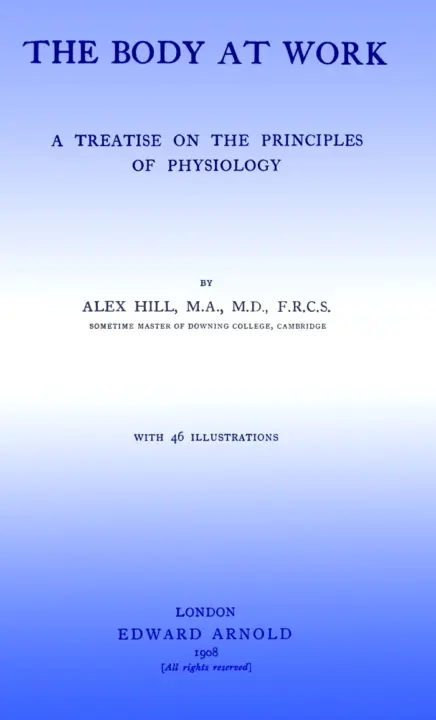
The Body at Work: A Treatise on the Principles of Physiology — digital edition cover

THE CLASSIC COLLECTION · 1908

The Body at Work: A Treatise on the Principles of Physiology

"The Body at Work: A Treatise on the Principles of Physiology" by Alex Hill is a scientific publication written in the early 20th century. The work discusses the various functions and interdependencies of physiological processes in living organisms, emphasizing the study of life and its manifestations rather than just anatomical structures. Hill aims to address the complexities of physiology in an accessible manner for readers unfamiliar with the foundational sciences. The opening of the treatise introduces the field of physiology, establishing it as the science concerned with the activities and functions of living beings. Hill contrasts physiology with anatomy, emphasizing that the former focuses on understanding how the body operates and responds to stimuli as opposed to merely detailing its structural components. He argues that the physiologist's role evolves through observational experimentation, leading to inferences about bodily functions, a process that historically highlights the interplay between living systems and their underlying structures. This section sets the stage for an exploration of life forms and their complex functionalities throughout the text.

Introduction adapted from the source catalogue; source summaries may be automatically generated.

Start reading ↓

Free to read · English · 172,268 words · No account needed

MAKE TIME FOR A GOOD BOOK

The Body at Work: A Treatise on the Principles of Physiology

On by default. Untick to stop anonymous reading totals. Each page counts after 10 seconds in view. How this works.

Anonymous counting is on unless you have switched it off.

The Body at Work: A Treatise on the Principles of Physiology

B
A
C

so placed as to divide B and C, the charge delivered by A between. This arrangement has, probably, an anatomical expression which accounts for the relative ease or difficulty of a path, even on the supposition that impulses do not open out as they advance—do not spread along all the branches into which an axon divides—but keep to a given line. The axon of neurone A divides, to branch about B, C, and D; but its representation in the several pericellular nets (the expression may pass for the sake of the simplicity which it introduces into the picture) is unequal. In the vinegar experiment the impulses delivered to the spinal cord by the root-ganglion neurone A pass to neurone B of the posterior horn. B’s axon arborizes more freely about the cell-body of neurone C in the anterior horn of the same side than it does about neurone D in the anterior horn of the opposite side. Hence the impulses generated by the vinegar stimulate C, sufficiently to discharge it, so long as that road is open, more quickly than they stimulate D. That C should be dischargeable only so long as the foot is free implies that the activity of the neurone is in some way conditioned by its relation with the muscles which it innervates. When the foot is held this relation is interfered with, giving to the impulses generated by the continued action of the vinegar time to overcome the resistance of D.

The simile of the opening up of paths is fairly applicable to the results which follow the use of artificial stimuli. Neurones seem to link up in series under the influence of the impulses which bombard them, popping like fireworks united by a common fuse.

Experimental evidence points to the following conclusions: (1) Resistance is offered at a synapse. This resistance must be overcome before an impulse can get through from neurone 1 to neurone 2. (2) The impulse does not, properly speaking, pass from 1, through 2. It infects 2, causing it to discharge a fresh impulse. (3) Time is of the essence of this process. Either the impulses head up at the synapse, or, passing through into the neurone, they produce a cumulative effect within it, which provokes it to discharge. (The latter hypothesis, which is the less likely of the two, transfers the resistance from the synapse to the neurone to be infected.) These conclusions are based upon experiments of the following kind: The minimal stimulus which will evoke a reflex action is determined. A stronger stimulus is then applied. The reflex occurs more promptly, and is more pronounced. But on further increasing the stimulus, it is found that the limit of effectiveness is soon reached. The proportional relation of response to stimulus is much less evident than it is when the experiment is tried with a nerve-muscle. Choosing a reflex action easily provoked, the afferent path is stimulated with an electric current interrupted fifty times a second. The impulses which flow down the efferent path to the muscle follow one another at the rate of about ten a second. A column of nerve-fibres within the spinal cord is stimulated fifty times a second. Again, the discharge into anterior roots has the natural rhythm of about ten. The cortex of the “motor area” of the great brain is stimulated with a rapidly interrupted current. The muscles which it governs contract with their natural rhythm. The cortex is sliced away, and the stimulus applied to the white matter beneath. A similar result is obtained. Evidence such as this points to an independence of action on the part of the neurones which one can express only in terms of resistance and explosion. But there is another line of thought which leads to the development of a picture of the working nervous system which seems at first sight incompatible with the one that we have sketched. The phenomenon of the knee-jerk (p. 274) reveals a nervous system so intimately linked together, so homogeneous, so mobile, that no event, however trivial, occurs in any part without sending a vibration throughout the rest. Instead of a multitude of batteries enveloped in a labyrinth of wires interrupted by myriads of switches which are crackling on and off, the image of a sheet of water better figures our conception—a material so frictionless that it is a-ripple from side to side and end to end, from the most distant rivulet which feeds it to the farthest trickle in which it drains away. It is a fluid in a state of infinite commotion, the movements of its particles varying in amplitude from tremulous quiverings which scarcely frost the silver of its surface to waves which, breaking on the muscular system, throw it up in heaps. The vinegar experiment seems to demand a scheme of batteries and wires. The knee-jerk points to a continuous conducting medium. Other phenomena suggest the superposition of the two pictures; the conception of a nervous system consisting of a uniform medium conducting, not indifferently in all directions, but with such freedom that from our point of view the paths are infinite in number; and within this conducting medium nerve-cell bodies and their processes which collect and distribute groups of vibrations sufficiently strong in combination to produce visible effects. In order that one of these neurones may be stimulated to discharging-point, the medium by which it is surrounded must be thrown into such a state of agitation as suffices to infect it. The considerations which point to the formulation of this double or superposed scheme are such as follow: The passage of tone-impulses does not appear compatible with the ideas we have formed on other evidence of synaptic resistance and neuronic discharge. They are too feeble for such a mechanism. The short “reflex time” of the knee-jerk points to the passage of the agitation up a sensory root to the spinal cord, and through a non-resistant medium to the environment of the motor cells which it discharges, missing the neurone or neurones which intervene in the case of ordinary reflex actions. This is an illustration of the way in which tone-impulses, which we imagine as conducted by the non-resistant medium, pass over into discharges which produce visible effects. Again, the phenomena of =inhibition= appear to require the supposition of extra-neuronic conduction. Whenever a reflex path is in use, all other paths in its neighbourhood are closed. The passage of impulses leading to a particular reflex action is favoured by the suppression of conduction in its vicinity. When A is talking to D through the nerve-telephone, B and C are compelled to hold their peace. Inhibition is a phenomenon of universal occurrence. In relation to various actions, it is sufficiently pronounced to be visible in the effects which it produces. A simple experiment will illustrate this. Holding water in the mouth has no effect upon respiration, but during the act of swallowing respiratory movements are suspended. Whilst the swallowing reflex is occurring the respiratory reflex is inhibited. This might be attributed to the volitional control of respiration, and certainly when attention is being directed to the process volition plays a large part. But if a finger is placed on the pulse, it is possible to detect that, during the act of swallowing, the pulse quickens, owing to the suppression of the slowing action of the vagus upon the heart. Here is a case in which inhibition is in no degree a voluntary action. Nor is it of any value as an adjunct to the particular reflex with which it is associated. It is an illustration of the universal rule that activity of any one spot in the nervous system is the cause of the quieting of the surrounding area. Impulses which reflexly check the heart cannot get through the medulla oblongata whilst the swallowing impulses are traversing it. Inhibition has been described as a drainage of nerve-force into the active area. On the structural side it seems to require the conception of an extra-neuronic substance which, agitated in the vicinity of the cells which are to be discharged, is brought to rest around neighbouring cells. The promulgation through the nervous system of the state which, when it reaches the centres of consciousness, produces pain also seems to call for an hypothesis of extra-neuronic conduction.

Your reading position is saved on this browser. Take it to another device with a library code. Reading pages adapt to text, rather than matching a printed edition.

BEHIND THE WORDS

About Alex Hill

Alex Hill (1856–1929). Explore The Body at Work: A Treatise on the Principles of Physiology in this collection. These books span science & nature.

Explore this author’s books →

THE READERS’ VERDICT

How did this story stay with you?

Not rated yet
Your rating for The Body at Work: A Treatise on the Principles of Physiology

Be the first to share your verdict.

One rating per browser, which you can change or remove. A necessary browser identifier remembers your vote. How ratings work

A GOOD STORY DESERVES COMPANY

Pass this book along.

A great read is even better when it’s shared.

SEND A LITTLE INSPIRATION

Share this book

BEHIND THE BOOK

Edition & source details.

Title
The Body at Work: A Treatise on the Principles of Physiology
Author
Alex Hill
First publication (Open Library catalogue match)
1908
Digital edition publisher
Project Gutenberg
Gutenberg release date
2020-08-31
Language
English
Source edition imprint
Not stated in source catalogue
Source identifier
Project Gutenberg #63089
Contributors
No additional named contributors in source metadata

Public-domain source & licence

This eBook is for the use of anyone anywhere in the United States and most other parts of the world at no cost and with almost no restrictions whatsoever. You may copy it, give it away or re-use it under the terms of the Project Gutenberg License included with this eBook or online at www.gutenberg.org. If you are not located in the United States, you will have to check the laws of the country where you are located before using this eBook. Read the source licence.

Full source licence and obtaining an original copy

The original source file, including credits and licence, is retained by this library. Request an original-format copy at no charge. Please include the book title and Project Gutenberg identifier #63089.

the full Project Gutenberg License must appear
prominently whenever any copy of a Project Gutenberg work (any work
on which the phrase “Project Gutenberg” appears, or with which the
phrase “Project Gutenberg” is associated) is accessed, displayed,
performed, viewed, copied or distributed:

This eBook is for the use of anyone anywhere in the United States and most
other parts of the world at no cost and with almost no restrictions
whatsoever. You may copy it, give it away or re-use it under the terms
of the Project Gutenberg™ License included with this eBook or online
at www.gutenberg.org. If you
are not located in the United States, you will have to check the laws
of the country where you are located before using this eBook.

1.E.2. If an individual Project Gutenberg electronic work is
derived from texts not protected by U.S. copyright law (does not
contain a notice indicating that it is posted with permission of the
copyright holder), the work can be copied and distributed to anyone in
the United States without paying any fees or charges. If you are
redistributing or providing access to a work with the phrase “Project
Gutenberg” associated with or appearing on the work, you must comply
either with the requirements of paragraphs 1.E.1 through 1.E.7 or
obtain permission for the use of the work and the Project Gutenberg
trademark as set forth in paragraphs 1.E.8 or 1.E.9.

1.E.3. If an individual Project Gutenberg electronic work is posted
with the permission of the copyright holder, your use and distribution
must comply with both paragraphs 1.E.1 through 1.E.7 and any
additional terms imposed by the copyright holder. Additional terms
will be linked to the Project Gutenberg License for all works
posted with the permission of the copyright holder found at the
beginning of this work.

1.E.4. Do not unlink or detach or remove the full Project Gutenberg
License terms from this work, or any files containing a part of this
work or any other work associated with Project Gutenberg.

1.E.5. Do not copy, display, perform, distribute or redistribute this
electronic work, or any part of this electronic work, without
prominently displaying the sentence set forth in paragraph 1.E.1 with
active links or immediate access to the full terms of the Project
Gutenberg License.

1.E.6. You may convert to and distribute this work in any binary,
compressed, marked up, nonproprietary or proprietary form, including
any word processing or hypertext form. However, if you provide access
to or distribute copies of a Project Gutenberg work in a format
other than “Plain Vanilla ASCII” or other format used in the official
version posted on the official Project Gutenberg website
(www.gutenberg.org), you must, at no additional cost, fee or expense
to the user, provide a copy, a means of exporting a copy, or a means
of obtaining a copy upon request, of the work in its original “Plain
Vanilla ASCII” or other form. Any alternate format must include the
full Project Gutenberg License as specified in paragraph 1.E.1.

1.E.7. Do not charge a fee for access to, viewing, displaying,
performing, copying or distributing any Project Gutenberg works
unless you comply with paragraph 1.E.8 or 1.E.9.

1.E.8. You may charge a reasonable fee for copies of or providing
access to or distributing Project Gutenberg electronic works
provided that:

• You pay a royalty fee of 20% of the gross profits you derive from
the use of Project Gutenberg works calculated using the method
you already use to calculate your applicable taxes. The fee is owed
to the owner of the Project Gutenberg trademark, but he has
agreed to donate royalties under this paragraph to the Project
Gutenberg Literary Archive Foundation. Royalty payments must be paid
within 60 days following each date on which you prepare (or are
legally required to prepare) your periodic tax returns. Royalty
payments should be clearly marked as such and sent to the Project
Gutenberg Literary Archive Foundation at the address specified in
Section 4, “Information about donations to the Project Gutenberg
Literary Archive Foundation.”

• You provide a full refund of any money paid by a user who notifies
you in writing (or by e-mail) within 30 days of receipt that s/he
does not agree to the terms of the full Project Gutenberg™
License. You must require such a user to return or destroy all
copies of the works possessed in a physical medium and discontinue
all use of and all access to other copies of Project Gutenberg™
works.

• You provide, in accordance with paragraph 1.F.3, a full refund of
any money paid for a work or a replacement copy, if a defect in the
electronic work is discovered and reported to you within 90 days of
receipt of the work.

• You comply with all other terms of this agreement for free
distribution of Project Gutenberg™ works.


1.E.9. If you wish to charge a fee or distribute a Project
Gutenberg™ electronic work or group of works on different terms than
are set forth in this agreement, you must obtain permission in writing
from the Project Gutenberg Literary Archive Foundation, the manager of
the Project Gutenberg™ trademark. Contact the Foundation as set
forth in Section 3 below.

1.F.

1.F.1. Project Gutenberg volunteers and employees expend considerable
effort to identify, do copyright research on, transcribe and proofread
works not protected by U.S. copyright law in creating the Project
Gutenberg™ collection. Despite these efforts, Project Gutenberg™
electronic works, and the medium on which they may be stored, may
contain “Defects,” such as, but not limited to, incomplete, inaccurate
or corrupt data, transcription errors, a copyright or other
intellectual property infringement, a defective or damaged disk or
other medium, a computer virus, or computer codes that damage or
cannot be read by your equipment.

1.F.2. LIMITED WARRANTY, DISCLAIMER OF DAMAGES - Except for the “Right
of Replacement or Refund” described in paragraph 1.F.3, the Project
Gutenberg Literary Archive Foundation, the owner of the Project
Gutenberg™ trademark, and any other party distributing a Project
Gutenberg™ electronic work under this agreement, disclaim all
liability to you for damages, costs and expenses, including legal
fees. YOU AGREE THAT YOU HAVE NO REMEDIES FOR NEGLIGENCE, STRICT
LIABILITY, BREACH OF WARRANTY OR BREACH OF CONTRACT EXCEPT THOSE
PROVIDED IN PARAGRAPH 1.F.3. YOU AGREE THAT THE FOUNDATION, THE
TRADEMARK OWNER, AND ANY DISTRIBUTOR UNDER THIS AGREEMENT WILL NOT BE
LIABLE TO YOU FOR ACTUAL, DIRECT, INDIRECT, CONSEQUENTIAL, PUNITIVE OR
INCIDENTAL DAMAGES EVEN IF YOU GIVE NOTICE OF THE POSSIBILITY OF SUCH
DAMAGE.

1.F.3. LIMITED RIGHT OF REPLACEMENT OR REFUND - If you discover a
defect in this electronic work within 90 days of receiving it, you can
receive a refund of the money (if any) you paid for it by sending a
written explanation to the person you received the work from. If you
received the work on a physical medium, you must return the medium
with your written explanation. The person or entity that provided you
with the defective work may elect to provide a replacement copy in
lieu of a refund. If you received the work electronically, the person
or entity providing it to you may choose to give you a second
opportunity to receive the work electronically in lieu of a refund. If
the second copy is also defective, you may demand a refund in writing
without further opportunities to fix the problem.

1.F.4. Except for the limited right of replacement or refund set forth
in paragraph 1.F.3, this work is provided to you ‘AS-IS’, WITH NO
OTHER WARRANTIES OF ANY KIND, EXPRESS OR IMPLIED, INCLUDING BUT NOT
LIMITED TO WARRANTIES OF MERCHANTABILITY OR FITNESS FOR ANY PURPOSE.

1.F.5. Some states do not allow disclaimers of certain implied
warranties or the exclusion or limitation of certain types of
damages. If any disclaimer or limitation set forth in this agreement
violates the law of the state applicable to this agreement, the
agreement shall be interpreted to make the maximum disclaimer or
limitation permitted by the applicable state law. The invalidity or
unenforceability of any provision of this agreement shall not void the
remaining provisions.

1.F.6. INDEMNITY - You agree to indemnify and hold the Foundation, the
trademark owner, any agent or employee of the Foundation, anyone
providing copies of Project Gutenberg™ electronic works in
accordance with this agreement, and any volunteers associated with the
production, promotion and distribution of Project Gutenberg™
electronic works, harmless from all liability, costs and expenses,
including legal fees, that arise directly or indirectly from any of
the following which you do or cause to occur: (a) distribution of this
or any Project Gutenberg work, (b) alteration, modification, or
additions or deletions to any Project Gutenberg work, and (c) any
Defect you cause.

Section 2. Information about the Mission of Project Gutenberg

Project Gutenberg is synonymous with the free distribution of
electronic works in formats readable by the widest variety of
computers including obsolete, old, middle-aged and new computers. It
exists because of the efforts of hundreds of volunteers and donations
from people in all walks of life.

Volunteers and financial support to provide volunteers with the
assistance they need are critical to reaching Project Gutenberg’s
goals and ensuring that the Project Gutenberg collection will
remain freely available for generations to come. In 2001, the Project
Gutenberg Literary Archive Foundation was created to provide a secure
and permanent future for Project Gutenberg and future
generations. To learn more about the Project Gutenberg Literary
Archive Foundation and how your efforts and donations can help, see
Sections 3 and 4 and the Foundation information page at www.gutenberg.org.

Section 3. Information about the Project Gutenberg Literary Archive Foundation

The Project Gutenberg Literary Archive Foundation is a non-profit
501(c)(3) educational corporation organized under the laws of the
state of Mississippi and granted tax exempt status by the Internal
Revenue Service. The Foundation’s EIN or federal tax identification
number is 64-6221541. Contributions to the Project Gutenberg Literary
Archive Foundation are tax deductible to the full extent permitted by
U.S. federal laws and your state’s laws.

The Foundation’s business office is located at 41 Watchung Plaza #516,
Montclair NJ 07042, USA, +1 (862) 621-9288. Email contact links and up
to date contact information can be found at the Foundation’s website
and official page at www.gutenberg.org/contact

Section 4. Information about Donations to the Project Gutenberg
Literary Archive Foundation

Project Gutenberg™ depends upon and cannot survive without widespread
public support and donations to carry out its mission of
increasing the number of public domain and licensed works that can be
freely distributed in machine-readable form accessible by the widest
array of equipment including outdated equipment. Many small donations
($1 to $5,000) are particularly important to maintaining tax exempt
status with the IRS.

The Foundation is committed to complying with the laws regulating
charities and charitable donations in all 50 states of the United
States. Compliance requirements are not uniform and it takes a
considerable effort, much paperwork and many fees to meet and keep up
with these requirements. We do not solicit donations in locations
where we have not received written confirmation of compliance. To SEND
DONATIONS or determine the status of compliance for any particular state
visit www.gutenberg.org/donate.

While we cannot and do not solicit contributions from states where we
have not met the solicitation requirements, we know of no prohibition
against accepting unsolicited donations from donors in such states who
approach us with offers to donate.

International donations are gratefully accepted, but we cannot make
any statements concerning tax treatment of donations received from
outside the United States. U.S. laws alone swamp our small staff.

Please check the Project Gutenberg web pages for current donation
methods and addresses. Donations are accepted in a number of other
ways including checks, online payments and credit card donations. To
donate, please visit: www.gutenberg.org/donate.

Section 5. General Information About Project Gutenberg electronic works

Professor Michael S. Hart was the originator of the Project
Gutenberg concept of a library of electronic works that could be
freely shared with anyone. For forty years, he produced and
distributed Project Gutenberg eBooks with only a loose network of
volunteer support.

Project Gutenberg eBooks are often created from several printed
editions, all of which are confirmed as not protected by copyright in
the U.S. unless a copyright notice is included. Thus, we do not
necessarily keep eBooks in compliance with any particular paper
edition.

Most people start at our website which has the main PG search
facility: www.gutenberg.org.

This website includes information about Project Gutenberg,
including how to make donations to the Project Gutenberg Literary
Archive Foundation, how to help produce our new eBooks, and how to
subscribe to our email newsletter to hear about new eBooks.


KEEP YOUR CURIOSITY GOING

Your next chapter awaits.

Your privacy choices

Reading is always free. You can change these settings at any time.

Book banners link to our books on simonward.net. They do not use advertising cookies or tracking.

Privacy & cookie policy · Reading data and privacy controls