
Letters to a Friend, Written to Mrs. Ezra S. Carr, 1866-1879
John Muir
THE CLASSIC COLLECTION · 1908
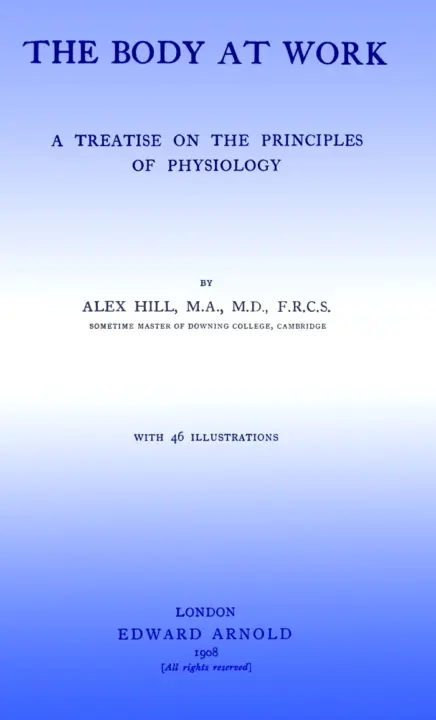
"The Body at Work: A Treatise on the Principles of Physiology" by Alex Hill is a scientific publication written in the early 20th century. The work discusses the various functions and interdependencies of physiological processes in living organisms, emphasizing the study of life and its manifestations rather than just anatomical structures. Hill aims to address the complexities of physiology in an accessible manner for readers unfamiliar with the foundational sciences. The opening of the treatise introduces the field of physiology, establishing it as the science concerned with the activities and functions of living beings. Hill contrasts physiology with anatomy, emphasizing that the former focuses on understanding how the body operates and responds to stimuli as opposed to merely detailing its structural components. He argues that the physiologist's role evolves through observational experimentation, leading to inferences about bodily functions, a process that historically highlights the interplay between living systems and their underlying structures. This section sets the stage for an exploration of life forms and their complex functionalities throughout the text.
Introduction adapted from the source catalogue; source summaries may be automatically generated.
Free to read · English · 172,268 words · No account needed
MAKE TIME FOR A GOOD BOOK
On by default. Untick to stop anonymous reading totals. Each page counts after 10 seconds in view. How this works.
Anonymous counting is on unless you have switched it off.
Neither proteins nor sugar reach the lacteal radicle. Both these substance are absorbed from the lymph in the tissue-spaces of the villus by the blood-capillaries and venules which traverse them. The veins of the intestine unite to form the portal vein, up which proteins and sugar are carried to the liver, where they are stored, to be doled out into the blood-stream as the tissues need them.
=Bacteria of the Alimentary Canal.=—The enzymes (ferments) of the several digestive juices are not the only agents which modify the constitution of the foods within the alimentary canal. Throughout the whole of the tract conditions are in many respects favourable for the growth of putrefactive organisms. Mouth, stomach, small and large intestine, has each its special bacterial flora. It is doubtful whether any of these organisms, with the single exception of the bacteria which in herbivorous animals break up cellulose, are favourable to digestion. That they are not necessary has been shown by an ingenious experiment on new-born animals. Guinea-pigs born in an aseptic chamber, through which filtered air was drawn, and fed every hour on sterilized milk, throve and put on weight. When killed at the end of eight days, no germs were present in their alimentary tracts. Yet in all animals under ordinary conditions bacteria are present in great numbers, at any rate, after the nursing period, and, for good or ill, produce important fermentations. Only a single bacillus (B. bifidus), and that a friendly germ, is, it is asserted, present in the intestines of an infant at the breast; whereas a bottle-fed baby houses a variety of parasites.
In the stomach, sugars are changed by the Bacterium acidi lactici into lactic acid, which is further split into butyric acid, carbonic acid gas, and hydrogen. Succinic acid and other substances are also formed. This occurs in the first stage of gastric digestion. When a considerable quantity of hydrochloric acid has been poured out, lactic fermentation is stopped. The small amount of gaseous products formed normally is of little consequence; but flatulence is a most annoying symptom of indigestion. “Put your trust in Providence, and you will feel more cheerful after luncheon,” Dr. Jowett is alleged to have remarked to a despondent friend. The presence of food stimulates the stomach to contraction. Accumulated gases are expelled. Hydrochloric acid is secreted, and puts a stop to fermentation for a time. But if the meal be too heavy or the mucous membrane in an irritable condition, the contents of the stomach become unduly acid in the later stages of digestion. Other bacteria then develop, leading to fresh trouble; more gases accumulate, and the dyspeptic’s distress is greater than it was before. Unfortunately, antiseptics, such as creosote, and carminatives, such as oil of lavender, oil of peppermint, or alcohol, which for the moment give relief, increase irritability, and consequently in the long-run make matters worse. It is the fermentation of the later stages of digestion which causes most annoyance. Admirable as was the Master of Balliol’s advice, it hardly took account of the fact that bacteria which cause flatulence, with its resultant feeling of oppression, are derived for the most part from the imperfectly digested, and therefore actively fermenting, remnants of food which were present in the stomach when the meal was taken. It would be far beyond the scope of this book to consider the pathology of dyspepsia; but the study of normal conditions reveals the fact that some amount of fermentation invariably occurs. The Bacterium acidi lactici is always present in the stomach. Normally its activity is arrested by the hydrochloric acid of the gastric juice about twenty minutes after a meal. After this no further multiplication of bacteria should occur. The presence of bacteria which grow in a strongly acid medium usually indicates that the stomach was not completely emptied before fresh food reached it. It may be that the last meal was too large or the interval too short. If the mucous membrane is in an unhealthy condition, its own secretions afford material on which bacteria thrive. Nothing short of washing it out with a stomach-pump will clean it up. The presence, at the time of feeding, of food left over from the previous meal is likely to perpetuate the unsatisfactory state of affairs. All the glands of the alimentary tract exhibit a tendency to periodicity. Their efficiency is greatest when activity follows a period of rest. If the stomach is not able to expel its contents, it has not the opportunity of preparing for fresh duties. Fat undergoes a certain amount of rancid fermentation in the stomach. Proteins are not attacked by bacteria in the stomach unless the condition of the organ is very unsatisfactory. The odour of the products of their decomposition is then recognizable in the breath.
Your reading position is saved on this browser. Take it to another device with a library code. Reading pages adapt to text, rather than matching a printed edition.
BEHIND THE BOOK
This eBook is for the use of anyone anywhere in the United States and most other parts of the world at no cost and with almost no restrictions whatsoever. You may copy it, give it away or re-use it under the terms of the Project Gutenberg License included with this eBook or online at www.gutenberg.org. If you are not located in the United States, you will have to check the laws of the country where you are located before using this eBook. Read the source licence.
The original source file, including credits and licence, is retained by this library. Request an original-format copy at no charge. Please include the book title and Project Gutenberg identifier #63089.
KEEP YOUR CURIOSITY GOING
John Muir

Asa Gray
Asa Gray

Florence Nightingale
Elizabeth Robins Pennell
Denison Olmsted