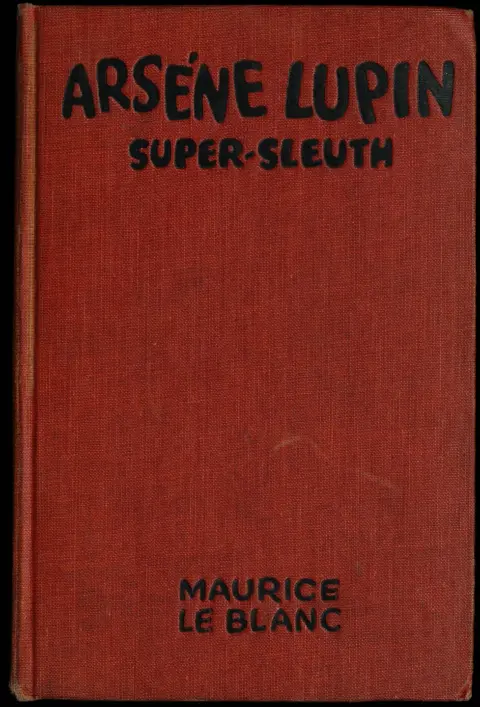
Arsène Lupin, super-sleuth
Maurice Leblanc
THE CLASSIC COLLECTION · 1907
"The Blonde Lady" by Maurice Leblanc is a detective novel written in the early 20th century. The story follows the cunning thief Arsène Lupin as he battles against English detective Holmlock Shears, weaving a tale filled with mystery, stolen treasures, and the pursuit of a valuable lottery ticket. The main plot begins with the theft of M. Gerbois' writing desk, which contains a winning lottery ticket worth a million francs, leading to a duel of wits between Lupin and Shears. The opening of this engaging narrative introduces M. Gerbois, a professor who purchases a writing desk for his daughter's birthday only to have it stolen shortly afterward. As he discovers that the desk contained the ticket for a million francs, he resolves to reclaim his fortune, while Lupin, the thief, openly declares his claim to the winning ticket. This sets off a series of events including Gerbois’ frantic attempts to prove his ownership and the kidnapping of his daughter, Suzanne. The opening establishes a thrilling tension between the characters and hints at a gripping contest of intelligence and morality as both men seek to outmaneuver each other in a high-stakes game.
Introduction adapted from the source catalogue; source summaries may be automatically generated.
Free to read · English · 62,476 words · No account needed
MAKE TIME FOR A GOOD BOOK
On by default. Untick to stop anonymous reading totals. Each page counts after 10 seconds in view. How this works.
Anonymous counting is on unless you have switched it off.
A faint whistle sounded in reply. Putting the pipe to his mouth, he
whispered:
"Any one there, Dubreuil?"
"No."
"Can I come up?"
"Yes."
He replaced the bracket, saying, as he did so:
"Where will progress stop? Our age teems with little inventions that make life really charming and picturesque. And so amusing too ... especially when a man knows the game of life as I know it!"
He touched one of the marble mouldings of the mantel-piece and made it swing round on a pivot. The marble slab itself moved and the mirror above it slid between invisible grooves, revealing a yawning gap which contained the lower steps of a staircase built in the body of the chimney itself. It was all very clean, in carefully-polished iron and white porcelain tiles.
He climbed up to the fifth floor, which had a similar opening over the mantel-piece, and found M. Dubreuil awaiting him:
"Is everything finished here?"
"Everything."
"All cleared up?"
"Quite."
"The staff?"
"All gone, except the three men keeping watch."
"Let's go up."
They climbed by the same way to the servants' floor and emerged in a garret where they found three men, one of whom was looking out of the window.
"Any news?"
"No, governor."
"Is the street quiet?"
"Absolutely."
"I shall leave for good in ten minutes.... You will go too. In the meantime, if you notice the least suspicious movement in the street, let me know."
"I've got my finger on the alarm-bell governor."
"Dubreuil, did you remember to tell the removers not to touch the
bell-wires?"
"Yes. They work perfectly."
"That's all right, then."
The two gentlemen returned to Felix Davey's flat. And Davey, after readjusting the marble moulding, exclaimed, gaily:
"Dubreuil, I should love to see the faces of those who discover all these wonderful contrivances: alarm-bells, a network of electric wires and speaking-tubes, invisible passages, sliding floor-boards, secret staircases!... regular pantomime machinery!"
"What an advertisement for Arsene Lupin!"
"We could very well have done without the advertisement. It seems a pity to leave so fine an installation. We shall have to begin all over again, Dubreuil ... and upon a new plan, of course, for it never does to repeat one's self. Confound that Shears!"
"He's not come back, I suppose?"
"How could he? There's only one boat from Southampton, which leaves at midnight. From the Havre, there's only one train, which leaves at eight in the morning and arrives at eleven three. Once he has not taken the midnight steamer--and he has not, for my orders to the captain were formal--he can't reach France till this evening, via Newhaven and Dieppe."
"If he comes back!"
Your reading position is saved on this browser. Take it to another device with a library code. Reading pages adapt to text, rather than matching a printed edition.
Maurice Leblanc
Maurice Leblanc

Maurice Leblanc
Maurice Leblanc
BEHIND THE BOOK
This eBook is for the use of anyone anywhere in the United States and most other parts of the world at no cost and with almost no restrictions whatsoever. You may copy it, give it away or re-use it under the terms of the Project Gutenberg License included with this eBook or online at www.gutenberg.org. If you are not located in the United States, you will have to check the laws of the country where you are located before using this eBook. Read the source licence.
The original source file, including credits and licence, is retained by this library. Request an original-format copy at no charge. Please include the book title and Project Gutenberg identifier #24839.
KEEP YOUR CURIOSITY GOING
Coulson Kernahan

Maurice Baring
Frances Wright
Cécile Tormay

Frederic Jesup Stimson

W. H. P. (William Henry Pope) Jarvis