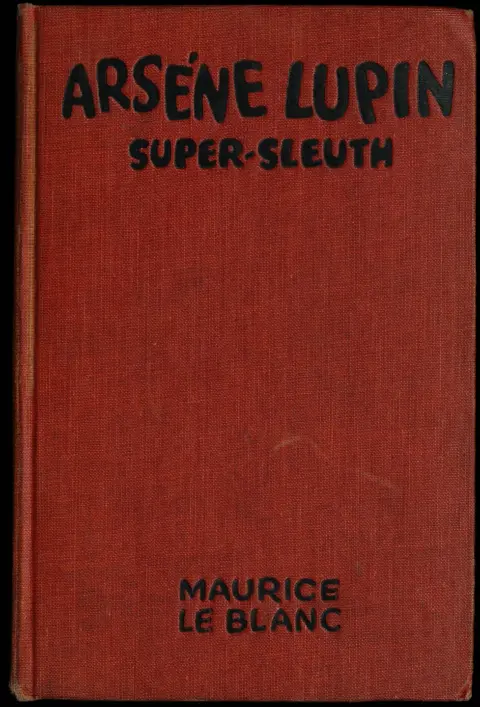
Arsène Lupin, super-sleuth
Maurice Leblanc
THE CLASSIC COLLECTION · 1907
"The Blonde Lady" by Maurice Leblanc is a detective novel written in the early 20th century. The story follows the cunning thief Arsène Lupin as he battles against English detective Holmlock Shears, weaving a tale filled with mystery, stolen treasures, and the pursuit of a valuable lottery ticket. The main plot begins with the theft of M. Gerbois' writing desk, which contains a winning lottery ticket worth a million francs, leading to a duel of wits between Lupin and Shears. The opening of this engaging narrative introduces M. Gerbois, a professor who purchases a writing desk for his daughter's birthday only to have it stolen shortly afterward. As he discovers that the desk contained the ticket for a million francs, he resolves to reclaim his fortune, while Lupin, the thief, openly declares his claim to the winning ticket. This sets off a series of events including Gerbois’ frantic attempts to prove his ownership and the kidnapping of his daughter, Suzanne. The opening establishes a thrilling tension between the characters and hints at a gripping contest of intelligence and morality as both men seek to outmaneuver each other in a high-stakes game.
Introduction adapted from the source catalogue; source summaries may be automatically generated.
Free to read · English · 62,476 words · No account needed
MAKE TIME FOR A GOOD BOOK
On by default. Untick to stop anonymous reading totals. Each page counts after 10 seconds in view. How this works.
Anonymous counting is on unless you have switched it off.
In the evening of the twenty-seventh of March, old General Baron d'Hautrec, who had been French Ambassador in Berlin under the Second Empire, was sleeping comfortably in an easy-chair in the house which his brother had left him six months before, at 134, Avenue Henri-Martin. His lady companion continued to read aloud to him, while Soeur Auguste warmed the bed and prepared the night-light.
As an exceptional case, the sister was returning to her convent that evening, to spend the night with the Mother Superior, and, at eleven o'clock, she said:
"I'm finished now, Mlle. Antoinette, and I'm going."
"Very well, sister."
"And don't forget that the cook is sleeping out to-night and that you are alone in the house with the man-servant."
"You need have no fear for monsieur le baron: I shall sleep in the next room, as arranged, and leave the door open."
The nun went away. A minute later, Charles, the man-servant, came in for his orders. The baron had woke up. He replied himself:
"Just the same as usual, Charles. Try the electric bell, to see if it rings in your bedroom properly, and, if you hear it during the night, run down at once and go straight to the doctor."
"Are you still anxious, general?"
"I don't feel well.... I don't feel at all well. Come, Mlle. Antoinette, where were we in your book?"
"Aren't you going to bed, monsieur le baron?"
"No, no, I don't care to go to bed till very late; besides, I can do
without help."
Twenty minutes later, the old man dozed off again and Antoinette moved
away on tip-toe.
At that moment, Charles was carefully closing the shutters on the ground floor, as usual. In the kitchen, he pushed the bolt of the door that led to the garden and, in the front hall, he not only locked the double door, but put up the chain fastening the two leaves. Then he went up to his attic on the third floor, got into bed and fell asleep.
Perhaps an hour had elapsed when, suddenly, he jumped out of bed: the bell was ringing. It went on for quite a long time, seven or eight seconds, perhaps, and in a steady, uninterrupted way.
"That's all right," said Charles, recovering his wits. "Some fresh whim of the baron's, I suppose."
He huddled on his clothes, ran down the stairs, stopped before the door and, from habit, knocked. No answer. He entered the room:
"Hullo!" he muttered. "No light.... What on earth have they put the light out for?" And he called, in a whisper, "Mademoiselle!..."
No reply.
"Are you there, mademoiselle?... What's the matter? Is monsieur le baron
ill?"
Your reading position is saved on this browser. Take it to another device with a library code. Reading pages adapt to text, rather than matching a printed edition.
Maurice Leblanc
Maurice Leblanc
Maurice Leblanc
Maurice Leblanc
BEHIND THE BOOK
This eBook is for the use of anyone anywhere in the United States and most other parts of the world at no cost and with almost no restrictions whatsoever. You may copy it, give it away or re-use it under the terms of the Project Gutenberg License included with this eBook or online at www.gutenberg.org. If you are not located in the United States, you will have to check the laws of the country where you are located before using this eBook. Read the source licence.
The original source file, including credits and licence, is retained by this library. Request an original-format copy at no charge. Please include the book title and Project Gutenberg identifier #24839.
KEEP YOUR CURIOSITY GOING
Coulson Kernahan

Maurice Baring
Frances Wright
Cécile Tormay

Frederic Jesup Stimson

W. H. P. (William Henry Pope) Jarvis