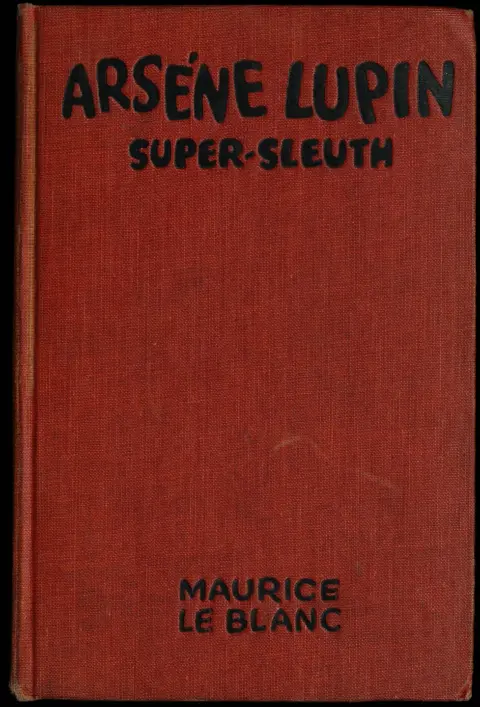
Arsène Lupin, super-sleuth
Maurice Leblanc
THE CLASSIC COLLECTION · 1907
"The Blonde Lady" by Maurice Leblanc is a detective novel written in the early 20th century. The story follows the cunning thief Arsène Lupin as he battles against English detective Holmlock Shears, weaving a tale filled with mystery, stolen treasures, and the pursuit of a valuable lottery ticket. The main plot begins with the theft of M. Gerbois' writing desk, which contains a winning lottery ticket worth a million francs, leading to a duel of wits between Lupin and Shears. The opening of this engaging narrative introduces M. Gerbois, a professor who purchases a writing desk for his daughter's birthday only to have it stolen shortly afterward. As he discovers that the desk contained the ticket for a million francs, he resolves to reclaim his fortune, while Lupin, the thief, openly declares his claim to the winning ticket. This sets off a series of events including Gerbois’ frantic attempts to prove his ownership and the kidnapping of his daughter, Suzanne. The opening establishes a thrilling tension between the characters and hints at a gripping contest of intelligence and morality as both men seek to outmaneuver each other in a high-stakes game.
Introduction adapted from the source catalogue; source summaries may be automatically generated.
Free to read · English · 62,476 words · No account needed
MAKE TIME FOR A GOOD BOOK
On by default. Untick to stop anonymous reading totals. Each page counts after 10 seconds in view. How this works.
Anonymous counting is on unless you have switched it off.
"Gentlemen, I am grieved beyond measure at your mishap. You will have a poor opinion of our French hospitality. Lord, what a night you must have spent! Upon my word, Lupin might have shown you more consideration!"
They took a cab to the Elysee-Palace. Wilson went to the office and asked for the key of his room.
The clerk looked through the visitors' book and replied, in great
surprise:
"But you gave up your room this morning, sir!"
"What do you mean? How did I give up my room?"
"You sent us a letter by your friend."
"What friend?"
"Why, the gentleman who brought us your letter.... Here it is, with your
card enclosed."
Wilson took the letter and the enclosure. It was certainly one of his visiting-cards and the letter was in his writing:
"Good Lord!" he muttered. "Here's another nasty trick." And he added, anxiously, "What about the luggage?"
"Why, your friend took it with him."
"Oh!.... So you gave it to him?"
"Certainly, on the authority of your card."
"Just so ... just so...."
They both went out and wandered down the Champs-Elysees, slowly and
silently. A fine autumn sun filled the avenue. The air was mild and
light.
At the Rond-Point, Shears lit his pipe and resumed his walk. Wilson
cried:
"I can't understand you, Shears; you take it so calmly! The man laughs at you, plays with you as a cat plays with a mouse ... and you don't utter a word!"
Shears stopped and said:
"I'm thinking of your visiting-card, Wilson."
"Well?"
"Well, here is a man, who, by way of preparing for a possible struggle with us, obtains specimens of your handwriting and mine and has one of your cards ready in his pocketbook. Have you thought of the amount of precaution, of perspicacity, of determination, of method, of organization that all this represents?"
"You mean to say ..."
"I mean to say, Wilson, that, to fight an enemy so formidably armed, so wonderfully equipped--and to beat him--takes ... a man like myself. And, even then, Wilson," he added, laughing, "one does not succeed at the first attempt, as you see!"
At six o'clock, the Echo de France published the following paragraph
in its special edition:
"This morning, M. Thenard, the commissary of police of the 16th division, released Messrs. Holmlock Shears and Wilson, who had been confined, by order of Arsene Lupin, in the late Baron d'Hautrec's house, where they spent an excellent night.
"They were also relieved of their luggage and have laid an
information against Arsene Lupin.
"Arsene Lupin has been satisfied with giving them a little lesson this time; but he earnestly begs them not to compel him to adopt more serious measures."
Your reading position is saved on this browser. Take it to another device with a library code. Reading pages adapt to text, rather than matching a printed edition.
Maurice Leblanc
Maurice Leblanc
Maurice Leblanc
Maurice Leblanc
BEHIND THE BOOK
This eBook is for the use of anyone anywhere in the United States and most other parts of the world at no cost and with almost no restrictions whatsoever. You may copy it, give it away or re-use it under the terms of the Project Gutenberg License included with this eBook or online at www.gutenberg.org. If you are not located in the United States, you will have to check the laws of the country where you are located before using this eBook. Read the source licence.
The original source file, including credits and licence, is retained by this library. Request an original-format copy at no charge. Please include the book title and Project Gutenberg identifier #24839.
KEEP YOUR CURIOSITY GOING
Coulson Kernahan

Maurice Baring
Frances Wright
Cécile Tormay

Frederic Jesup Stimson

W. H. P. (William Henry Pope) Jarvis