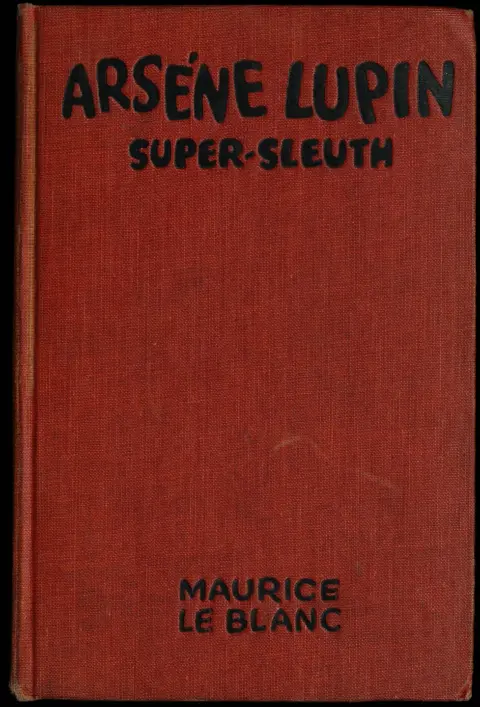
Arsène Lupin, super-sleuth
Maurice Leblanc
THE CLASSIC COLLECTION · 1907
"The Blonde Lady" by Maurice Leblanc is a detective novel written in the early 20th century. The story follows the cunning thief Arsène Lupin as he battles against English detective Holmlock Shears, weaving a tale filled with mystery, stolen treasures, and the pursuit of a valuable lottery ticket. The main plot begins with the theft of M. Gerbois' writing desk, which contains a winning lottery ticket worth a million francs, leading to a duel of wits between Lupin and Shears. The opening of this engaging narrative introduces M. Gerbois, a professor who purchases a writing desk for his daughter's birthday only to have it stolen shortly afterward. As he discovers that the desk contained the ticket for a million francs, he resolves to reclaim his fortune, while Lupin, the thief, openly declares his claim to the winning ticket. This sets off a series of events including Gerbois’ frantic attempts to prove his ownership and the kidnapping of his daughter, Suzanne. The opening establishes a thrilling tension between the characters and hints at a gripping contest of intelligence and morality as both men seek to outmaneuver each other in a high-stakes game.
Introduction adapted from the source catalogue; source summaries may be automatically generated.
Free to read · English · 62,476 words · No account needed
MAKE TIME FOR A GOOD BOOK
On by default. Untick to stop anonymous reading totals. Each page counts after 10 seconds in view. How this works.
Anonymous counting is on unless you have switched it off.
"So you do take an interest in something besides number 514, series 23, the Rue Clapeyron mystery, the blonde lady and Arsene Lupin?"
"Hee, hee!" grinned the old inspector. "I won't go so far as to declare that Lupin has nothing to do with the case we're engaged on.... But let us dismiss the story of the lottery-ticket from our minds, until further orders, and look into this matter."
Ganimard is not one of those mighty detectives whose proceedings form a school, as it were, and whose names will always remain inscribed on the judicial annals of Europe. He lacks the flashes of genius that illumine a Dupin, a Lecoq or a Holmlock Shears. But he possesses first-rate average qualities: perspicacity, sagacity, perseverance and even a certain amount of intuition. His greatest merit lies in the fact that he is absolutely independent of outside influences. Short of a kind of fascination which Arsene Lupin wields over him, he works without allowing himself to be biased or disturbed.
At any rate, the part which he played that morning did not lack brilliancy and his assistance was of the sort which a magistrate is able to appreciate.
"To start with," he began, "I will ask Charles here to be very definite on one point: were all the objects which, on the first occasion, he saw upset or disturbed put back, on the second, exactly in their usual places?"
"Exactly."
"It is obvious, therefore, that they can only have been put back by a person to whom the place of each of those objects was familiar."
The remark impressed the bystanders. Ganimard resumed:
"Another question, Mr. Charles.... You were woke by a ring.... Who was it, according to you, that called you?"
"Monsieur le baron, of course."
"Very well. But at what moment do you take it that he rang?"
"After the struggle ... at the moment of dying."
"Impossible, because you found him lying, lifeless, at a spot more than four yards removed from the bell-push."
"Then he rang during the struggle."
"Impossible, because the bell, you told us, rang steadily, without interruption, and went on for seven or eight seconds. Do you think that his assailant would have given him time to ring like that?"
"Then it was before, at the moment when he was attacked."
"Impossible. You told us that, between the ring of the bell and the instant when you entered the room, three minutes elapsed, at most. If, therefore, the baron had rung before, it would be necessary for the struggle, the murder, the dying agony and the flight to have taken place within that short space of three minutes. I repeat, it is impossible."
Your reading position is saved on this browser. Take it to another device with a library code. Reading pages adapt to text, rather than matching a printed edition.
Maurice Leblanc
Maurice Leblanc
Maurice Leblanc
Maurice Leblanc
BEHIND THE BOOK
This eBook is for the use of anyone anywhere in the United States and most other parts of the world at no cost and with almost no restrictions whatsoever. You may copy it, give it away or re-use it under the terms of the Project Gutenberg License included with this eBook or online at www.gutenberg.org. If you are not located in the United States, you will have to check the laws of the country where you are located before using this eBook. Read the source licence.
The original source file, including credits and licence, is retained by this library. Request an original-format copy at no charge. Please include the book title and Project Gutenberg identifier #24839.
KEEP YOUR CURIOSITY GOING
Coulson Kernahan

Maurice Baring
Frances Wright
Cécile Tormay

Frederic Jesup Stimson

W. H. P. (William Henry Pope) Jarvis