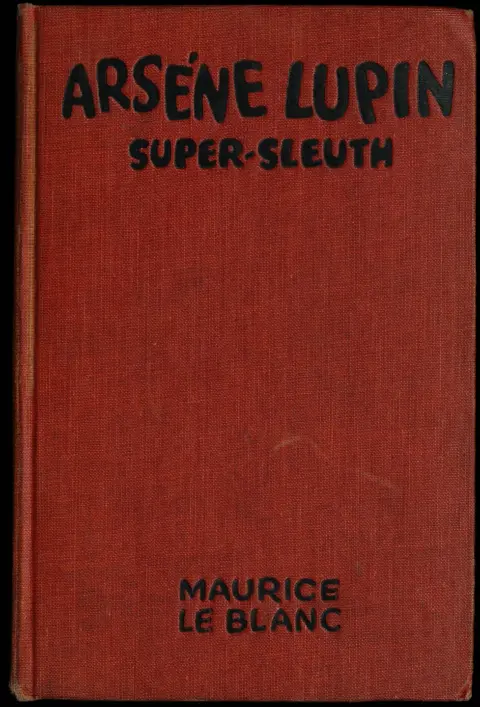
Arsène Lupin, super-sleuth
Maurice Leblanc
THE CLASSIC COLLECTION · 1907
"The Blonde Lady" by Maurice Leblanc is a detective novel written in the early 20th century. The story follows the cunning thief Arsène Lupin as he battles against English detective Holmlock Shears, weaving a tale filled with mystery, stolen treasures, and the pursuit of a valuable lottery ticket. The main plot begins with the theft of M. Gerbois' writing desk, which contains a winning lottery ticket worth a million francs, leading to a duel of wits between Lupin and Shears. The opening of this engaging narrative introduces M. Gerbois, a professor who purchases a writing desk for his daughter's birthday only to have it stolen shortly afterward. As he discovers that the desk contained the ticket for a million francs, he resolves to reclaim his fortune, while Lupin, the thief, openly declares his claim to the winning ticket. This sets off a series of events including Gerbois’ frantic attempts to prove his ownership and the kidnapping of his daughter, Suzanne. The opening establishes a thrilling tension between the characters and hints at a gripping contest of intelligence and morality as both men seek to outmaneuver each other in a high-stakes game.
Introduction adapted from the source catalogue; source summaries may be automatically generated.
Free to read · English · 62,476 words · No account needed
MAKE TIME FOR A GOOD BOOK
On by default. Untick to stop anonymous reading totals. Each page counts after 10 seconds in view. How this works.
Anonymous counting is on unless you have switched it off.
During that long, that cruel accumulation of small super-added proofs, not a muscle of her face had moved, not a gleam of rebellion or fear had disturbed the serenity of her limpid glance. What was she thinking? And, still more, what would she say at the solemn moment when she must reply, when she must defend herself and break the iron circle in which the Englishman had so cleverly imprisoned her?
The moment had struck, and the girl was silent.
"Speak! speak!" cried M. d'Imblevalle.
She did not speak.
He insisted:
"One word will clear you.... One word of protest and I will believe
you."
That word she did not utter.
The baron stepped briskly across the room, returned, went back again and then, addressing Shears:
"Well, no, sir! I refuse to believe it true! There are some crimes which are impossible! And this is opposed to all that I know, all that I have seen for a year." He put his hand on the Englishman's shoulder. "But are you yourself, sir, absolutely and definitely sure that you are not mistaken?"
Shears hesitated, like a man attacked unawares, who does not defend himself at once. However, he smiled and said:
"No one but the person whom I accuse could, thanks to the position which she fills in your house, know that the Jewish lamp contained that magnificent jewel."
"I refuse to believe it," muttered the baron.
"Ask her."
It was, in fact, the one thing which he had not tried, in the blind confidence which he felt in the girl. But it was no longer permissible to deny the evidence.
He went up to her and, looking her straight in the eyes:
"Was it you, mademoiselle? Did you take the jewel? Did you correspond with Arsene Lupin and sham the burglary?"
She replied:
"Yes, monsieur."
She did not lower her head. Her face expressed neither shame nor
embarrassment.
"Is it possible?" stammered M. d'Imblevalle. "I would never have believed ... you are the last person I should have suspected.... How did you do it, unhappy girl?"
She said:
"I did as Mr. Shears has said. On Saturday night, I came down here to the boudoir, took the lamp and, in the morning, carried it ... to that man."
"But no," objected the baron; "what you say is impossible."
"Impossible! Why?"
"Because I found the door of the boudoir locked in the morning."
She coloured, lost countenance and looked at Shears as though to ask his
advice.
Your reading position is saved on this browser. Take it to another device with a library code. Reading pages adapt to text, rather than matching a printed edition.
Maurice Leblanc
Maurice Leblanc
Maurice Leblanc
Maurice Leblanc
BEHIND THE BOOK
This eBook is for the use of anyone anywhere in the United States and most other parts of the world at no cost and with almost no restrictions whatsoever. You may copy it, give it away or re-use it under the terms of the Project Gutenberg License included with this eBook or online at www.gutenberg.org. If you are not located in the United States, you will have to check the laws of the country where you are located before using this eBook. Read the source licence.
The original source file, including credits and licence, is retained by this library. Request an original-format copy at no charge. Please include the book title and Project Gutenberg identifier #24839.
KEEP YOUR CURIOSITY GOING
Coulson Kernahan

Maurice Baring
Frances Wright
Cécile Tormay

Frederic Jesup Stimson

W. H. P. (William Henry Pope) Jarvis