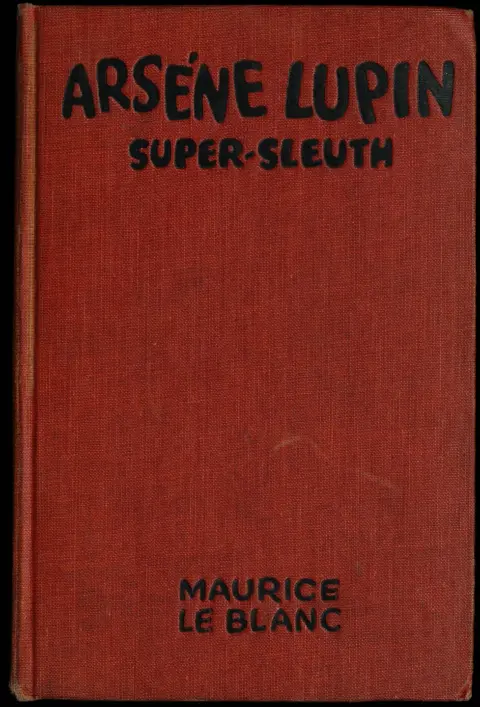
Arsène Lupin, super-sleuth
Maurice Leblanc
THE CLASSIC COLLECTION · 1907
"The Blonde Lady" by Maurice Leblanc is a detective novel written in the early 20th century. The story follows the cunning thief Arsène Lupin as he battles against English detective Holmlock Shears, weaving a tale filled with mystery, stolen treasures, and the pursuit of a valuable lottery ticket. The main plot begins with the theft of M. Gerbois' writing desk, which contains a winning lottery ticket worth a million francs, leading to a duel of wits between Lupin and Shears. The opening of this engaging narrative introduces M. Gerbois, a professor who purchases a writing desk for his daughter's birthday only to have it stolen shortly afterward. As he discovers that the desk contained the ticket for a million francs, he resolves to reclaim his fortune, while Lupin, the thief, openly declares his claim to the winning ticket. This sets off a series of events including Gerbois’ frantic attempts to prove his ownership and the kidnapping of his daughter, Suzanne. The opening establishes a thrilling tension between the characters and hints at a gripping contest of intelligence and morality as both men seek to outmaneuver each other in a high-stakes game.
Introduction adapted from the source catalogue; source summaries may be automatically generated.
Free to read · English · 62,476 words · No account needed
MAKE TIME FOR A GOOD BOOK
On by default. Untick to stop anonymous reading totals. Each page counts after 10 seconds in view. How this works.
Anonymous counting is on unless you have switched it off.
It was just three o'clock when these events happened. At six o'clock precisely, as he had declared, Holmlock Shears, clad in a pair of trousers too short and a jacket too tight for him, which he had borrowed from an inn-keeper at Neuilly, and wearing a cap and a flannel shirt with a silk cord and tassels, entered the boudoir in the Rue Murillo, after sending word to M. and Mme. d'Imblevalle to ask for an interview.
They found him walking up and down. And he looked to them so comical in his queer costume that they had a difficulty in suppressing their inclination to laugh. With a pensive air and a bent back, he walked, like an automaton, from the window to the door and the door to the window, taking each time the same number of steps and turning each time in the same direction.
He stopped, took up a knick-knack, examined it mechanically and then
resumed his walk.
At last, planting himself in front of them, he asked:
"Is mademoiselle here?"
"Yes, in the garden, with the children."
"Monsieur le baron, as this will be our final conversation, I should like Mlle. Demun to be present at it."
"So you decidedly...?"
"Have a little patience, monsieur. The truth will emerge plainly from the facts which I propose to lay before you with the greatest possible precision."
"Very well. Suzanne, do you mind...?"
Mme. d'Imblevalle rose and returned almost at once, accompanied by Alice Demun. Mademoiselle, looking a little paler than usual, remained standing, leaning against a table and without even asking to know why she had been sent for.
Shears appeared not to see her and, turning abruptly toward
M. d'Imblevalle, made his statement in a tone that admitted
of no reply:
"After an inquiry extending over several days, and although certain events for a moment altered my view, I will repeat what I said from the first, that the Jewish lamp was stolen by some one living in this house."
"The name?"
"I know it."
"Your evidence?"
"The evidence which I have is enough to confound the culprit."
"It is not enough that the culprit should be confounded. He must
restore...."
"The Jewish lamp? It is in my possession!"
"The opal necklace? The snuff-box?..."
"The opal necklace, the snuff-box, in short everything that was stolen on the second occasion is in my possession."
Shears loved this dry, claptrap way of announcing his triumphs.
As a matter of fact, the baron and his wife seemed stupefied and looked at him with a silent curiosity which was, in itself, the highest praise.
Your reading position is saved on this browser. Take it to another device with a library code. Reading pages adapt to text, rather than matching a printed edition.
Maurice Leblanc
Maurice Leblanc
Maurice Leblanc
Maurice Leblanc
BEHIND THE BOOK
This eBook is for the use of anyone anywhere in the United States and most other parts of the world at no cost and with almost no restrictions whatsoever. You may copy it, give it away or re-use it under the terms of the Project Gutenberg License included with this eBook or online at www.gutenberg.org. If you are not located in the United States, you will have to check the laws of the country where you are located before using this eBook. Read the source licence.
The original source file, including credits and licence, is retained by this library. Request an original-format copy at no charge. Please include the book title and Project Gutenberg identifier #24839.
KEEP YOUR CURIOSITY GOING
Coulson Kernahan

Maurice Baring
Frances Wright
Cécile Tormay

Frederic Jesup Stimson

W. H. P. (William Henry Pope) Jarvis