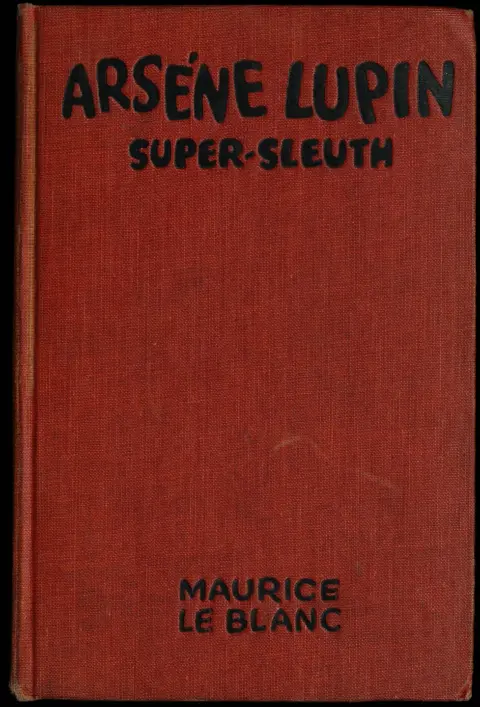
Arsène Lupin, super-sleuth
Maurice Leblanc
THE CLASSIC COLLECTION · 1907
"The Blonde Lady" by Maurice Leblanc is a detective novel written in the early 20th century. The story follows the cunning thief Arsène Lupin as he battles against English detective Holmlock Shears, weaving a tale filled with mystery, stolen treasures, and the pursuit of a valuable lottery ticket. The main plot begins with the theft of M. Gerbois' writing desk, which contains a winning lottery ticket worth a million francs, leading to a duel of wits between Lupin and Shears. The opening of this engaging narrative introduces M. Gerbois, a professor who purchases a writing desk for his daughter's birthday only to have it stolen shortly afterward. As he discovers that the desk contained the ticket for a million francs, he resolves to reclaim his fortune, while Lupin, the thief, openly declares his claim to the winning ticket. This sets off a series of events including Gerbois’ frantic attempts to prove his ownership and the kidnapping of his daughter, Suzanne. The opening establishes a thrilling tension between the characters and hints at a gripping contest of intelligence and morality as both men seek to outmaneuver each other in a high-stakes game.
Introduction adapted from the source catalogue; source summaries may be automatically generated.
Free to read · English · 62,476 words · No account needed
MAKE TIME FOR A GOOD BOOK
On by default. Untick to stop anonymous reading totals. Each page counts after 10 seconds in view. How this works.
Anonymous counting is on unless you have switched it off.
Either C H 237 was the official number of a poste restante or else the two letters C H formed part of an incomplete word. Shears turned over the leaves of the album: nothing had been cut from any of the following pages. He must, therefore, until further orders, be content with the explanation hit upon.
"Isn't it fun?"
Henriette had returned.
He replied:
"Yes, great fun! Only, haven't you any other papers?... Or else some words ready cut out, for me to stick on?"
"Papers?... No.... And then mademoiselle wouldn't like it."
"Mademoiselle?"
"Yes, mademoiselle has scolded me already."
"Why?"
"Because I told you things ... and she says you must never tell things about people you are fond of."
"You were quite right to tell me."
Henriette seemed delighted with his approval, so much so that, from a tiny canvas bag pinned on to her frock, she took a few strips of stuff, three buttons, two lumps of sugar and, lastly, a square piece of paper which she held out to Shears:
"There, I'll give it you all the same." It was the number of a cab, No.
8279.
"Where did you get this from?"
"It fell out of her purse."
"When?"
"On Sunday, at mass, when she was taking out some coppers for the
collection."
"Capital! And now I will tell you how not to get scolded. Don't tell mademoiselle that you have seen me."
Shears went off in search of M. d'Imblevalle and asked him straight out
about mademoiselle.
The baron gave a start:
"Alice Demun!... Would you think?... Oh, impossible!"
"How long has she been in your service?"
"Only twelve months, but I know no quieter person nor any in whom I
place more confidence."
"How is it that I have not yet seen her?"
"She was away for two days."
"And at present?"
"Immediately on her return, she took up her position by your friend's bedside. She is a first-rate nurse ... gentle ... attentive. Mr. Wilson seems delighted with her."
"Oh!" said Shears, who had quite omitted to inquire after old chap's
progress.
He thought for a moment and asked:
"And did she go out on Sunday morning?"
"The day after the robbery?"
"Yes."
The baron called his wife and put the question to her. She replied:
"Mademoiselle took the children to the eleven o'clock mass, as usual."
"But before that?"
"Before? No.... Or rather.... But I was so upset by the theft!... Still, I remember that, on the evening before, she asked leave to go out on Sunday morning ... to see a cousin who was passing through Paris, I think. But surely you don't suspect her?"
"Certainly not. But I should like to see her."
Your reading position is saved on this browser. Take it to another device with a library code. Reading pages adapt to text, rather than matching a printed edition.
Maurice Leblanc
Maurice Leblanc
Maurice Leblanc
Maurice Leblanc
BEHIND THE BOOK
This eBook is for the use of anyone anywhere in the United States and most other parts of the world at no cost and with almost no restrictions whatsoever. You may copy it, give it away or re-use it under the terms of the Project Gutenberg License included with this eBook or online at www.gutenberg.org. If you are not located in the United States, you will have to check the laws of the country where you are located before using this eBook. Read the source licence.
The original source file, including credits and licence, is retained by this library. Request an original-format copy at no charge. Please include the book title and Project Gutenberg identifier #24839.
KEEP YOUR CURIOSITY GOING
Coulson Kernahan

Maurice Baring
Frances Wright
Cécile Tormay

Frederic Jesup Stimson

W. H. P. (William Henry Pope) Jarvis