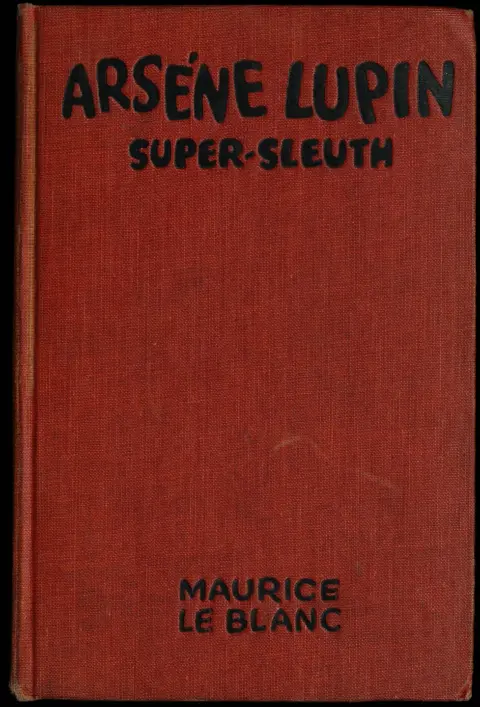
Arsène Lupin, super-sleuth
Maurice Leblanc
THE CLASSIC COLLECTION · 1907
"The Blonde Lady" by Maurice Leblanc is a detective novel written in the early 20th century. The story follows the cunning thief Arsène Lupin as he battles against English detective Holmlock Shears, weaving a tale filled with mystery, stolen treasures, and the pursuit of a valuable lottery ticket. The main plot begins with the theft of M. Gerbois' writing desk, which contains a winning lottery ticket worth a million francs, leading to a duel of wits between Lupin and Shears. The opening of this engaging narrative introduces M. Gerbois, a professor who purchases a writing desk for his daughter's birthday only to have it stolen shortly afterward. As he discovers that the desk contained the ticket for a million francs, he resolves to reclaim his fortune, while Lupin, the thief, openly declares his claim to the winning ticket. This sets off a series of events including Gerbois’ frantic attempts to prove his ownership and the kidnapping of his daughter, Suzanne. The opening establishes a thrilling tension between the characters and hints at a gripping contest of intelligence and morality as both men seek to outmaneuver each other in a high-stakes game.
Introduction adapted from the source catalogue; source summaries may be automatically generated.
Free to read · English · 62,476 words · No account needed
MAKE TIME FOR A GOOD BOOK
On by default. Untick to stop anonymous reading totals. Each page counts after 10 seconds in view. How this works.
Anonymous counting is on unless you have switched it off.
An hour later, at dinner, he saw Sophie and Henrietta, the d'Imblevalles' children, two pretty little girls of eight and six respectively. The conversation languished. Shears replied to the pleasant remarks of the baron and his wife in so surly a tone that they thought it better to keep silence. Coffee was served. Shears swallowed the contents of his cup and rose from his chair.
At that moment, a servant entered with a telephone message for him.
Shears opened it and read:
"Accept my enthusiastic admiration. Results obtained by you in so short a time make my head reel. I feel quite giddy.
He could not suppress a gesture of annoyance and, showing the telegram
to the baron:
"Do you begin to believe," he said, "that your walls have eyes and
ears?"
"I can't understand it," murmured M. d'Imblevalle, astounded.
"Nor I. But what I do understand is that not a movement takes place here unperceived by him. Not a word is spoken but he hears it."
That evening, Wilson went to bed with the easy conscience of a man who has done his duty and who has no other business before him than to go to sleep. So he went to sleep very quickly and was visited by beautiful dreams, in which he was hunting down Lupin all by himself and just on the point of arresting him with his own hand; and the feeling of the pursuit was so lifelike that he woke up.
Some one was touching his bed. He seized his revolver:
"Another movement, Lupin, and I shoot!"
"Steady, old chap, steady on!"
"Hullo, is that you, Shears? Do you want me?"
"I want your eyes. Get up...."
He led him to the window:
"Look over there ... beyond the railings...."
"In the park?"
"Yes. Do you see anything?"
"No, nothing."
"Try again; I am sure you see something."
"Oh, so I do: a shadow ... no, two!"
"I thought so: against the railings.... See, they're moving.... Let's
lose no time."
Groping and holding on to the banister, they made their way down the stairs and came to a room that opened on to the garden steps. Through the glass doors, they could see the two figures still in the same place.
"It's curious," said Shears. "I seem to hear noises in the house."
"In the house? Impossible! Everbody's asleep."
"Listen, though...."
At that moment, a faint whistle sounded from the railings and they perceived an undecided light that seemed to come from the house.
"The d'Imblevalles must have switched on their light," muttered Shears. "It's their room above us."
"Then it's they we heard, no doubt," said Wilson. "Perhaps they are
watching the railings."
Your reading position is saved on this browser. Take it to another device with a library code. Reading pages adapt to text, rather than matching a printed edition.
Maurice Leblanc
Maurice Leblanc
Maurice Leblanc
Maurice Leblanc
BEHIND THE BOOK
This eBook is for the use of anyone anywhere in the United States and most other parts of the world at no cost and with almost no restrictions whatsoever. You may copy it, give it away or re-use it under the terms of the Project Gutenberg License included with this eBook or online at www.gutenberg.org. If you are not located in the United States, you will have to check the laws of the country where you are located before using this eBook. Read the source licence.
The original source file, including credits and licence, is retained by this library. Request an original-format copy at no charge. Please include the book title and Project Gutenberg identifier #24839.
KEEP YOUR CURIOSITY GOING
Coulson Kernahan

Maurice Baring
Frances Wright
Cécile Tormay

Frederic Jesup Stimson

W. H. P. (William Henry Pope) Jarvis