
The unhallowed harvest
Homer Greene
THE CLASSIC COLLECTION · 1887
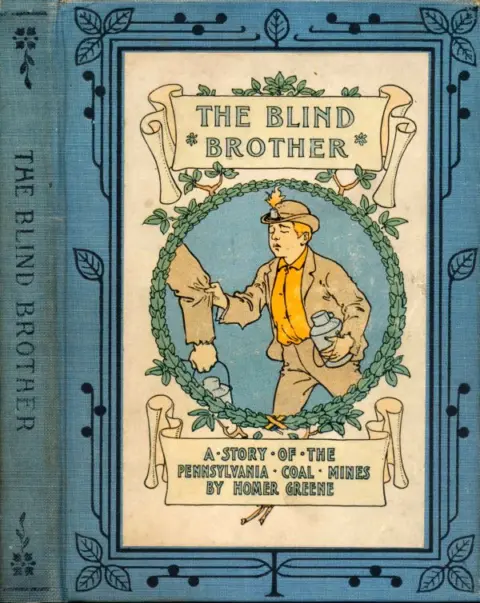
"The Blind Brother: A Story of the Pennsylvania Coal Mines" by Homer Greene is a novel written in the late 19th century. The story revolves around two brothers, Tom and Bennie Taylor, who are navigating the harsh realities of life in the Pennsylvania coal mines during a time of labor strikes. Tom, the older brother, is determined to help his blind sibling regain his sight, highlighting themes of familial loyalty, sacrifice, and the moral dilemmas faced by the working class. At the start of the novel, we are introduced to Bennie, a blind boy who works as a door-boy in the coal mine, relying on his older brother Tom for support and guidance. The narrative sets the stage for their struggles as they navigate the complexities of life in a mining community facing turmoil from strikes. A significant moment occurs when Bennie shares his hopes of saving money to seek medical treatment for his blindness, which underscores the brothers' deep bond. As the story unfolds, Bennie becomes lost in the mine, prompting a desperate search by Tom, which ultimately tests their resilience and love for one another amid a backdrop of social unrest and personal sacrifice. This opening sets up a poignant exploration of the intersection of personal dreams and harsh realities.
Introduction adapted from the source catalogue; source summaries may be automatically generated.
Free to read · English · 27,621 words · No account needed
MAKE TIME FOR A GOOD BOOK
On by default. Untick to stop anonymous reading totals. Each page counts after 10 seconds in view. How this works.
Anonymous counting is on unless you have switched it off.
For some distance from the new chambers the car-track was laid in the airway; then it turned down through an entrance into the heading, and from that point followed the heading to the foot of the slope. Where the route crossed from the airway to the heading, the space between the pillars had been carefully boarded across, so that the air current should not be turned aside; and a door had been placed in the boarding, to be opened whenever the cars approached, and shut as soon as they had passed by.
That door was attended by a boy.
To this point the party had now come, and one by one filed through the opening, while Bennie, the door-boy, stood holding back the door to let them pass.
“Ho, Jack, tak’ the door-boy wi’ ye!” shouted some one in the rear.
The great, broad-shouldered, rough-bearded man who led the procession turned back to where Bennie, apparently lost in astonishment at this unusual occurrence, still stood, with his hand on the door.
“Come along, lad!” he said; “come along! Ye’ll have a gret play-spell
noo.”
“I can’t leave the door, sir,” answered Bennie. “The cars’ll be comin’
soon.”
“Ye need na min’ the cars. Come along wi’ ye, I say!”
“But I can’t go till Tom comes, anyway, you know.”
The man came a step closer. He had the frame of a giant. The others who passed by were like children beside him. Then one of the men who worked in the mine, and who knew Bennie, came through the doorway, the last in the group, and said,--
“Don’t hurt the boy; let him alone. His brother’ll take him out; he
always does.”
All this time Bennie stood quite still, with his hand on the door,
never turning his head.
It was a strange thing for a boy to stand motionless like that, and look neither to the right nor the left, while an excited group of men passed by, one of whom had stopped and approached him, as if he meant him harm. It roused the curiosity of “Jack the Giant,” as the miners called him, and, plucking his lamp from his cap, he flashed the light of it up into Bennie’s face.
The boy did not stir; no muscle of his face moved; even his eyes
remained open and fixed.
“Why, lad! lad! What’s the matter wi’ ye?” There was tenderness in the giant’s voice as he spoke, and tenderness in his bearded face as Bennie answered,--
“Don’t you know? I’m blind.”
“Blind! An’ a-workin’ i’ the mines?”
Your reading position is saved on this browser. Take it to another device with a library code. Reading pages adapt to text, rather than matching a printed edition.
Homer Greene

Homer Greene

Homer Greene
Homer Greene
BEHIND THE BOOK
This eBook is for the use of anyone anywhere in the United States and most other parts of the world at no cost and with almost no restrictions whatsoever. You may copy it, give it away or re-use it under the terms of the Project Gutenberg License included with this eBook or online at www.gutenberg.org. If you are not located in the United States, you will have to check the laws of the country where you are located before using this eBook. Read the source licence.
The original source file, including credits and licence, is retained by this library. Request an original-format copy at no charge. Please include the book title and Project Gutenberg identifier #45232.
KEEP YOUR CURIOSITY GOING
Coulson Kernahan

Maurice Baring
Frances Wright
Cécile Tormay

Frederic Jesup Stimson

W. H. P. (William Henry Pope) Jarvis