
The unhallowed harvest
Homer Greene
THE CLASSIC COLLECTION · 1887
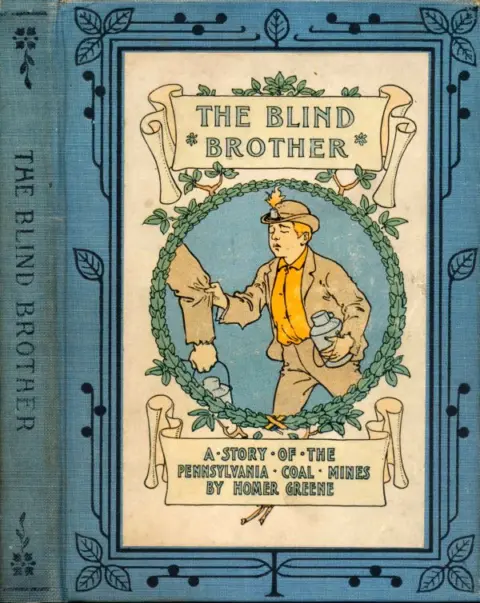
"The Blind Brother: A Story of the Pennsylvania Coal Mines" by Homer Greene is a novel written in the late 19th century. The story revolves around two brothers, Tom and Bennie Taylor, who are navigating the harsh realities of life in the Pennsylvania coal mines during a time of labor strikes. Tom, the older brother, is determined to help his blind sibling regain his sight, highlighting themes of familial loyalty, sacrifice, and the moral dilemmas faced by the working class. At the start of the novel, we are introduced to Bennie, a blind boy who works as a door-boy in the coal mine, relying on his older brother Tom for support and guidance. The narrative sets the stage for their struggles as they navigate the complexities of life in a mining community facing turmoil from strikes. A significant moment occurs when Bennie shares his hopes of saving money to seek medical treatment for his blindness, which underscores the brothers' deep bond. As the story unfolds, Bennie becomes lost in the mine, prompting a desperate search by Tom, which ultimately tests their resilience and love for one another amid a backdrop of social unrest and personal sacrifice. This opening sets up a poignant exploration of the intersection of personal dreams and harsh realities.
Introduction adapted from the source catalogue; source summaries may be automatically generated.
Free to read · English · 27,621 words · No account needed
MAKE TIME FOR A GOOD BOOK
On by default. Untick to stop anonymous reading totals. Each page counts after 10 seconds in view. How this works.
Anonymous counting is on unless you have switched it off.
And without waiting for more words, the boy started off on a run.
It was already past ten o’clock, and he had not had a mouthful of supper, but that was nothing in consideration of the fact that Sandy had been good to him, and would have helped him, and was, even now, waiting for him. So, with a light and grateful heart, he hurried on.
He passed beyond the little row of cottages, of which his mother’s was one, over the hill by a foot-path, and then along the mine car-track to the breaker. Before him the great building loomed up, like some huge castle of old, cutting its outlines sharply against the moon-illumined sky, and throwing a broad black shadow for hundreds of feet to the west.
Through the shadow went Tom, around by the engine-room, where the watchman’s light was glimmering faintly through the grimy window; out again into the moonlight, up, by a foot-path, to the summit of another hill, along by another row of darkened dwellings, to a cottage where a light was still burning, and there he stopped.
The door opened before he reached it, and a man in shirt-sleeves
stepped out and hailed him:
“Is that you, Tom? An’ did ye find Bennie?”
“Yes, Sandy. I came to tell you we just got home. Found him down in the south chambers; he tried to come out alone, an’ got lost. So I’ll not need you, Sandy, with the same thanks as if I did, an’ good-night to you!”
“Good-nicht till ye, Tom! I’m glad the lad’s safe wi’ the mither. Tom,” as the boy turned away, “ye’ll not be afeard to be goin’ home alone?”
Tom laughed.
“Do I looked scared, Sandy? Give yourself no fear for me; I’m afraid o’
naught.”
Before Sandy turned in at his door, Tom had disappeared below the brow of the hill. The loose gravel rolled under his feet as he hurried down, and once, near the bottom, he slipped and fell.
As he rose, he was astonished to see the figure of a man steal carefully along in the shadow of the breaker, and disappear around the corner by the engine-room.
Tom went down cautiously into the shadow, and stopped for a moment in the track by the loading-place to listen. He thought he heard a noise in there; something that sounded like the snapping of dry twigs.
The next moment a man came out from under that portion of the breaker, with his head turned back over his shoulder, muttering, as he advanced toward Tom,--
Your reading position is saved on this browser. Take it to another device with a library code. Reading pages adapt to text, rather than matching a printed edition.
Homer Greene

Homer Greene

Homer Greene
Homer Greene
BEHIND THE BOOK
This eBook is for the use of anyone anywhere in the United States and most other parts of the world at no cost and with almost no restrictions whatsoever. You may copy it, give it away or re-use it under the terms of the Project Gutenberg License included with this eBook or online at www.gutenberg.org. If you are not located in the United States, you will have to check the laws of the country where you are located before using this eBook. Read the source licence.
The original source file, including credits and licence, is retained by this library. Request an original-format copy at no charge. Please include the book title and Project Gutenberg identifier #45232.
KEEP YOUR CURIOSITY GOING
Coulson Kernahan

Maurice Baring
Frances Wright
Cécile Tormay

Frederic Jesup Stimson

W. H. P. (William Henry Pope) Jarvis