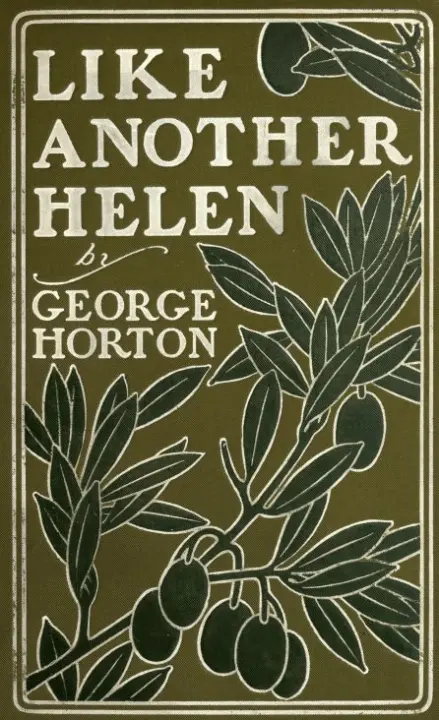
Like Another Helen
George Horton
THE CLASSIC COLLECTION · 1926
"The blight of Asia : An account of the systematic extermination of Christian…. by George Horton is a historical account written in the early 20th century. It indicts Ottoman and later Turkish authorities for organized violence against Christian populations—Armenians and Greeks in particular—culminating in the destruction of Smyrna, while also criticizing the complicity and silence of the Great Powers. Framed by the author’s long service in the Near East, it combines eyewitness reporting, quoted testimonies, and polemical argument to portray a deliberate program of extermination and its geopolitical enablers. The opening of the work sets the tone with a foreword condemning Western inaction, followed by an introduction in which the former U.S. consul explains his aims and firsthand vantage—from the Young Turk revolution through the Smyrna fire. Early chapters list major massacres from the 19th century, quote Gladstone’s and others’ denunciations, and describe how post-1908 “Turkification” quickly turned to repression: assassinations, forced disarmament of Christians, torture, and widespread intimidation that helped drive Balkan Christians into alliance. The narrative then shifts to western Asia Minor, recounting boycotts, incitement, killings, expulsions, and the destruction of villages around Smyrna, illustrated by the 1914 sack of Phocea as an “organized” operation. A substantial section presents corroborating evidence on the Armenian deportations—eyewitness accounts from Aleppo and a detailed report by Walter M. Geddes—depicting caravans of women, children, and the elderly dying from brutality, starvation, and disease, and notes similar devastation in the Pontus. It closes this opening portion with the 1919 Greek landing at Smyrna—acknowledging initial shootings and looting, then emphasizing Governor Sterghiades’ swift punishments—and outlines the subsequent Hellenic administration’s reforms, from curbing vice to funding Turkish schools and building public health services.
Introduction adapted from the source catalogue; source summaries may be automatically generated.
Free to read · English · 61,956 words · No account needed
MAKE TIME FOR A GOOD BOOK
On by default. Untick to stop anonymous reading totals. Each page counts after 10 seconds in view. How this works.
Anonymous counting is on unless you have switched it off.
As throwing some light on the spirit in which the foregoing pages have been written, I append the following letters, the first two from American missionary associations, the third from a committee of prominent Turks at Smyrna:
“AMERICAN BOARD OF COMMISSIONERS FOR FOREIGN MISSIONS
Incorporated 1812
Congregational House, 14 Beacon Street Boston, Massachusetts.
March 22, 1923.
“Doctor George Horton, American Consul-General, Care Consular Bureau, State Dept., Washington, D. C.
“Dear Doctor Horton:
“Enclosed is a letter written by Mr. Getchell in behalf of the missionaries of Smyrna, addressed to Doctor Barton, to have been handed to you on board the steamer which you in some way failed to take.
“It was thus delayed and reached my hands only yesterday.
“Please accept the sentiments expressed although unfortunately so long delayed in transmission. The original of the letter addressed to Doctor Barton was delivered when the party reached America and was read by him on his return from China.
“We are watching events in the Near East with the greatest interest and, as one of the missionaries has said, ‘with hopes that scarce know themselves from fear.’
“I have heard that the American Consulate is again functioning in Smyrna and it is possible that you are there once more. If so, it will be a comfort and a relief of many persons whose interests are still largely centered in that city.
“I trust that you and your family have maintained your health despite the terrible strain upon you and that you will be able to continue in the splendid cooperation with our missionaries that has characterized your work in the past.
“Very sincerely yours,
(Signed) “Ernest W. Biggs.”
The letter referred to as “enclosed” was as follows:
“Athens, Greece, October 12, 1922.
“Reverend James L. Barton, D. D., Secretary of the American Board, 14 Beacon Street, Boston, Mass.
“Dear Doctor Barton:
“At a recent station meeting of the Smyrna missionaries now refugees in the city of Athens (numbering fourteen adults), a vote was passed recognizing the exceedingly helpful and sympathetic services of our Consul-General, Doctor Horton, during the days of the late Smyrna tragedy. The vote also expressed the desire that a copy of this letter be sent to the State Department, Washington, D. C., and one also to Doctor Horton himself.
“During those days of Turkish fire, pillage and massacre, which laid the beautiful city of Smyrna in ashes and rendered homeless her Christian population of not less than 500,000 people, including the refugees from the surrounding towns and villages, Doctor Horton passed through more trying, exacting and dangerous experiences than I could imagine any official of the United States Government, doing service abroad, has ever been called upon to undergo.
Your reading position is saved on this browser. Take it to another device with a library code. Reading pages adapt to text, rather than matching a printed edition.
George Horton
BEHIND THE BOOK
This eBook is for the use of anyone anywhere in the United States and most other parts of the world at no cost and with almost no restrictions whatsoever. You may copy it, give it away or re-use it under the terms of the Project Gutenberg License included with this eBook or online at www.gutenberg.org. If you are not located in the United States, you will have to check the laws of the country where you are located before using this eBook. Read the source licence.
The original source file, including credits and licence, is retained by this library. Request an original-format copy at no charge. Please include the book title and Project Gutenberg identifier #76324.
KEEP YOUR CURIOSITY GOING
Cécile Tormay

Moritz Busch
John L. Ransom
Frances Wright
Cécile Tormay

Mabel Potter Daggett