THE CLASSIC COLLECTION✦The Recruiting OfficerCLASSIC FREE BOOKS
The Recruiting Officer
George Farquhar
THE CLASSIC COLLECTION · 1707
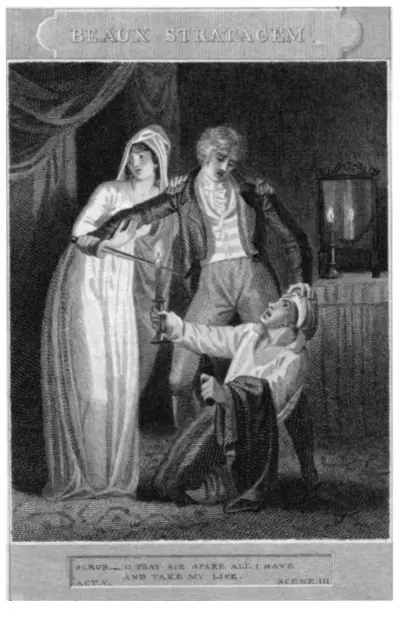
"The Beaux-Stratagem: A comedy in five acts by George Farquhar" is a comedy first produced in 1707. Two impoverished gentlemen, Aimwell and Archer, devise a scheme to marry wealthy heiresses and restore their fortunes. Traveling to Lichfield, they target the beautiful Dorinda, with Archer posing as Aimwell's servant to deceive the locals. Complications arise when Aimwell genuinely falls in love, the innkeeper's daughter pursues Archer, and a band of thieves plots to rob their intended targets, threatening their carefully laid plans.
Introduction adapted from the source catalogue; source summaries may be automatically generated.
Free to read · English · 21,886 words · No account needed
MAKE TIME FOR A GOOD BOOK
On by default. Untick to stop anonymous reading totals. Each page counts after 10 seconds in view. How this works.
Anonymous counting is on unless you have switched it off.
Bon. That's none of my business; he's my landlord, and so a man, you know, would not----but I'cod he's no better than--sir, my humble service to you. [Drinks.] Though I value not a farthing what he can do to me; I pay him his rent at quarter day; I have a good running trade; I have but one daughter, and I can give her--but no matter for that.
Aim. You are very happy, Mr. Boniface; pray what other company have
you in town?
Bon. A power of fine ladies; and then we have the French Officers.
Aim. O that's right, you have a good many of those gentlemen: pray how do you like their company?
Bon. So well, as the saying is, that I could wish we had as many more of them; they are full of money, and pay double for every thing they have; they know, sir, that we paid good round taxes for the taking of them, and so they are willing to reimburse us a little; one of them lodges in my house.
Enter ARCHER.
Arch. Landlord, there are some French Gentlemen below, that ask for
you.
Bon. I'll wait on them----Does your master stay long in town, as the
saying is? [To ARCHER.
Arch. I can't tell, as the saying is.
Bon. Come from London?
Arch. No!
Bon. Going to London, mayhap?
Arch. No!
Bon. An odd fellow this; [Bar Bell rings.] I beg your worship's pardon, I'll wait on you in half a minute. [Exit.
Aim. The coast's clear, I see--Now, my dear Archer, welcome to
Litchfield!
Arch. I thank thee, my dear brother in iniquity.
Aim. Iniquity! pr'ythee, leave canting; you need not change your style
with your dress.
Arch. Don't mistake me, Aimwell, for 'tis still my maxim, that there's no scandal like rags, nor any crimes so shameful as poverty. Men must not be poor; idleness is the root of all evil; the world's wide enough, let them bustle; fortune has taken the weak under her protection, but men of sense are left to their industry.
Aim. Upon which topic we proceed, and, I think, luckily hitherto: would not any man swear now, that I am a man of quality, and you my servant, when, if our intrinsic value were known----
Arch. Come, come, we are the men of intrinsic value, who can strike our fortunes out of ourselves, whose worth is independent of accidents in life, or revolutions in government: we have heads to get money, and hearts to spend it.
Your reading position is saved on this browser. Take it to another device with a library code. Reading pages adapt to text, rather than matching a printed edition.
George Farquhar
George Farquhar
BEHIND THE BOOK
This eBook is for the use of anyone anywhere in the United States and most other parts of the world at no cost and with almost no restrictions whatsoever. You may copy it, give it away or re-use it under the terms of the Project Gutenberg License included with this eBook or online at www.gutenberg.org. If you are not located in the United States, you will have to check the laws of the country where you are located before using this eBook. Read the source licence.
The original source file, including credits and licence, is retained by this library. Request an original-format copy at no charge. Please include the book title and Project Gutenberg identifier #37195.
KEEP YOUR CURIOSITY GOING
Maurice Baring
W. B. (William Butler) Yeats
Edward Martyn

John Brougham & Charlotte Brontë
Marguerite Merington
Leonid Andreyev