THE CLASSIC COLLECTION✦The Recruiting OfficerCLASSIC FREE BOOKS
The Recruiting Officer
George Farquhar
THE CLASSIC COLLECTION · 1707
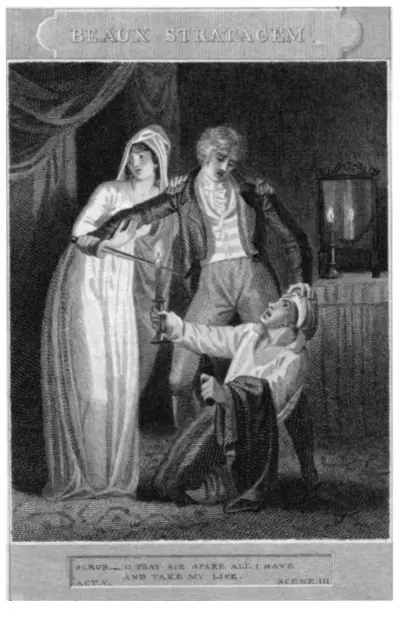
"The Beaux-Stratagem: A comedy in five acts by George Farquhar" is a comedy first produced in 1707. Two impoverished gentlemen, Aimwell and Archer, devise a scheme to marry wealthy heiresses and restore their fortunes. Traveling to Lichfield, they target the beautiful Dorinda, with Archer posing as Aimwell's servant to deceive the locals. Complications arise when Aimwell genuinely falls in love, the innkeeper's daughter pursues Archer, and a band of thieves plots to rob their intended targets, threatening their carefully laid plans.
Introduction adapted from the source catalogue; source summaries may be automatically generated.
Free to read · English · 21,886 words · No account needed
MAKE TIME FOR A GOOD BOOK
On by default. Untick to stop anonymous reading totals. Each page counts after 10 seconds in view. How this works.
Anonymous counting is on unless you have switched it off.
Aim. And have you lived so long upon this ale, landlord?
Bon. Eight and fifty years, upon my credit, sir; but it killed my wife, poor woman, as the saying is.
Aim. How came that to pass?
Bon. I don't know how, sir; she would not let the ale take its natural course, sir: she was for qualifying it every now and then with a dram, as the saying is, and an honest gentleman, that came this way from Ireland, made her a present of a dozen bottles of Usquebaugh----but the poor woman was never well after; but, however, I was obliged to the gentleman, you know.
Aim. Why, was it the Usquebaugh that killed her?
Bon. My Lady Bountiful said so--she, good lady, did what could be done; she cured her of three tympanies, but the fourth carried her off; but she's happy, and I'm contented, as the saying is.
Aim. Who's that Lady Bountiful, you mentioned?
Bon. 'Ods my life, sir, we'll drink her health. [Drinks.] My Lady Bountiful is one of the best of women: her last husband, Sir Charles Bountiful, left her worth a thousand pounds a year; and I believe she lays out one half on't in charitable uses, for the good of her neighbours: she cures all disorders incidental to men, women and children; in short, she has cured more people in and about Litchfield within ten years, than the doctors have killed in twenty, and that's a bold word.
Aim. Has the lady been any other way useful in her generation?
Bon. Yes, sir, she has a daughter by Sir Charles, the finest woman in all our country, and the greatest fortune: she has a son too by her first husband, 'Squire Sullen, who married a fine lady from London t'other day; if you please, sir, we'll drink his health.
Aim. What sort of a man is he?
Bon. Why, sir, the man's well enough; says little, thinks less, and does--nothing at all, 'faith: but he's a man of great estate, and values nobody.
Aim. A sportsman, I suppose?
Bon. Yes, sir, he's a man of pleasure; he plays at whist, and smokes his pipe eight-and-forty hours together sometimes.
Aim. A fine sportsman truly! and married, you say?
Bon. Ay, and to a curious woman, sir--but he's a---- He wants it here, sir. [Pointing to his Forehead.
Aim. He has it there, you mean.
Your reading position is saved on this browser. Take it to another device with a library code. Reading pages adapt to text, rather than matching a printed edition.
George Farquhar
George Farquhar
BEHIND THE BOOK
This eBook is for the use of anyone anywhere in the United States and most other parts of the world at no cost and with almost no restrictions whatsoever. You may copy it, give it away or re-use it under the terms of the Project Gutenberg License included with this eBook or online at www.gutenberg.org. If you are not located in the United States, you will have to check the laws of the country where you are located before using this eBook. Read the source licence.
The original source file, including credits and licence, is retained by this library. Request an original-format copy at no charge. Please include the book title and Project Gutenberg identifier #37195.
KEEP YOUR CURIOSITY GOING
Maurice Baring
W. B. (William Butler) Yeats
Edward Martyn

John Brougham & Charlotte Brontë
Marguerite Merington
Leonid Andreyev