THE CLASSIC COLLECTION✦Less than kinCLASSIC FREE BOOKS
Less than kin
Alice Duer Miller
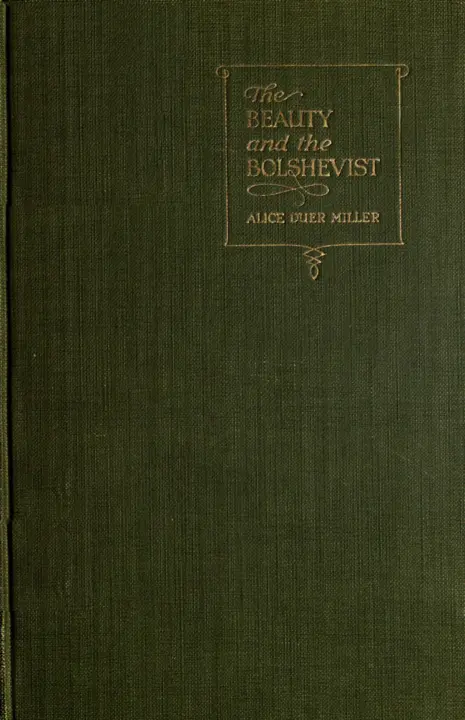
THE CLASSIC COLLECTION · 1920
"The Beauty and the Bolshevist" by Alice Duer Miller is a novel likely written during the early 20th century, specifically around the time of the 1920s. The story centers on Ben Moreton, an idealistic editor of a radical newspaper, and his tumultuous relationship with his brother David, who is on the verge of marrying a capitalistic heiress, Eugenia Cord. Ben’s journey consists of navigating family loyalty while grappling with political convictions and societal expectations. At the start of the book, the conflict is introduced through Ben's internal struggle regarding David's engagement to Eugenia Cord. As Ben prepares to confront his brother, who seems oblivious to the consequences of such a union, he receives news of the engagement just as tensions rise between his own socialist beliefs and the prevailing capitalist society represented by the Cords. The narrative explores the dynamics within the Moreton family, the clash between social classes, and the emergence of romantic interests, particularly between Ben and Crystal Cord, Eugenia's sister. This opening section establishes a rich foundation for themes of love, societal expectations, and the pursuit of personal integrity amidst the looming shadow of class conflict.
Introduction adapted from the source catalogue; source summaries may be automatically generated.
Free to read · English · 21,635 words · No account needed
MAKE TIME FOR A GOOD BOOK
On by default. Untick to stop anonymous reading totals. Each page counts after 10 seconds in view. How this works.
Anonymous counting is on unless you have switched it off.
“Glory!” exclaimed Ben, with open contempt for such people. “Think of penalizing the first honest attempt to understand!”
“You see the point of my plan, don’t you, Ben?” said Crystal.
“You bet I do.”
“That’s wonderful,” she answered, “for you’ve only heard half of it. In July, August, and September, we will come here to Newport, and you will get to understand father’s—”
“Hold on,” cried Ben, “just a moment. That is absolutely impossible, Crystal. You don’t understand. The paper couldn’t keep me a day if I did that.”
“Ha!” cried Mr. Cord, coming suddenly to life. “There’s freedom for
you!”
“That would be very cruel of the owners, Ben, but if they did—”
“It wouldn’t be cruel at all,” said Moreton. “They wouldn’t have any choice. I should have lost all influence with my readers, if it were known—”
“Glory!” said Mr. Cord. “Think of penalizing the first honest attempt to understand the capitalistic class!”
Ben stood silent, caught in the grip of an intellectual dilemma which he felt every instant would dissolve itself and which didn’t.
Crystal for the first time moved away from her father. “Those are my terms,” she said. “I stay with the man who agrees to them, and if you both decline them—well, I’ll go off and try and open the oyster by myself.”
There was a long momentous pause, and then Tomes’s discreet knock on
the door.
“Mr. Verriman on the telephone, madam.”
“I can’t come,” said Crystal. “Ask him to send a message.”
“Don’t you see, Crystal, what your plan would do?” said her father. “Either it would make Moreton a red revolutionist and me a persecuting Bourbon, or else it would just ruin us both for either of our objectives.”
“It won’t ruin you for my objectives,” said Crystal, “and women are more human, you know, than men.”
Another knock at the door. Tomes’s voice again:
“Mr. Verriman wishes to know if he might dine here this evening?”
“No,” said Cord, looking at Crystal.
Crystal raised her voice. “Certainly, Tomes. Say we shall be delighted to have him—at eight.”
Both men turned to her.
“Why did you do that, Crystal? Verriman—here—to-night?”
Crystal did not answer—the identity of their tones, their words, and their irritation with her should have told them the answer, but didn’t.
She knew that only opposition to Eddie and Eddie’s many prototypes could weld her two men solidly together.
Your reading position is saved on this browser. Take it to another device with a library code. Reading pages adapt to text, rather than matching a printed edition.
Alice Duer Miller
Alice Duer Miller
Alice Duer Miller
Alice Duer Miller
BEHIND THE BOOK
This eBook is for the use of anyone anywhere in the United States and most other parts of the world at no cost and with almost no restrictions whatsoever. You may copy it, give it away or re-use it under the terms of the Project Gutenberg License included with this eBook or online at www.gutenberg.org. If you are not located in the United States, you will have to check the laws of the country where you are located before using this eBook. Read the source licence.
The original source file, including credits and licence, is retained by this library. Request an original-format copy at no charge. Please include the book title and Project Gutenberg identifier #13146.
KEEP YOUR CURIOSITY GOING
Coulson Kernahan

Maurice Baring
Frances Wright
Cécile Tormay

Frederic Jesup Stimson

W. H. P. (William Henry Pope) Jarvis