
The Milkmaid of Montfermeil (Novels of Paul de Kock Volume XX)
Paul de Kock
THE CLASSIC COLLECTION · 1903
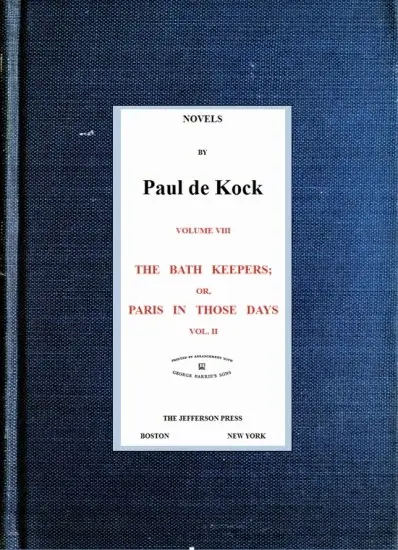
"The Bath Keepers; Or, Paris in Those Days, v.2" by Paul de Kock is a novel written in the early 19th century. This narrative explores the lives of ordinary Parisians, delving into their interactions, struggles, and the societal norms of the time. The plot centers around the characters of Ambroisine and Bathilde, focusing on themes of love, betrayal, and social ostracization as Bathilde seeks refuge and understanding after facing familial rejection due to her circumstances. The opening of the novel introduces a stormy night where Ambroisine anxiously awaits her father, Master Hugonnet, while grappling with the repercussions of her friend Bathilde's recent troubles. After a drunken encounter at home, Ambroisine opens the door to find Bathilde, who has been cast out by her parents for becoming pregnant and is in desperate need of shelter. The emotional tension increases as Bathilde reveals her plight, her love for Comte Léodgard, and the urgent need for acknowledgment from him. This sets the stage for the central conflicts that will unfold throughout the narrative, highlighting the impact of personal choices against the backdrop of societal expectations.
Introduction adapted from the source catalogue; source summaries may be automatically generated.
Free to read · English · 97,494 words · No account needed
MAKE TIME FOR A GOOD BOOK
On by default. Untick to stop anonymous reading totals. Each page counts after 10 seconds in view. How this works.
Anonymous counting is on unless you have switched it off.
One beautiful day in spring, Valentine de Mongarcin sat in the salon where her aunt Madame de Ravenelle preferred to pass her time, amusing herself by picking out chords on her zither and singing the words of a new virelay.
Madame de Ravenelle, reclining on an immense couch, listened to her niece, keeping time gently with her head, and smiling with the contented expression of a person whose digestion is good and who has no cares.
The fair Valentine was a long way from displaying a countenance as placid as her aunt's; her brow often contracted; her mouth expressed melancholy rather than pleasure, and her eyes, which she turned constantly from side to side, indicated that her mind was deeply preoccupied.
"Well! go on, Valentine; why have you stopped singing?" inquired the old
lady.
"What do you say, aunt? was I singing?"
"Well! this is charming! do you mean that you did not know it? that you sang without being aware of it?"
"I assure you, aunt, that I was not thinking of music at all!"
"Is it possible? However, you have been so distraught, so pensive, for some time past, that if I did not know you, I should really believe that you had some passion in your heart!--But I am not at all alarmed in that direction; I know that you love no one!"
"That is true, aunt: I have no love for anyone."
"Still, you will have to decide some day. You do not lack suitors, at all events; there are more than ten gentlemen, rich and of noble birth, who seek your hand. I say to them all: 'Wait, be patient; she will come to it.'"
Valentine made no reply. But, a few minutes later, she asked:
"Did you hear anything last evening, aunt, at Madame de Brissac's reception, of a very--a very extraordinary occurrence?"
"No, niece, no; and I prefer not to. Extraordinary events sometimes cause keen emotion, and I dislike anything that disturbs my delightfully quiet life."
"Well, I heard two young gentlemen talking within a few feet of me--not so low that I could not hear their words. One of them said: 'Yes, my friend, Léodgard de Marvejols is married.'--'That is impossible,' the other replied; 'why should his marriage be kept secret?'--The first one answered; but just then he and his friend walked away, so that I could learn nothing more."
"You must have heard wrong, niece; or else the young gentleman was amusing himself at his friend's expense.--A man of the Marvejols blood does not contract a marriage without letting it be known beforehand in society! That would in truth be most extraordinary!"
Your reading position is saved on this browser. Take it to another device with a library code. Reading pages adapt to text, rather than matching a printed edition.
Paul de Kock

Paul de Kock

Paul de Kock

Paul de Kock
BEHIND THE BOOK
This eBook is for the use of anyone anywhere in the United States and most other parts of the world at no cost and with almost no restrictions whatsoever. You may copy it, give it away or re-use it under the terms of the Project Gutenberg License included with this eBook or online at www.gutenberg.org. If you are not located in the United States, you will have to check the laws of the country where you are located before using this eBook. Read the source licence.
The original source file, including credits and licence, is retained by this library. Request an original-format copy at no charge. Please include the book title and Project Gutenberg identifier #40518.
KEEP YOUR CURIOSITY GOING
Coulson Kernahan

Maurice Baring
Frances Wright
Cécile Tormay

Frederic Jesup Stimson

W. H. P. (William Henry Pope) Jarvis