
The Milkmaid of Montfermeil (Novels of Paul de Kock Volume XX)
Paul de Kock
THE CLASSIC COLLECTION · 1903
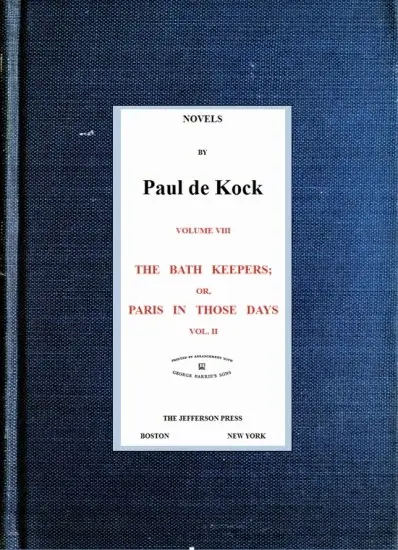
"The Bath Keepers; Or, Paris in Those Days, v.2" by Paul de Kock is a novel written in the early 19th century. This narrative explores the lives of ordinary Parisians, delving into their interactions, struggles, and the societal norms of the time. The plot centers around the characters of Ambroisine and Bathilde, focusing on themes of love, betrayal, and social ostracization as Bathilde seeks refuge and understanding after facing familial rejection due to her circumstances. The opening of the novel introduces a stormy night where Ambroisine anxiously awaits her father, Master Hugonnet, while grappling with the repercussions of her friend Bathilde's recent troubles. After a drunken encounter at home, Ambroisine opens the door to find Bathilde, who has been cast out by her parents for becoming pregnant and is in desperate need of shelter. The emotional tension increases as Bathilde reveals her plight, her love for Comte Léodgard, and the urgent need for acknowledgment from him. This sets the stage for the central conflicts that will unfold throughout the narrative, highlighting the impact of personal choices against the backdrop of societal expectations.
Introduction adapted from the source catalogue; source summaries may be automatically generated.
Free to read · English · 97,494 words · No account needed
MAKE TIME FOR A GOOD BOOK
On by default. Untick to stop anonymous reading totals. Each page counts after 10 seconds in view. How this works.
Anonymous counting is on unless you have switched it off.
And Passedix tossed the account into a tiny fire that burned in a huge fireplace, whose feeble heat hardly changed the temperature, which was very cold outside.
Dame Cadichard, marvelling at the noble indifference with which her tenant paid his debts, said to him, with a respectful inclination of the head:
"Monsieur le chevalier, would you accept a plate of this soup? That will help you to wait for what you propose to send for to the wine shop."
"Oh, no! no, thanks!" cried Passedix, probably recalling the accident that had befallen the soup. "I have no desire to taste it.--May I not have Popelinette's services?"
"I beg pardon, monsieur le chevalier,--at once, instantly."
And Dame Cadichard, leaving her soup, left the room and went into the hall to call her servant in such shrill, imperative tones that old Popelinette soon came running in in dismay, crying:
"What's the matter? who's sick? where's the fire? Something must have
happened!"
"The matter is, Popelinette, that Monsieur le Chevalier de Passedix wants to send you on an errand, and he must not be kept waiting."
"What! was it for that thing that madame was yelling as if she wanted to
sprain her throat?"
"That thing!--Popelinette, try to express yourself more respectfully when you are talking about Monsieur de Passedix!"
The old servant stood with a dazed expression in the middle of the room, unable to understand how it happened that her mistress spoke so kindly now of a tenant whom she had abused so roundly only that morning.
Passedix put an end to the servant's conjectures by placing a gold piece in her hand, with these words:
"Go to the nearest wine shop, Popelinette, and order a dainty breakfast; let them bring everything for three. I feel capable of multiplying the size of my mouthfuls by three. Order several bottles of the best wine, also.--Go, and what money remains shall be yours!"
The sight of a fine gold doubloon instantly made the servant as polite and zealous as her mistress. What a mighty influence has that metal, which acts in the same way upon almost all temperaments! Physicians have never found its like among all the drugs that they force us to take.
When Popelinette had gone, the chevalier resumed his seat at the table
and said to his hostess:
"Now, Dame Cadichard, let us talk a little. You will readily understand, I think, that a man with two thousand crowns a year, to say nothing of the lesser objects, cannot continue to live under the eaves, where he has for fellow lodgers rats of all dimensions."
Your reading position is saved on this browser. Take it to another device with a library code. Reading pages adapt to text, rather than matching a printed edition.
Paul de Kock

Paul de Kock

Paul de Kock

Paul de Kock
BEHIND THE BOOK
This eBook is for the use of anyone anywhere in the United States and most other parts of the world at no cost and with almost no restrictions whatsoever. You may copy it, give it away or re-use it under the terms of the Project Gutenberg License included with this eBook or online at www.gutenberg.org. If you are not located in the United States, you will have to check the laws of the country where you are located before using this eBook. Read the source licence.
The original source file, including credits and licence, is retained by this library. Request an original-format copy at no charge. Please include the book title and Project Gutenberg identifier #40518.
KEEP YOUR CURIOSITY GOING
Coulson Kernahan

Maurice Baring
Frances Wright
Cécile Tormay

Frederic Jesup Stimson

W. H. P. (William Henry Pope) Jarvis