
The Milkmaid of Montfermeil (Novels of Paul de Kock Volume XX)
Paul de Kock
THE CLASSIC COLLECTION · 1903
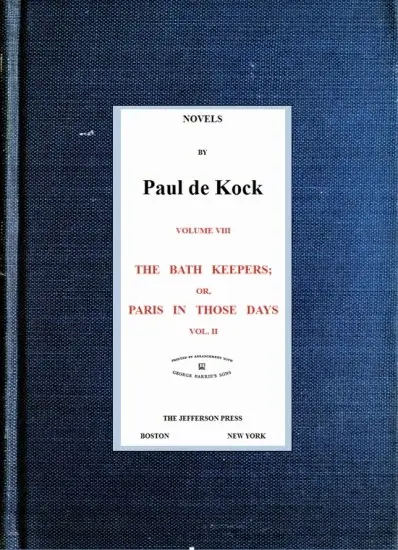
"The Bath Keepers; Or, Paris in Those Days, v.2" by Paul de Kock is a novel written in the early 19th century. This narrative explores the lives of ordinary Parisians, delving into their interactions, struggles, and the societal norms of the time. The plot centers around the characters of Ambroisine and Bathilde, focusing on themes of love, betrayal, and social ostracization as Bathilde seeks refuge and understanding after facing familial rejection due to her circumstances. The opening of the novel introduces a stormy night where Ambroisine anxiously awaits her father, Master Hugonnet, while grappling with the repercussions of her friend Bathilde's recent troubles. After a drunken encounter at home, Ambroisine opens the door to find Bathilde, who has been cast out by her parents for becoming pregnant and is in desperate need of shelter. The emotional tension increases as Bathilde reveals her plight, her love for Comte Léodgard, and the urgent need for acknowledgment from him. This sets the stage for the central conflicts that will unfold throughout the narrative, highlighting the impact of personal choices against the backdrop of societal expectations.
Introduction adapted from the source catalogue; source summaries may be automatically generated.
Free to read · English · 97,494 words · No account needed
MAKE TIME FOR A GOOD BOOK
On by default. Untick to stop anonymous reading totals. Each page counts after 10 seconds in view. How this works.
Anonymous counting is on unless you have switched it off.
Jarnonville listened attentively to what Ambroisine said; for a moment he seemed moved, but almost instantly, as if he regretted that he had allowed his heart to be touched, he pushed the girl away and would have walked on.
"A mere love story!" he said; "a woman seduced! What have I to do with all that? Comte Léodgard's intrigues do not concern me!"
"But a poor girl who is on the point of becoming a mother, and whose child, spurned by its father, will have no name, nothing to eat--that concerns you, for you are compassionate to children, I know!"
Jarnonville stopped; he passed his hand across his forehead, heaved a profound sigh, and returned to Ambroisine, saying:
"Come with me!"
The chevalier retraced his steps to Léodgard's house and knocked; the gate swung open and he bade Ambroisine enter with him.
Seeing the girl in the courtyard, the concierge, who recognized her,
cried:
"What are you doing here? Monsieur le comte will not receive you, as you know quite well! I have orders to send you away whenever you come here, so----"
"This young woman is with me," said Jarnonville, in a tone that imposed silence on the concierge. "Hold your peace!"
And taking Ambroisine's hand, he led her through the vestibule at the right into a room preceding the banquet hall, and said:
"Remain here. I will find Léodgard and send him to you, without telling him who it is that wishes to see him."
"Oh! thanks! thanks a thousand times, seigneur!--I knew that you would
help me!"
Jarnonville left the room; and Ambroisine, undismayed, awaited Léodgard's appearance. She was not embarrassed at finding herself in that sumptuous abode. Grandeur loses all its prestige when it loses its power to inspire respect.
Hardly five minutes had passed when Léodgard entered the room in which
Ambroisine awaited him.
"A lady to see me?" he exclaimed; "why does she not come to the salons where my guests are assembled?"
"Because that is not her place, monsieur le comte, and because, no doubt, you would not be pleased to see her there," said Ambroisine, stepping forward with a resolute air.
As he recognized Hugonnet's daughter, Léodgard could not restrain an angry gesture. He glanced at her disdainfully and muttered:
"What! is it you? By hell! you are persistent! You have been to my house too often already; you must have understood that I did not choose to receive you. You have no right to violate a person's domicile thus!--Understand, my dear, that this is not your father's bathing establishment, where anyone who pleases has a right to enter."
Your reading position is saved on this browser. Take it to another device with a library code. Reading pages adapt to text, rather than matching a printed edition.
Paul de Kock

Paul de Kock

Paul de Kock

Paul de Kock
BEHIND THE BOOK
This eBook is for the use of anyone anywhere in the United States and most other parts of the world at no cost and with almost no restrictions whatsoever. You may copy it, give it away or re-use it under the terms of the Project Gutenberg License included with this eBook or online at www.gutenberg.org. If you are not located in the United States, you will have to check the laws of the country where you are located before using this eBook. Read the source licence.
The original source file, including credits and licence, is retained by this library. Request an original-format copy at no charge. Please include the book title and Project Gutenberg identifier #40518.
KEEP YOUR CURIOSITY GOING
Coulson Kernahan

Maurice Baring
Frances Wright
Cécile Tormay

Frederic Jesup Stimson

W. H. P. (William Henry Pope) Jarvis