
The Milkmaid of Montfermeil (Novels of Paul de Kock Volume XX)
Paul de Kock
THE CLASSIC COLLECTION · 1903
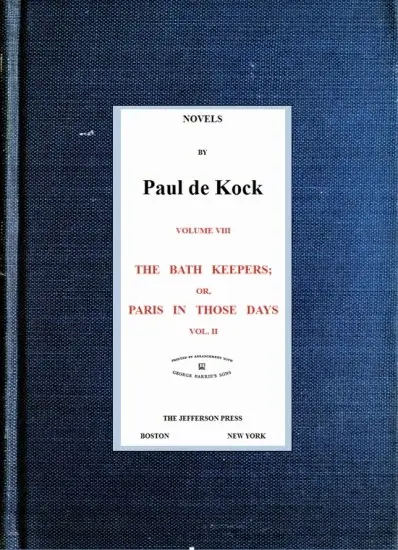
"The Bath Keepers; Or, Paris in Those Days, v.2" by Paul de Kock is a novel written in the early 19th century. This narrative explores the lives of ordinary Parisians, delving into their interactions, struggles, and the societal norms of the time. The plot centers around the characters of Ambroisine and Bathilde, focusing on themes of love, betrayal, and social ostracization as Bathilde seeks refuge and understanding after facing familial rejection due to her circumstances. The opening of the novel introduces a stormy night where Ambroisine anxiously awaits her father, Master Hugonnet, while grappling with the repercussions of her friend Bathilde's recent troubles. After a drunken encounter at home, Ambroisine opens the door to find Bathilde, who has been cast out by her parents for becoming pregnant and is in desperate need of shelter. The emotional tension increases as Bathilde reveals her plight, her love for Comte Léodgard, and the urgent need for acknowledgment from him. This sets the stage for the central conflicts that will unfold throughout the narrative, highlighting the impact of personal choices against the backdrop of societal expectations.
Introduction adapted from the source catalogue; source summaries may be automatically generated.
Free to read · English · 97,494 words · No account needed
MAKE TIME FOR A GOOD BOOK
On by default. Untick to stop anonymous reading totals. Each page counts after 10 seconds in view. How this works.
Anonymous counting is on unless you have switched it off.
At last, a servant appeared and informed Jarnonville that the cardinal could receive him, and the chevalier was ushered into Richelieu's study.
The minister was alone; dressed in his red soutane, and pale, thin, fatigued by overwork. That fragile, ailing man, who made all Europe tremble, retained in his glance, instinct with fire and vivacity, all the youthful vigor that his body had lost.
Seated at his desk, examining reports, Richelieu toyed with a cat that lay on his knees, while two others played on a rug at his feet. When the Sire de Jarnonville entered, the cardinal raised his head, looked at him a few seconds, and said at last in a tone that bore no trace of anger:
"What is this that I hear, Sire de Jarnonville? That you have been fighting a duel with the Comte de Marvejols? Is that the truth?"
"Yes, monseigneur."
"But you must be familiar with the edicts concerning single combats. I have been compelled to put a curb upon this barbarous custom, this mania that men have for killing one another for an idle word! If I had not regulated the matter, the whole of the king's court would have taken the field!--You know, then, monsieur, that it is a capital offence?"
"I know it, monseigneur."
"And that did not stop you!--What motive had you, grave enough to induce you to defy the law?--Come, speak, chevalier. I thought that you were a friend to Comte Léodgard; you were his child's godfather, I believe."
"I acted in place of the old Marquis de Marvejols--that is true."
"You take a deep interest in the young countess--and you fight with her husband!--What was the cause of this duel?"
Jarnonville, who did not lie readily, especially when it was necessary to invent a long story, was considerably embarrassed beneath Richelieu's piercing gaze, and faltered:
"Sometimes, monseigneur, between two persons who meet often, a word too lightly spoken is enough.--Comte Léodgard is quick to take offence--and--and I myself lose my head sometimes."
While Jarnonville was seeking his phrases, the cardinal, who was watching him closely, glanced at the short, broad sword that hung at his belt. He frowned, and said, interrupting him:
"You have a peculiar sword there, chevalier?"
"This sword--ah, yes! I do not--er--wear it usually."
"I think not, for I have never seen it upon you. Whence have you it?"
"Why, I found it with other weapons--which belonged to my father."
"Ah! by the way, have you heard aught of the charges made by a young woman with respect to Comte Léodgard?"
"Not until this morning, monseigneur."
"You do not give credit to them, do you?"
Your reading position is saved on this browser. Take it to another device with a library code. Reading pages adapt to text, rather than matching a printed edition.
Paul de Kock

Paul de Kock

Paul de Kock

Paul de Kock
BEHIND THE BOOK
This eBook is for the use of anyone anywhere in the United States and most other parts of the world at no cost and with almost no restrictions whatsoever. You may copy it, give it away or re-use it under the terms of the Project Gutenberg License included with this eBook or online at www.gutenberg.org. If you are not located in the United States, you will have to check the laws of the country where you are located before using this eBook. Read the source licence.
The original source file, including credits and licence, is retained by this library. Request an original-format copy at no charge. Please include the book title and Project Gutenberg identifier #40518.
KEEP YOUR CURIOSITY GOING
Coulson Kernahan

Maurice Baring
Frances Wright
Cécile Tormay

Frederic Jesup Stimson

W. H. P. (William Henry Pope) Jarvis