
The Milkmaid of Montfermeil (Novels of Paul de Kock Volume XX)
Paul de Kock
THE CLASSIC COLLECTION · 1903
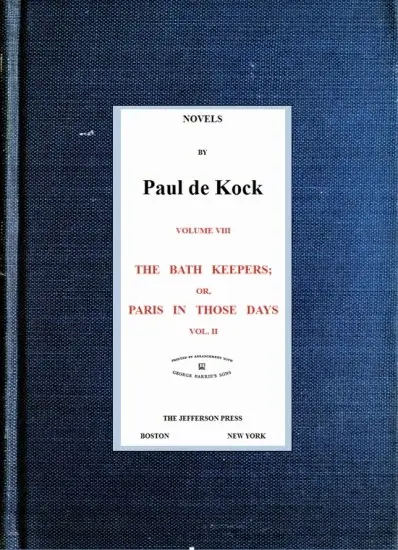
"The Bath Keepers; Or, Paris in Those Days, v.2" by Paul de Kock is a novel written in the early 19th century. This narrative explores the lives of ordinary Parisians, delving into their interactions, struggles, and the societal norms of the time. The plot centers around the characters of Ambroisine and Bathilde, focusing on themes of love, betrayal, and social ostracization as Bathilde seeks refuge and understanding after facing familial rejection due to her circumstances. The opening of the novel introduces a stormy night where Ambroisine anxiously awaits her father, Master Hugonnet, while grappling with the repercussions of her friend Bathilde's recent troubles. After a drunken encounter at home, Ambroisine opens the door to find Bathilde, who has been cast out by her parents for becoming pregnant and is in desperate need of shelter. The emotional tension increases as Bathilde reveals her plight, her love for Comte Léodgard, and the urgent need for acknowledgment from him. This sets the stage for the central conflicts that will unfold throughout the narrative, highlighting the impact of personal choices against the backdrop of societal expectations.
Introduction adapted from the source catalogue; source summaries may be automatically generated.
Free to read · English · 97,494 words · No account needed
MAKE TIME FOR A GOOD BOOK
On by default. Untick to stop anonymous reading totals. Each page counts after 10 seconds in view. How this works.
Anonymous counting is on unless you have switched it off.
"Why, he is becoming a charming cavalier!" said Camilla; "he told me that I was ravishingly beautiful; he noticed my costume! He is more gallant than Léodgard.--I believe that we can make a conquest of him now, Flavia."
"Oh! I no longer care about it; I preferred him when he was all in black and looked like a bear."
While the two ladies exchanged their opinions concerning Jarnonville, the new-comer was being discussed also in a group of young gentlemen.
"Did you see Jarnonville, Monclair?"
"Yes, I have just bade him good-evening."
"Don't you think that he cuts an entirely different figure from what he
used?"
"Why so? because he wears a blue cloak instead of a black one?"
"No, it is not that; but because he no longer has that gloomy, unhappy expression that he used to carry with him everywhere."
"That is true," said young La Valteline; "I noticed the change; it impressed me when Jarnonville entered the salon."
"Well, messieurs, what is there so surprising in that?" said Monclair; "after all, grief is not eternal! After the rain comes the sunshine! And Jarnonville's coming here proves that he is no longer a foe to pleasure."
"I tell you, messieurs," said the Baron de Montrevert, shaking his head with an air of importance, "that a change in humor, in disposition, never happens without a cause."
"Well! do you know what the cause is, Montrevert?" inquired Sénange.
"Oh! perhaps! perhaps!"
"He knows it, messieurs, he is going to tell us what it is. Speak, my dear fellow, speak, we will not lose a syllable!"
"I will tell you, messieurs, what someone told me--the reports that are current; I vouch for nothing, however."
"The preamble is perfect! Come down to the facts, advocate."
"Well! this is what people say: for several months past, Jarnonville has been a frequent visitor at the Hôtel de Marvejols, where the young countess lives."
"Oh! the deuce! is it so? And what does he go there for?"
"Why, it seems to me to be very easy to guess; he goes to see our friend
Léodgard's wife."
"The bath keeper's daughter!"
"Hush! you wretch! Suppose Léodgard should hear you! He will not allow anyone to speak of his wife, either kindly or unkindly. Only a few days ago, the young Vicomte de Saunois ventured in his presence to jest about ill-assorted marriages; he threw his glove in his face, and the next morning he killed Saunois by running him through with his sword."
"What do we care for all that?--Let us return to Jarnonville; so he goes to pay court to the little countess, eh?"
Your reading position is saved on this browser. Take it to another device with a library code. Reading pages adapt to text, rather than matching a printed edition.
Paul de Kock

Paul de Kock

Paul de Kock

Paul de Kock
BEHIND THE BOOK
This eBook is for the use of anyone anywhere in the United States and most other parts of the world at no cost and with almost no restrictions whatsoever. You may copy it, give it away or re-use it under the terms of the Project Gutenberg License included with this eBook or online at www.gutenberg.org. If you are not located in the United States, you will have to check the laws of the country where you are located before using this eBook. Read the source licence.
The original source file, including credits and licence, is retained by this library. Request an original-format copy at no charge. Please include the book title and Project Gutenberg identifier #40518.
KEEP YOUR CURIOSITY GOING
Coulson Kernahan

Maurice Baring
Frances Wright
Cécile Tormay

Frederic Jesup Stimson

W. H. P. (William Henry Pope) Jarvis