
The Milkmaid of Montfermeil (Novels of Paul de Kock Volume XX)
Paul de Kock
THE CLASSIC COLLECTION · 1903
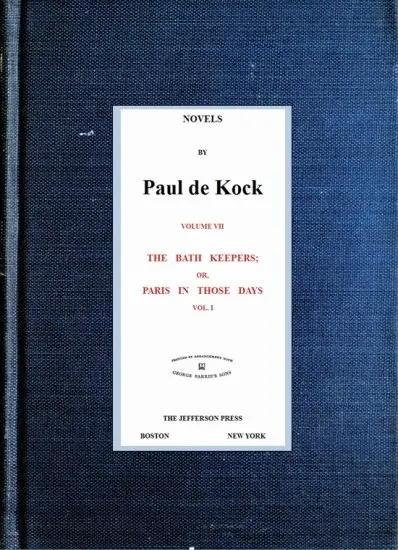
"The Bath Keepers; Or, Paris in Those Days, v.1" by Paul de Kock is a historical novel written in the early 19th century. The story unfolds in 1634 Paris, a city depicted as dark, damp, and filled with a mix of noblemen, commoners, and rogues. The narrative centers on Léodgard de Marvejols, a young nobleman embroiled in gambling and questionable escapades. He navigates the various social strata and intrigues of the time, revealing the character of a man caught between refinement and rowdy adventure. At the start of the novel, we are introduced to the gloomy streets of Paris where Léodgard, described as handsome yet troubled, reflects on his fortunes and misfortunes. Having just experienced a night of gambling, he encounters Giovanni, an infamous Italian robber, and through their exchange, we witness Léodgard's arrogance and desire for thrill. Following this confrontation, the story shifts to the bathhouses of the city, which serve as social meeting points for various characters, including the engaging bath keepers and their daughters, Ambroisine and Bathilde. The societal dynamics of the time are established, featuring humor, romance, and the allure of Paris’s nightlife, setting the stage for the characters' intertwined fates.
Introduction adapted from the source catalogue; source summaries may be automatically generated.
Free to read · English · 91,304 words · No account needed
MAKE TIME FOR A GOOD BOOK
On by default. Untick to stop anonymous reading totals. Each page counts after 10 seconds in view. How this works.
Anonymous counting is on unless you have switched it off.
The Gascon, who was very curious to know what the girl had to tell him, lost no time in seating himself by her side on a bench; whereupon Ambroisine resumed the conversation, taking care, however, to speak in undertones.
"Have you known the Sire de Jarnonville long?"
"No--about a year; and even so, I know him only from having been with him in several affrays. He fights well, I am bound to admit, but he's a good-for-nothing fellow. He doesn't believe in anything, and I don't like atheists. I am a bad man with the fair, a libertine, a rake, a seducer!--anything you please, I will not say nay. But all that does not prevent my being religious, for without religion there is no true chivalry; and all those stainless knights who fought in Palestine would then be mere braggarts.--But why do you ask me that question?"
"Because, if you had known the Sire de Jarnonville long, you would probably know as much about him as I do, and you would have a very different opinion of him.--I will tell you what I have heard here. About five or six months ago, the Black Chevalier, for he is sometimes so called, had just left our house, where he had been telling the story of one of his exploits--he had broken everything in a tavern, I believe. When he had gone, a gentleman quite advanced in years, but with a face that inspired respect, said to another gentleman who was with him: 'Poor Jarnonville! how he has changed! who would believe, to look at him now, that he was once the mildest, most obliging, most virtuous of men! the man who was held up as a model to young gentlemen who were just entering the world!'--'What can have changed him so?' the other inquired.--'Jarnonville was married, and he lost his wife, whom he loved very dearly; but she had left him a child, a little girl, who was, they say, an angel of beauty, sweetness, and docility. Jarnonville adored little Blanche--that was his daughter's name; she had become his only love, his sole joy, his whole hope for the future; constantly intent upon providing some pleasure, some delight for his darling child, his grief for his wife's death gradually faded away. Happy and proud to be all in all to his daughter, who became every day more charming in body and mind, Jarnonville hardly ever left little Blanche. At four years of age--and that is very, very young!--at four years of age, the child understood all that she owed to her father, all the sacrifices to which he submitted for her sake; but she repaid them all by her love. Never did a child of that age manifest such affection for its father! If he left her for an instant, her eyes filled with tears; but as soon as she saw him, an enchanting smile lighted up her lovely face.--Poor child! You will understand how he must have loved her!--Well! that child, already so far beyond her years in her feelings and her intelligence, that pretty Blanche--he lost her after an illness of a few days only! One of those cruel diseases which feed upon childhood, and which the doctors are as yet unable to cure, carried off the poor little darling!--I will not try to describe her father's grief; it would be impossible. But the frightful calamity that had befallen him changed his character absolutely. Jarnonville accused heaven, Providence. Having never been guilty in his whole life of any evil deed, he rebelled against the fate that dealt him such a cruel blow, which snatched away that little creature to whom life seemed to offer such a beautiful and peaceful prospect--in short, that man, who had always been so religious, ceased utterly to be so, and blasphemed God. Deaf to all consolation, he lived a long while in retirement. When, by dint of constant solicitation, his friends succeeded in luring him back into society, he was no longer the Jarnonville of other days. To divert his thoughts from his grief, he joins all the parties conceived by the worst scapegraces in the city; not a duel, not a nocturnal affray, in which he does not take part. He drinks, drinks to excess, gambles, passes whole nights in debauchery, serves as second to all the young scatterbrains who sow discord in families. He has become the bugbear of the petits bourgeois, the terror of cabaretiers, tavern keepers, of all decent folk; in a word, he is just the opposite of all that he used to be.--But, for my part, I cannot help pitying him; it is his head which is at fault, not his heart; it is despair that has changed his nature. Nor do I believe that he is altogether lost! He still wears mourning for his daughter. In the midst of his debauchery, he has not chosen to lay aside his sombre garments; and when he seems most excited by gambling, wine, or passion, show him a child of about the age of his little Blanche when she died, and you will see a magical change take place in him instantly; his eyes will fill with tears, and that man, whose glance made you tremble a moment before, will become silent and as gentle as a child.'
Your reading position is saved on this browser. Take it to another device with a library code. Reading pages adapt to text, rather than matching a printed edition.
Paul de Kock

Paul de Kock

Paul de Kock

Paul de Kock
BEHIND THE BOOK
This eBook is for the use of anyone anywhere in the United States and most other parts of the world at no cost and with almost no restrictions whatsoever. You may copy it, give it away or re-use it under the terms of the Project Gutenberg License included with this eBook or online at www.gutenberg.org. If you are not located in the United States, you will have to check the laws of the country where you are located before using this eBook. Read the source licence.
The original source file, including credits and licence, is retained by this library. Request an original-format copy at no charge. Please include the book title and Project Gutenberg identifier #40335.
KEEP YOUR CURIOSITY GOING
Cécile Tormay

Moritz Busch
Coulson Kernahan
John L. Ransom

Maurice Baring
Frances Wright