
The Milkmaid of Montfermeil (Novels of Paul de Kock Volume XX)
Paul de Kock
THE CLASSIC COLLECTION · 1903
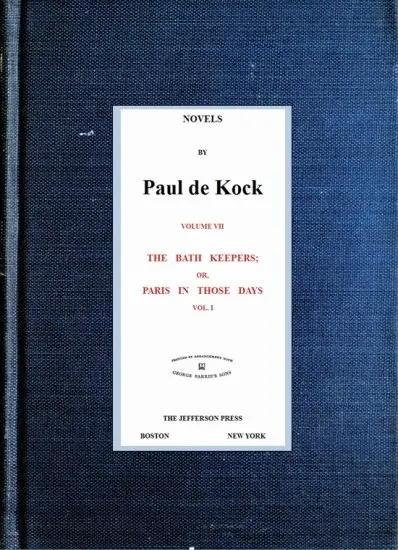
"The Bath Keepers; Or, Paris in Those Days, v.1" by Paul de Kock is a historical novel written in the early 19th century. The story unfolds in 1634 Paris, a city depicted as dark, damp, and filled with a mix of noblemen, commoners, and rogues. The narrative centers on Léodgard de Marvejols, a young nobleman embroiled in gambling and questionable escapades. He navigates the various social strata and intrigues of the time, revealing the character of a man caught between refinement and rowdy adventure. At the start of the novel, we are introduced to the gloomy streets of Paris where Léodgard, described as handsome yet troubled, reflects on his fortunes and misfortunes. Having just experienced a night of gambling, he encounters Giovanni, an infamous Italian robber, and through their exchange, we witness Léodgard's arrogance and desire for thrill. Following this confrontation, the story shifts to the bathhouses of the city, which serve as social meeting points for various characters, including the engaging bath keepers and their daughters, Ambroisine and Bathilde. The societal dynamics of the time are established, featuring humor, romance, and the allure of Paris’s nightlife, setting the stage for the characters' intertwined fates.
Introduction adapted from the source catalogue; source summaries may be automatically generated.
Free to read · English · 91,304 words · No account needed
MAKE TIME FOR A GOOD BOOK
On by default. Untick to stop anonymous reading totals. Each page counts after 10 seconds in view. How this works.
Anonymous counting is on unless you have switched it off.
It was the morrow of a grand reception given at the Hôtel de Mongarcin,--a function which had brought together the most noble dames and the gentlemen of the first families of France then residing in the capital.
Madame de Ravenelle and her niece had done the honors of the fête; but Valentine especially had displayed that grace and refinement of manner which made her a noteworthy figure everywhere.
It was she who had conceived the idea of giving a reception; and her aunt had consented, but on condition that her niece should take it upon herself to arrange and manage everything.
The guests had conversed; they had played lansquenet, brelan, primero, dice, and other fashionable games; they had danced sarabands, passe-pieds, branles, and all the dances then in vogue. In fact, everybody had seemed delighted with the evening's entertainment, and had lavished compliments upon Valentine and Madame de Ravenelle, congratulating the latter upon having a niece who did the honors of her house so gracefully.
And as the givers of a large party are usually very tired on the following day, the old aunt was stretched out on a reclining chair, from which she did not stir; while Valentine sat on a sofa, with her feet on a soft hassock, holding in her hands a piece of embroidery upon which she was not working.
"Are you asleep, aunt?" inquired Valentine, after a very long silence.
"I think not, niece; at all events, if I had been, your question would
have waked me!"
"Oh! I see that you were not asleep at all.--Our reception last night was very brilliant, was it not?"
"If it is to ask me that that you interfere with my doze----"
"No; I wanted to ask you also if you noticed that all those whom we
invited came?"
"All! do you think so?"
"Yes, aunt, with the exception of a single one.--Oh! I am quite sure that you noticed that, too."
"It is true," said Madame de Ravenelle, partly rising, "that the young Comte de Marvejols did not come."
"He is the one I mean. I trust that now you will not give another thought to my marrying this gentleman, who shows--I will not say so little zeal, for he has shown zeal in avoiding me!--but who is almost discourteous to us!"
"But, Valentine, young Léodgard's father, the Marquis de Marvejols, accepted our invitation; he apologized for his son and said that fatigue, an attack of fever, kept him at home."
"Of course you do not suppose that I believe a word of that! Fatigue! fever! If he were ill, would his father have come to our party?"
Your reading position is saved on this browser. Take it to another device with a library code. Reading pages adapt to text, rather than matching a printed edition.
Paul de Kock

Paul de Kock

Paul de Kock

Paul de Kock
BEHIND THE BOOK
This eBook is for the use of anyone anywhere in the United States and most other parts of the world at no cost and with almost no restrictions whatsoever. You may copy it, give it away or re-use it under the terms of the Project Gutenberg License included with this eBook or online at www.gutenberg.org. If you are not located in the United States, you will have to check the laws of the country where you are located before using this eBook. Read the source licence.
The original source file, including credits and licence, is retained by this library. Request an original-format copy at no charge. Please include the book title and Project Gutenberg identifier #40335.
KEEP YOUR CURIOSITY GOING
Cécile Tormay

Moritz Busch
Coulson Kernahan
John L. Ransom

Maurice Baring
Frances Wright