
The Milkmaid of Montfermeil (Novels of Paul de Kock Volume XX)
Paul de Kock
THE CLASSIC COLLECTION · 1903
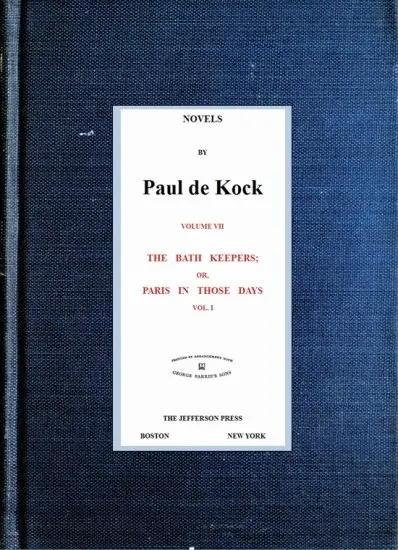
"The Bath Keepers; Or, Paris in Those Days, v.1" by Paul de Kock is a historical novel written in the early 19th century. The story unfolds in 1634 Paris, a city depicted as dark, damp, and filled with a mix of noblemen, commoners, and rogues. The narrative centers on Léodgard de Marvejols, a young nobleman embroiled in gambling and questionable escapades. He navigates the various social strata and intrigues of the time, revealing the character of a man caught between refinement and rowdy adventure. At the start of the novel, we are introduced to the gloomy streets of Paris where Léodgard, described as handsome yet troubled, reflects on his fortunes and misfortunes. Having just experienced a night of gambling, he encounters Giovanni, an infamous Italian robber, and through their exchange, we witness Léodgard's arrogance and desire for thrill. Following this confrontation, the story shifts to the bathhouses of the city, which serve as social meeting points for various characters, including the engaging bath keepers and their daughters, Ambroisine and Bathilde. The societal dynamics of the time are established, featuring humor, romance, and the allure of Paris’s nightlife, setting the stage for the characters' intertwined fates.
Introduction adapted from the source catalogue; source summaries may be automatically generated.
Free to read · English · 91,304 words · No account needed
MAKE TIME FOR A GOOD BOOK
On by default. Untick to stop anonymous reading totals. Each page counts after 10 seconds in view. How this works.
Anonymous counting is on unless you have switched it off.
And the young nobles, as they shouted the name, waved their hats and handkerchiefs, while the bachelors and squires joined hands and began to dance and caper around the horse and his riders.
The girl's face flushed, her impatience got the better of her; she struck the horse's flank with her hand, while the peasant did his best to urge his steed forward, crying:
"Let go of Bourriquet's rein, seigneurs! let go of my horse, ten
thousand devils!"
"Ah! Bourriquet! the horse's name is Bourriquet!"
"His rider should bear that name!"
"Poor bourrique,[B] who has to carry another of his kind!"
[B] Bourrique, an ass; bourriquet, an ass's colt.
"No, no! your horse shall not take a step!"
"Don't worry him with your rein."
"Dismount, Cédrille of Pau; if not, we will forcibly remove you and your companion from Bourriquet's back!"
Some of Master Hugonnet's customers were already preparing to carry out this threat; but at that crisis, the Béarnais peasant, whose face had turned purple and had assumed a menacing expression, quickly raised his right arm, and brandishing in the air the dogwood staff with which his right hand was armed, twirled it about in the faces of those who approached, with such fearless and uncompromising dexterity that in a moment there was a large space cleared in front of the travellers; and yet, some of the jokers did not move back quickly enough to avoid a blow from the redoubtable dogwood staff.
Meanwhile, the pretty girl threw both arms about her companion, and, raising her head, seemed to defy with her glance those who surrounded her, and to say to them:
"Come forward now, if you dare!"
All this had taken place in an instant; but the panic was soon over, and all the young men, who were in the habit of beating the watch, fighting with citizens, and brawling every night in the streets of Paris, were in no humor to fly from a peasant's club. Having retired to a safe distance, they turned about once more and drew their swords; the bachelors, students, pages, and esquires did the same; for at that blessed epoch almost every man wore a sword or a rapier of some sort, in order to be always in a position to fight on the most trivial pretext: a consequence of the gentle manners and pacific customs of the good old times.
At sight of the bare swords, Miretta said to her companion:
"Come, push on, Cédrille! beat your horse! Let us get away from here, or some disaster will happen to us."
Your reading position is saved on this browser. Take it to another device with a library code. Reading pages adapt to text, rather than matching a printed edition.
Paul de Kock

Paul de Kock

Paul de Kock

Paul de Kock
BEHIND THE BOOK
This eBook is for the use of anyone anywhere in the United States and most other parts of the world at no cost and with almost no restrictions whatsoever. You may copy it, give it away or re-use it under the terms of the Project Gutenberg License included with this eBook or online at www.gutenberg.org. If you are not located in the United States, you will have to check the laws of the country where you are located before using this eBook. Read the source licence.
The original source file, including credits and licence, is retained by this library. Request an original-format copy at no charge. Please include the book title and Project Gutenberg identifier #40335.
KEEP YOUR CURIOSITY GOING
Cécile Tormay

Moritz Busch
Coulson Kernahan
John L. Ransom

Maurice Baring
Frances Wright