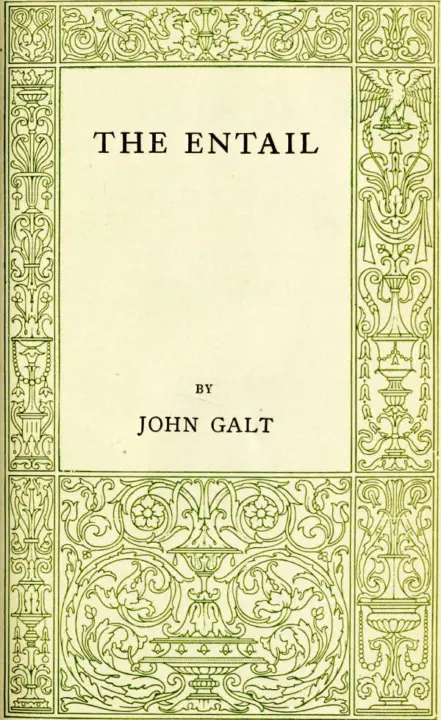
The Entail; or, The Lairds of Grippy
John Galt
THE CLASSIC COLLECTION · 1821
"The Ayrshire Legatees; Or, The Pringle Family" by John Galt is a novel written in the early 19th century. The story revolves around the Pringle family, particularly focused on Dr. Zachariah Pringle, who has just received news of inheriting a significant legacy from a distant relative in India. The narrative explores their journey to London to claim this inheritance, delving into themes of family dynamics, social class, and the sometimes humorous challenges faced by ordinary people navigating unexpected wealth and societal changes. The opening of the book establishes the context of the Pringle family's situation following the death of Colonel Armour, a cousin to Dr. Pringle. As they prepare for an extensive journey from their rural home to the bustling city of London, each family member's personality begins to shine through—including the earnest yet slightly anxious Dr. Pringle, his practical wife Janet, and their ambitious son Andrew. The family's interactions and communications, conveyed through letters and conversations, provide insight into their thoughts and concerns. The narrative blends humor and pathos, showcasing the contrast between country life and the complexities of urban existence, setting the stage for the family's adventure amidst the promise of newfound wealth.
Introduction adapted from the source catalogue; source summaries may be automatically generated.
Free to read · English · 49,875 words · No account needed
MAKE TIME FOR A GOOD BOOK
On by default. Untick to stop anonymous reading totals. Each page counts after 10 seconds in view. How this works.
Anonymous counting is on unless you have switched it off.
Of Wood, who was twice Lord Mayor, I know not what to say. There is a queer and wily cast in his pale countenance, that puzzles me exceedingly. In common parlance I would call him an empty vain creature; but when I look at that indescribable spirit, which indicates a strange and out-of-the-way manner of thinking, I humbly confess that he is no common man. He is evidently a person of no intellectual accomplishments; he has neither the language nor the deportment of a gentleman, in the usual understanding of the term; and yet there is something that I would almost call genius about him. It is not cunning, it is not wisdom, it is far from being prudence, and yet it is something as wary as prudence, as effectual as wisdom, and not less sinister than cunning. I would call it intuitive skill, a sort of instinct, by which he is enabled to attain his ends in defiance of a capacity naturally narrow, a judgment that topples with vanity, and an address at once mean and repulsive. To call him a great man, in any possible approximation of the word, would be ridiculous; that he is a good one, will be denied by those who envy his success, or hate his politics; but nothing, save the blindness of fanaticism, can call in question his possession of a rare and singular species of ability, let it be exerted in what cause it may. But my paper is full, and I have only room to subscribe myself, faithfully, yours,
"It appears to us," said Mr. Snodgrass, as he folded up the letter to return it to his pocket, "that the Londoners, with all their advantages of information, are neither purer nor better than their fellow-subjects in the country." "As to their betterness," replied Miss Mally, "I have a notion that they are far waur; and I hope you do not think that earthly knowledge of any sort has a tendency to make mankind, or womankind either, any better; for was not Solomon, who had more of it than any other man, a type and testification, that knowledge without grace is but vanity?" The young clergyman was somewhat startled at this application of a remark on which he laid no particular stress, and was thankful in his heart that Mrs. Glibbans was not present. He was not aware that Miss Mally had an orthodox corn, or bunyan, that could as little bear a touch from the royne-slippers of philosophy, as the inflamed gout of polemical controversy, which had gumfiated every mental joint and member of that zealous prop of the Relief Kirk. This was indeed the tender point of Miss Mally's character; for she was left unplucked on the stalk of single blessedness, owing entirely to a conversation on this very subject with the only lover she ever had, Mr. Dalgliesh, formerly helper in the neighbouring parish of Dintonknow. He happened incidentally to observe, that education was requisite to promote the interests of religion. But Miss Mally, on that occasion, jocularly maintained, that education had only a tendency to promote the sale of books. This, Mr. Dalgliesh thought, was a sneer at himself, he having some time before unfortunately published a short tract, entitled, "The moral union of our temporal and eternal interests considered, with respect to the establishment of parochial seminaries," and which fell still-born from the press. He therefore retorted with some acrimony, until, from less to more, Miss Mally ordered him to keep his distance; upon which he bounced out of the room, and they were never afterwards on speaking terms. Saving, however, and excepting this particular dogma, Miss Mally was on all other topics as liberal and beneficent as could be expected from a maiden lady, who was obliged to eke out her stinted income with a nimble needle and a close-clipping economy. The conversation with Mr. Snodgrass was not, however, lengthened into acrimony; for immediately after the remark which we have noticed, she proposed that they should call on Miss Isabella Tod to see Rachel's letter; indeed, this was rendered necessary by the state of the fire, for after boiling the kettle she had allowed it to fall low. It was her nightly practice after tea to take her evening seam, in a friendly way, to some of her neighbours' houses, by which she saved both coal and candle, while she acquired the news of the day, and was occasionally invited to stay supper.
Your reading position is saved on this browser. Take it to another device with a library code. Reading pages adapt to text, rather than matching a printed edition.
John Galt
John Galt
John Galt
John Galt
BEHIND THE BOOK
This eBook is for the use of anyone anywhere in the United States and most other parts of the world at no cost and with almost no restrictions whatsoever. You may copy it, give it away or re-use it under the terms of the Project Gutenberg License included with this eBook or online at www.gutenberg.org. If you are not located in the United States, you will have to check the laws of the country where you are located before using this eBook. Read the source licence.
The original source file, including credits and licence, is retained by this library. Request an original-format copy at no charge. Please include the book title and Project Gutenberg identifier #1384.
KEEP YOUR CURIOSITY GOING
Coulson Kernahan

Maurice Baring
Frances Wright
Cécile Tormay

Frederic Jesup Stimson

W. H. P. (William Henry Pope) Jarvis