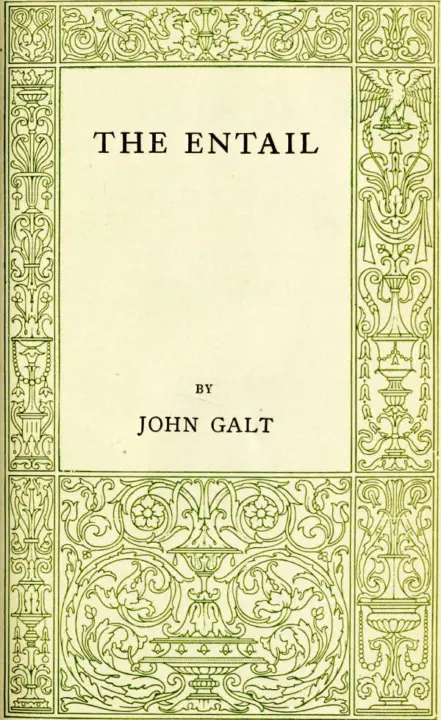
The Entail; or, The Lairds of Grippy
John Galt
THE CLASSIC COLLECTION · 1823
"Ringan Gilhaize, or The Covenanters" by John Galt is a historical novel written in the early 19th century. The story is set during the tumultuous period of the Scottish Reformation, focusing on the struggles for religious liberty and the conflict between the Covenanters and the ruling authorities. The main character is Ringan Gilhaize, who embodies the zealous spirit of the Covenanters, illustrating the tension between faith and oppression. The opening of the novel establishes a reflective tone as the narrator recounts the historical background and personal experiences of Ringan's grandfather during the Reformation. It highlights his family's past and their involvement in the early struggles against the Catholic Church. The narrative flows into his grandfather's youth, outlining the events that led him to join the fight for religious freedom alongside the Protestant reformers. An early conflict arises when the family's rebellious spirit is ignited by witnessing the hypocrisy of the church and the martyrdom of reformers, setting the stage for the broader conflicts that will emerge as a central theme in the story.
Introduction adapted from the source catalogue; source summaries may be automatically generated.
Free to read · English · 164,427 words · No account needed
MAKE TIME FOR A GOOD BOOK
On by default. Untick to stop anonymous reading totals. Each page counts after 10 seconds in view. How this works.
Anonymous counting is on unless you have switched it off.
Produced by Steven desJardins, Carla Foust, and the Online Distributed Proofreading Team at https://www.pgdp.net
Transcriber's note
Inconsistencies in language and dialect found in the original book have been retained. Minor punctuation errors have been changed without notice. Printer errors have been changed and are listed at the end.
Their constancy in torture and in death--
These on Tradition's tongue still live, these shall
On History's honest page be pictured bright
To latest times.
Ringan
Gilhaize
"Annals of the Parish," "Sir Andrew Wylie," "The Entail," Etc.
Sir GEORGE DOUGLAS, Bart.
London
GREENING & CO., LTD.
20 Cecil Court, Charing Cross Road
1899
There have, of course, been many men of genius who have united with great laxity and waywardness in their lives a high and perfect respect for their art; but instances of the directly contrary practice are much rarer, and among these there is probably none more prominent than that of the author of Ringan Gilhaize. Gifted by nature with a faculty which was at once brilliant, powerful and genial, he led an industrious life, the upright and generally exemplary character of which has never for a moment been called in question. But, in the sphere of his art, it is as undeniable as unaccountable that he cared little or nothing to do his best. The haps or whims of the moment seem, indeed, to have governed his production with an influence as of stars malign or fortunate. Furthermore, we know that the profession of authorship--that most distinguished of all professions, as, speaking in sober sadness without arrogance, we cannot but be bold to call it--that profession from which he was himself so well equipt to derive honour--was held by him in low esteem. So that, speaking of the time of his residence in Upper Canada, he thinks no shame to observe that he did then consider himself qualified to do something more useful than "stringing blethers[1] into rhyme," or "writing 'clishmaclavers' in a closet." And again says he, "to tell the truth, I have sometimes felt a little shamefaced in thinking myself so much an author, in consequence of the estimation in which I view the profession of book-making in general. A mere literary man--an author by profession--stands low in my opinion." Such remarks as these from a man of commanding literary talent are the reverse of pleasant reading. But let us deal with the speaker, as we would ourselves be dealt by--mercifully, and regard these petulant utterances as a mere expression of bitterness or perversity in one much tried and sorely disappointed. Even so, the fact remains that the sum of Galt's immense and varied production exhibits inequalities of execution for which only carelessness or contempt in the worker for his task can adequately account. We shall presently have occasion to speak of him in his relation to the great contemporary writer to whose life and work his own work and life present so many interesting points of similarity and diversity; but we may here note that, in the glaringly disparate character of his output, the author of The Provost is in absolute contrast to the author of The Antiquary. For, if Scott's work viewed as a whole be rarely of the very finest literary quality, its evenness within its own limits is on the other hand very striking indeed. For, of his twenty-seven novels, there are perhaps but three which fall perceptibly below the general level of excellence; whilst probably any one of at least as many as six or eight might by a quorum of competent judges be selected as the best of all. And hence, where in the case of other authors we are called on to read this masterpiece or those specimens, and, having done so, are held to have acquitted ourselves, in the case of Scott we cannot feel that we have done our duty till we have read through the Waverley Novels. How entirely different is it with Galt--where we find The Omen occupying one shelf with The Radical, The Annals of the Parish catalogued with Lawrie Todd, and The Spaewife side by side with The Covenanters! And obviously it is in this inequality in its author's work--in the magnitude, that is, of the rubbish-heap in which he chose to secrete his jewels--that the explanation of the neglect, if not rather oblivion, into which the work last-named has fallen can alone be sought and found. For, once in the threescore years of his busy life, Galt did his best, consistently and on a large scale, with the pen; and that once was in the novel of Ringan Gilhaize, or the Covenanters. What is more--however lamentably he may appear in general to lack the faculty of self-criticism--he knew when he had done his best, and among all his books this one remained his favourite. But a man has to pay for artistic as he has for moral delinquencies, and it would seem that the penalty of many a careless tome has been exacted in the obscuration of one of the finest and truest of historical romances in our language.[2] A word or two as to the genesis and character of the book which we have ventured thus to describe may not be out of place as preface to our endeavour to obtain for it a second hearing.
Your reading position is saved on this browser. Take it to another device with a library code. Reading pages adapt to text, rather than matching a printed edition.
John Galt
John Galt
John Galt
John Galt
BEHIND THE BOOK
This eBook is for the use of anyone anywhere in the United States and most other parts of the world at no cost and with almost no restrictions whatsoever. You may copy it, give it away or re-use it under the terms of the Project Gutenberg License included with this eBook or online at www.gutenberg.org. If you are not located in the United States, you will have to check the laws of the country where you are located before using this eBook. Read the source licence.
The original source file, including credits and licence, is retained by this library. Request an original-format copy at no charge. Please include the book title and Project Gutenberg identifier #30749.
KEEP YOUR CURIOSITY GOING
Cécile Tormay

Moritz Busch
Coulson Kernahan
John L. Ransom

Maurice Baring
Frances Wright