THE CLASSIC COLLECTION✦The spiritual exercises of St. IgnatiusCLASSIC FREE BOOKS
The spiritual exercises of St. Ignatius
of Loyola, Saint Ignatius & Charles Coppens
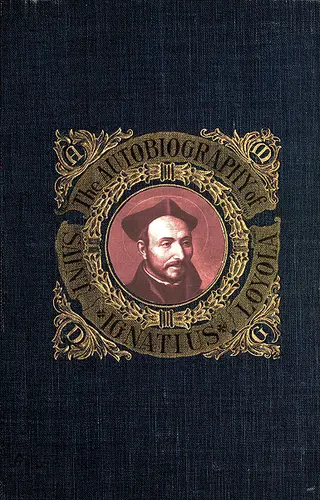
THE CLASSIC COLLECTION · 1900
"The Autobiography of St. Ignatius" by Saint Ignatius of Loyola is a spiritual memoir written in the early 16th century. The book recounts the profound personal transformation of Ignatius, highlighting his military past, intense spiritual experiences, and the founding of the Society of Jesus. The text offers readers an intimate look into his struggles with vanity and ambition, his recovery from a serious injury, and the gradual awakening of his spiritual purpose. The beginning of the autobiography portrays Ignatius as a man enthralled by worldly pursuits, particularly in his military career, until he is injured at the siege of Pampeluna. During his lengthy recovery, he begins reading about the lives of saints, which ignites a deeply spiritual yearning within him. The narrative describes his inner conflict as he grapples with returning to worldly fears versus embracing a life devoted to God. His epiphany leads him to forego his former ways and commit to a path of penance and service, eventually influencing many around him and setting the stage for his future endeavors in forming the Jesuit order.
Introduction adapted from the source catalogue; source summaries may be automatically generated.
Free to read · English · 22,811 words · No account needed
MAKE TIME FOR A GOOD BOOK
On by default. Untick to stop anonymous reading totals. Each page counts after 10 seconds in view. How this works.
Anonymous counting is on unless you have switched it off.
Nearly all the Jesuit writers had been Jesuit professors, with almost no exception, and nearly all had taught humanities, belles-lettres, and rhetoric. Father Southwell in 1676 numbers 2240 authors, and Father de Backer in 1876 counts 11,100.
We find some remarkable authors among the Jesuit writers. Foremost come the Bollandists, renowned throughout the world for their monumental work, the "Acta Sanctorum." Similar gigantic works were carried on by Fathers de Backer, Sommervogel, and Pachtler. In the various branches of learning we need mention a few of the greater writers.
In astronomy, we find Ricci, Perry, De Vico, Secchi, Curley, Sestini.
In mathematics, Hagen, Algue.
In naval tactics, "The Jesuit's Book."
In archaeology, Garucci, Marchi, the master of De Rossi.
In Oriental languages, Strassmaier, Harvas, Maas, Van den Gheyn.
In theology, Suarez, Vasquez, Toletus, Maldonatus, Franzelin.
In philosophy, Cominbricenses, Liberatore.
In moral philosophy, Busenbaum, Gury, Toledo, Ballerini, Layman,
Lehmkuhl, Genicot.
In asceticism, Alvarez de Paz, Gaudier, Rodriguez, Scaramelli, Grou.
The Spiritual Exercises comprise a whole library. Father Watragan has written a work merely to record the editions and commentaries on these Exercises.
St. Ignatius had gathered about him a body of picked men. The Roman College, the type of colleges of Jesuit education, would have for its professors only those who had been doctors of the University of Paris.
The outline of the course of education was given by St. Ignatius. It was completed and developed by Aquaviva. The work was still more perfected by Father Laynez, of whom it is said,--
"St. Ignatius praised him not only on account of other great merits, but particularly for devising and arranging the system of colleges."
As to the number of students found under a unified method of thorough teaching, it will be interesting to take them in review.
In Rome in 1584, the twenty colleges attending classes in the Roman College numbered 2108 students, in Poland there were 10,000 young men chiefly of the nobility, at Rome 2000, at La Fleche 1700. In the seventeenth century at the College of Louis le Grand, in Paris, the number varied between 2000 and 3000. In 1627 the Province of Paris had in fourteen colleges 13,195 students.
The papal seminaries under Gregory XIII, at Vienna, Dillengen, Fulda, Prague, Graetz, Olmuetz, Wilna, as well as in Japan, were directed by the Fathers, as also that of Pius V and of St. Charles Borromeo at Milan.
Taking an average, there were more than two hundred thousand students being educated in these educational institutions.
A comparison could be made on this basis of the work done by the Order and that which is accomplished by Oxford.
Your reading position is saved on this browser. Take it to another device with a library code. Reading pages adapt to text, rather than matching a printed edition.
of Loyola, Saint Ignatius & Charles Coppens
BEHIND THE BOOK
This eBook is for the use of anyone anywhere in the United States and most other parts of the world at no cost and with almost no restrictions whatsoever. You may copy it, give it away or re-use it under the terms of the Project Gutenberg License included with this eBook or online at www.gutenberg.org. If you are not located in the United States, you will have to check the laws of the country where you are located before using this eBook. Read the source licence.
The original source file, including credits and licence, is retained by this library. Request an original-format copy at no charge. Please include the book title and Project Gutenberg identifier #24534.
KEEP YOUR CURIOSITY GOING

David Patterson (Spirit) Hatch

David Patterson (Spirit) Hatch

David Patterson (Spirit) Hatch
Cécile Tormay

Moritz Busch
John L. Ransom