THE CLASSIC COLLECTION✦The spiritual exercises of St. IgnatiusCLASSIC FREE BOOKS
The spiritual exercises of St. Ignatius
of Loyola, Saint Ignatius & Charles Coppens
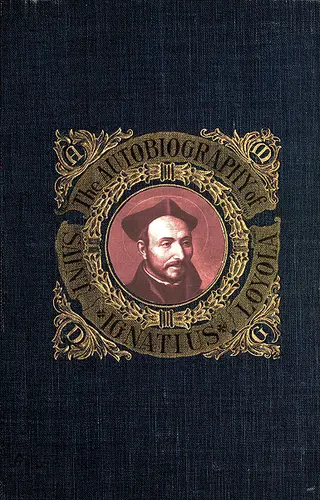
THE CLASSIC COLLECTION · 1900
"The Autobiography of St. Ignatius" by Saint Ignatius of Loyola is a spiritual memoir written in the early 16th century. The book recounts the profound personal transformation of Ignatius, highlighting his military past, intense spiritual experiences, and the founding of the Society of Jesus. The text offers readers an intimate look into his struggles with vanity and ambition, his recovery from a serious injury, and the gradual awakening of his spiritual purpose. The beginning of the autobiography portrays Ignatius as a man enthralled by worldly pursuits, particularly in his military career, until he is injured at the siege of Pampeluna. During his lengthy recovery, he begins reading about the lives of saints, which ignites a deeply spiritual yearning within him. The narrative describes his inner conflict as he grapples with returning to worldly fears versus embracing a life devoted to God. His epiphany leads him to forego his former ways and commit to a path of penance and service, eventually influencing many around him and setting the stage for his future endeavors in forming the Jesuit order.
Introduction adapted from the source catalogue; source summaries may be automatically generated.
Free to read · English · 22,811 words · No account needed
MAKE TIME FOR A GOOD BOOK
On by default. Untick to stop anonymous reading totals. Each page counts after 10 seconds in view. How this works.
Anonymous counting is on unless you have switched it off.
In 1542 the College of Coimbra, in Portugal, arose. In 1546 St. Francis Borgia founded the College of Gandia. In 1556 the College of Ingolstadt was founded. In 1552 a college was founded at Vienna, and in 1556 one at Prague. In 1553 the Roman College was fully founded. And in 1568 the colleges at Lima, Peru.
The German College founded in Rome by St. Ignatius produced many
remarkable men.
From it came 1 pope, Gregory XV, 24 cardinals, 6 electors of the Empire, 19 princes, 21 archbishops, 121 titular bishops, 100 bishops in partibus infidelium, 6 abbots or generals of religious orders, 11 martyrs of faith, 13 martyrs of charity, and 55 others, conspicuous for piety and learning.
This was at the end of the eighteenth century. In our own time in one classroom Father Cardella counted seventeen different orders of all different nationalities present at the lectures of theology in the Roman College.
The Roman College was the type of the Jesuit College. It was begun by Francis Borgia, in 1551, at the foot of the Capitol in Rome, with fourteen members of the Order and Father John Peltier, a Frenchman, as Superior.
The professors taught rhetoric and three languages,--Hebrew, Greek, and Latin. There were present there at a given time 2107 students, 300 in theology. The most eminent professors filled the chairs: theologians like Suarez and Vasquez; commentators such as Cornelius a Lapide and Maldonatus; founders of national history schools, as Mariana and Pallavicini; Clavius, reformer of the Gregorian Calendar; Kircher, universal in the exact sciences, while the other colleges throughout the world remained provided with their own required forces and maintained their own prestige.
From this college came forth distinguished men in every line of intellectual life, and general eminence, men of elevated thought and of noble and generous minds. In particular three characters came--young men that were to fill with admiration of their greatness the succeeding century.
Stanislaus Kostka, a Polish noble who died at seventeen years of age; Aloysius Gonzaga, an Italian prince of twenty-three; and John Berchmans, a Flemish townsman of twenty-two.
Among some of the famous men educated by the Jesuits we find Bossuet, Corneille, Moliere, Tasso, Fontenelle, Diderot, Voltaire, and Bourdaloue, himself a Jesuit.
When Pere Poree replied to the remark that he was not one of the great poets, he said, "At least you may grant that I have been able to make some of them." A few others were Descartes, Buffon, Justus Lipsius, Muratori the historian, Calderon, and Vico, the author of "Ideas of History," Richelieu, Tilly, Malesherbes, Don John of Austria, Luxembourg, Esterhazy, Choiseul, St. Francis de Sales, Lambertini, afterward Benedict XIV, the most learned of the popes, and the present Pontiff, Pope Leo XIII, renowned for his learning and wisdom.
Your reading position is saved on this browser. Take it to another device with a library code. Reading pages adapt to text, rather than matching a printed edition.
of Loyola, Saint Ignatius & Charles Coppens
BEHIND THE BOOK
This eBook is for the use of anyone anywhere in the United States and most other parts of the world at no cost and with almost no restrictions whatsoever. You may copy it, give it away or re-use it under the terms of the Project Gutenberg License included with this eBook or online at www.gutenberg.org. If you are not located in the United States, you will have to check the laws of the country where you are located before using this eBook. Read the source licence.
The original source file, including credits and licence, is retained by this library. Request an original-format copy at no charge. Please include the book title and Project Gutenberg identifier #24534.
KEEP YOUR CURIOSITY GOING

David Patterson (Spirit) Hatch

David Patterson (Spirit) Hatch

David Patterson (Spirit) Hatch
Cécile Tormay

Moritz Busch
John L. Ransom