THE CLASSIC COLLECTION✦In quest of the perfect bookCLASSIC FREE BOOKS
In quest of the perfect book
William Dana Orcutt
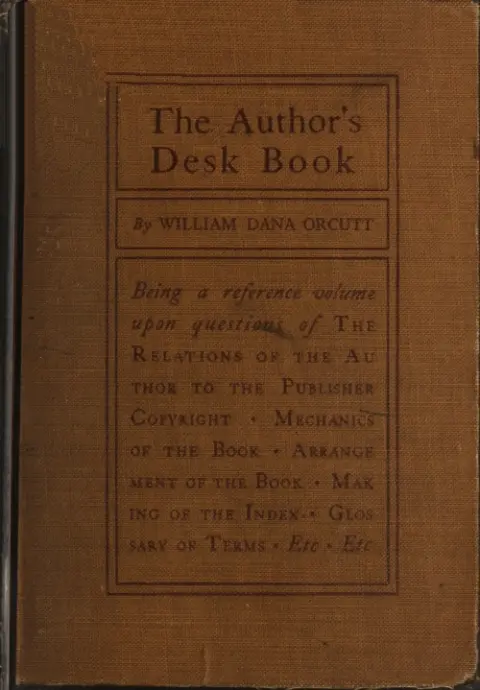
THE CLASSIC COLLECTION · 1914
"The Author's Desk Book" by William Dana Orcutt is a reference manual that serves as a comprehensive guide on the relationship between authors and publishers, including aspects of copyright law, manuscript submission, and the mechanics of book production, written in the early 20th century. The book discusses the intricacies involved in publishing, focusing on mutual responsibilities and the importance of cooperation between authors and publishers for successful literary ventures. The opening of this volume introduces the fundamental aspects of the relationships between authors and publishers, highlighting the essential nature of mutual trust and understanding in this often complex interaction. Orcutt emphasizes that while both parties aim for success, misunderstandings can arise due to differences in business acumen, especially since many authors are not well-versed in the intricacies of the publishing industry. He also touches on the role of literary agents and the significance of contracts, underscoring the evolving nature of publishing rights, particularly in light of new media such as film adaptations. Throughout this portion, Orcutt lays the groundwork for a deeper exploration of the practicalities and legalities that govern literary creation and distribution.
Introduction adapted from the source catalogue; source summaries may be automatically generated.
Free to read · English · 39,202 words · No account needed
MAKE TIME FOR A GOOD BOOK
On by default. Untick to stop anonymous reading totals. Each page counts after 10 seconds in view. How this works.
Anonymous counting is on unless you have switched it off.
=Embossing= (g).--The process of stamping leather, cloth, or paper with a plate for the purpose of producing a raised or relief effect.
=Embossing Plate= (e).--A plate cut or etched below the surface for the purpose of raising the image of the printed surface.
=En= (c).--One half the width of an em body.
=Enameled Paper= (g).--See Super-calendered Paper.
=End-papers= (b).--Usually known to the public as fly-leaves. The white or colored sheets placed by the binder at the beginning and end of a volume, one-half being pasted down upon the inside of the cover.
=English= (c).--The old-style name of a size of type equal to
14-point.
=English Finish Paper= (g).--A finished-surface paper, with a duller surface than super-calendered.
=English Linen or Low Buckram= (b).--A linen cloth, highly polished,
well colored and durable.
=Engraving= (g).--A picture or design cut or etched on metal or wood.
=Etching= (e).--A process of engraving in which the plate after being varnished is smoked, and the design or drawing is then cut through the varnish, afterwards being treated with acid which eats into the exposed parts of the metal.
=Extra Binding= (b).--A trade name for the hand-sewed and hand-bound
book.
=Extra Cloths= (b).--These in the plain finish and the various patterns are largely used for binding works of fiction, and are among the most expensive grades of book cloth. The fabric is heavily coated with color, entirely concealing the weave, producing a solid color surface.
=Extract= (g).--A passage taken from a book or work; a quotation,
excerpt, citation.
=Fanfare= (b).--A style of binding in which there is great profusion and repetition of flowers, foliage, and other small ornaments.
=Figure= (b).--A cut or diagram inserted in printed text.
=Fillet= (b).--A cylindrical instrument upon which simple lines are engraved, used in finishing.
(c).--A rule with broad or broad and narrow lines.
=Finisher= (el).--A workman who performs the final operations in
plate-making.
(b).--The workman who does hand-tooling, and performs the final operation or finishing on extra-bound books.
=Finishing= (b).--The part of a binder's work which consists in lettering and ornamenting the cover.
=FL Pattern= (b).--Embossing known as Fancy Line. A special design and very popular for diaries, blank books, and other similar lines.
=Flexible= (b).--When a book is sewed on raised bands and the sewing thread passed entirely around each band. A term applied also to the covers of the book, as for example, full flexible or entirely limp or semi-flexible, when a thin board or heavy paper is used in making the cover.
=Floret= (c).--A flower or leaf-shaped ornament.
Your reading position is saved on this browser. Take it to another device with a library code. Reading pages adapt to text, rather than matching a printed edition.
William Dana Orcutt
William Dana Orcutt
William Dana Orcutt
William Dana Orcutt
BEHIND THE BOOK
This eBook is for the use of anyone anywhere in the United States and most other parts of the world at no cost and with almost no restrictions whatsoever. You may copy it, give it away or re-use it under the terms of the Project Gutenberg License included with this eBook or online at www.gutenberg.org. If you are not located in the United States, you will have to check the laws of the country where you are located before using this eBook. Read the source licence.
The original source file, including credits and licence, is retained by this library. Request an original-format copy at no charge. Please include the book title and Project Gutenberg identifier #53520.
KEEP YOUR CURIOSITY GOING

Charles G. (Charles Griffith) Ross
Hannah Webster Foster

Emily Lawless
Edwin Hamlin Carr

Charles De Lano Hine
Andrew Ure