THE CLASSIC COLLECTION✦In quest of the perfect bookCLASSIC FREE BOOKS
In quest of the perfect book
William Dana Orcutt
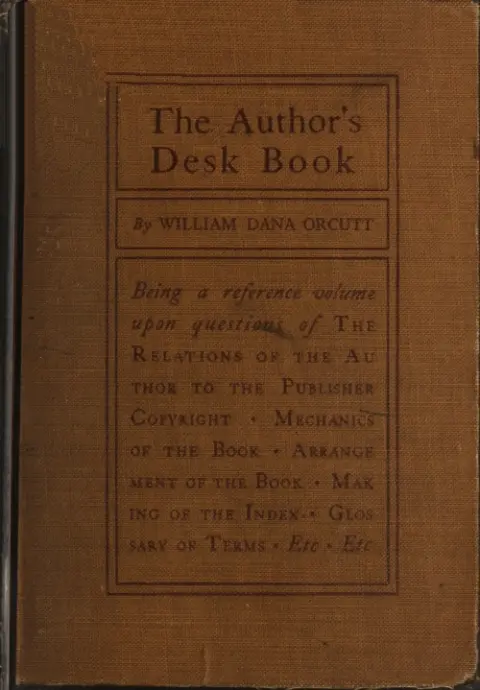
THE CLASSIC COLLECTION · 1914
"The Author's Desk Book" by William Dana Orcutt is a reference manual that serves as a comprehensive guide on the relationship between authors and publishers, including aspects of copyright law, manuscript submission, and the mechanics of book production, written in the early 20th century. The book discusses the intricacies involved in publishing, focusing on mutual responsibilities and the importance of cooperation between authors and publishers for successful literary ventures. The opening of this volume introduces the fundamental aspects of the relationships between authors and publishers, highlighting the essential nature of mutual trust and understanding in this often complex interaction. Orcutt emphasizes that while both parties aim for success, misunderstandings can arise due to differences in business acumen, especially since many authors are not well-versed in the intricacies of the publishing industry. He also touches on the role of literary agents and the significance of contracts, underscoring the evolving nature of publishing rights, particularly in light of new media such as film adaptations. Throughout this portion, Orcutt lays the groundwork for a deeper exploration of the practicalities and legalities that govern literary creation and distribution.
Introduction adapted from the source catalogue; source summaries may be automatically generated.
Free to read · English · 39,202 words · No account needed
MAKE TIME FOR A GOOD BOOK
On by default. Untick to stop anonymous reading totals. Each page counts after 10 seconds in view. How this works.
Anonymous counting is on unless you have switched it off.
=Dead Matter= (g).--Type or plates for which there is no further use.
=Deckle-edges= (g).--The rough, natural edges of hand-made paper. Deckle-edges are also formed on two edges of machine-made paper. They are poorly imitated by cutting or tearing paper.
=Dedication= (g).--An address prefixed to a literary composition, inscribed to a patron or a friend as a mark of respect or affection.
=Deep Etching= (e).--Additional etching made necessary to secure proper printing depth where this cannot be accomplished by routing, and usually caused by the use of dense black lines, or line negatives and halftone negatives being combined in one plate.
=Dentelle= (b).--A fine, tooled border resembling lacework.
=Descending Letters= (c).--Letters that descend below the type body,
as g, p, q, etc.
=Devil= (g).--The printer's errand boy or apprentice.
=Dies= (b).--Brass, zinc, or heavy electro plates used for embossing or stamping on covers the lettering and ornamental designs.
=Display= (c).--Composition in which different styles or sizes of type are used, such as on a title-page.
=Distributing= (c).--Returning types to their respective boxes.
=Divinity Calf= (b).--A dark-brown calf binding, decorated with blind-stamping and without gilding.
=Divinity Edges= (b).--See Circuit Edges.
=Doublé= (b).--The ornamented inside of the cover of a book, made with tooled leather, silk, or other material. Also termed doublure.
=Doubletone Ink= (p).--An ink in which the linseed oil medium, ordinarily transparent, is tinted with a lighter shade of the color. When this sinks into the paper, it automatically prints a second shade.
=Drop-folio= (c).--A page number, placed at the bottom of a page.
=Duck= (b).--Often called Canvas. A heavy cotton cloth, firmly woven and smooth. It is a desirable cloth for heavy books.
=Dummy= (g).--Pages of a book put together so as to show the general format of the finished book.
=Duodecimo= (g).--When a sheet of book paper is folded in twelve leaves it is called a duodecimo or 12mo.
=Duograph= (e).--Two halftone plates made from one copy, and usually printed in black and one tint, or two shades of the same color, the two plates made with different screen angles.
=Duotype= (e).--Two halftone plates made from one copy, both from the same negative and etched differently.
=Edition Work= (b).--Books bound in large numbers, as distinguished from single books or jobbing.
=Electrotype= (el).--A replica of composed type, plates, etc., forming a printing surface. This is produced by covering an impression made from the set type, etc., in wax or similar substance, with a galvanic coating of copper which is afterwards backed up by an alloy.
=Em= (c).--The square of any type body.
Your reading position is saved on this browser. Take it to another device with a library code. Reading pages adapt to text, rather than matching a printed edition.
William Dana Orcutt
William Dana Orcutt
William Dana Orcutt
William Dana Orcutt
BEHIND THE BOOK
This eBook is for the use of anyone anywhere in the United States and most other parts of the world at no cost and with almost no restrictions whatsoever. You may copy it, give it away or re-use it under the terms of the Project Gutenberg License included with this eBook or online at www.gutenberg.org. If you are not located in the United States, you will have to check the laws of the country where you are located before using this eBook. Read the source licence.
The original source file, including credits and licence, is retained by this library. Request an original-format copy at no charge. Please include the book title and Project Gutenberg identifier #53520.
KEEP YOUR CURIOSITY GOING

Charles G. (Charles Griffith) Ross
Hannah Webster Foster

Emily Lawless
Edwin Hamlin Carr

Charles De Lano Hine
Andrew Ure