THE CLASSIC COLLECTION✦An outlaw’s diary: the CommuneCLASSIC FREE BOOKS
An outlaw’s diary: the Commune
Cécile Tormay
THE CLASSIC COLLECTION · 1865
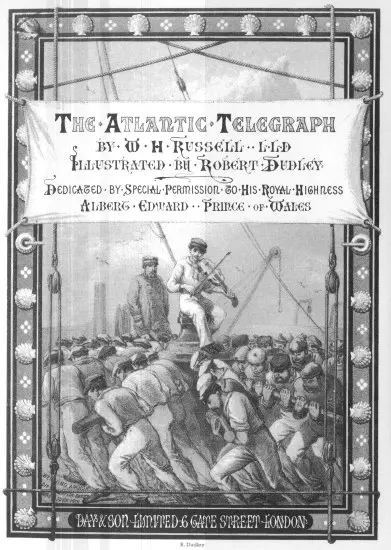
"The Atlantic Telegraph" by Sir William Howard Russell is a historical account written in the mid-19th century. This work delves into the ambitious project of laying the first telegraph cable across the Atlantic Ocean, chronicling the efforts and challenges faced by the engineers and inventors involved. Russell’s narrative likely emphasizes the technological advancements of the period and the historical significance of this endeavor in connecting Europe and North America. At the start of the narrative, the author provides a background on the history of electrical science and telegraphy, outlining the challenges faced by pioneers in the field. He references early experimental work by notable figures and discusses the evolution of ideas leading up to submarine telegraphy. As the chapter unfolds, Russell introduces characters like Cyrus Field, who plays a pivotal role in advocating for the transatlantic cable, summarizing the project’s origins, obstacles, and the determination of those who believed in the project’s potential to forever alter communication across the oceans. The opening sets a detailed stage for the epic tale of innovation intertwined with human ambition and the quest for connection.
Introduction adapted from the source catalogue; source summaries may be automatically generated.
Free to read · English · 55,317 words · No account needed
MAKE TIME FOR A GOOD BOOK
On by default. Untick to stop anonymous reading totals. Each page counts after 10 seconds in view. How this works.
Anonymous counting is on unless you have switched it off.
August 11th.--Nothing to record of the night and early morning, save that both were fine, and that the capstan took in the iron fishing-line easily till 5·20 a.m., ship’s time, when the grapnel came up to the bows. The cause of the failure was at once explained: the grapnel could not have caught the Cable, because in going down, or in dragging at the bottom, the chain of the shank had caught round one of the flukes. From the condition of the rope it was calculated that we were in only 1,950 fathoms of water, for nearly 500 fathoms of it were covered with the grey ooze of the bottom. The collectors scraped away at the precious gathering all the morning, and for a time forgot their sorrows.
It was now a dead calm, and Mr. Canning mustered his forces for another attempt for the Cable! He overhauled the wire rope, and exorcised hawsers out of crypts all over the ship.
“Hope lives eternal in the human breast.”
Although the previous trials, with better gear, had proved unsuccessful; although the tackle now used was a thing of shreds and patches; although Mr. Canning and others said, “We are going to make this attempt because it is our duty to exhaust every means in our power,” and thereby implied they had little or no confidence of success; there was scarcely a man in the ship who did not think “there is just a chance,” and who would not have made the endeavour had the matter been left to his own decision. It was some encouragement to ascertain that there were only 1,950 fathoms of water below us. It was argued that, if the Cable could be broken at the bight, another drift about a mile from the loose end would be certain to succeed, as the loose end would twist round the eastward portion of the Cable, and come up at a diminished strain to the surface. A grapnel with a shorter shank was selected for the next trial. The cablemen were set to work to coil down the new rope and hawsers between a circular enclosure, formed by uprights on the deck behind the capstan. Ropemakers and artificers examined the rope which had been already used. They served the injured strands with yarn, renewed portions chafed to death, tested bolts and shackles and swivels, and bent on new lengths of rope and hawser, whilst the ship was proceeding to take up her position for another demonstration against the Cable. The line now employed, the last left in the ship, was a thing of shreds and patches. It consisted of 1,600 fathoms of wire rope, 220 fathoms of hemp, and 510 fathoms of Manilla hawser, of which 1,760 fathoms could be depended upon, the rest being “suspicious.” The morning was not very fine; but the wind was light, and on the whole favourable, and the only circumstance to cause doubt or uneasiness was the current, the influence of which could not be determined. The observations of the officers rendered it doubtful whether the buoy No. 2 had drifted, and it was rather believed that in the interval between the breaking of the grapnel and the letting-go of the buoy, the Great Eastern herself had drifted from the place, and thus caused the apparent discrepancy in position. At 7·45 a.m. the ship was alongside buoy No. 2 once more, and thence proceeded to an advantageous bearing for drifting down on the Cable with her grapnel. The Terrible kept about two miles away, regarding our operations with a melancholy interest. At 11·30 a.m., ship’s time, the Great Eastern signalled “We are going to make a final effort,” and soon afterwards, “We are sorry you have had such uncomfortable waiting.” At 1·56 p.m., Greenwich time, when buoy No. 2 was bearing E. by N. about two miles, the ship’s head being W. and by S., the grapnel was let go, and soon reached the bottom, as the improvements in the machinery and capstan enabled the men to pay it out at the rate of fifty fathoms a minute. The fore-and-aft canvas was set, to counteract the force of the current, and the Great Eastern drifted to N.E, right across the Cable, before a light breeze from S.W. At first there was only a strain of 42 cwt. shown, and the ship went quite steadily and slowly towards the Cable. At 3·30 p.m. the strain increased, and then the Great Eastern gave some little sign of feeling a restraint on her actions from below, her head describing unsteady lines from W.N.W. to W. by S. The screw engines were gently brought into play to keep her head to the wind. The machinery and capstan, which had been put in motion some time previously to haul in the grapnel cable, now took it in easily and regularly, except when a shackle or swivel jarred it for a moment. Every movement of the ship was most keenly watched, till the increasing strain on the dynamometer showed that the same grip on the bottom which had twice turned the head of the Great Eastern, was again placed on the grapnel she was dragging along the bottom of the Atlantic. The index of the dynamometer rose: it marked 60 cwt., then it jerked up to 65 cwt., then it reached 70 cwt., then 75 cwt.: at last its iron finger pointed to 80 cwt. It was too much to stand by and witness the terrible struggle between the crisping, yielding hawser, which was coming in fast, the relentless iron-clad capstan, and the fierce resolute power in the black sea, which seemed endued with demoniacal energy as it tugged and swerved to and fro on the iron hook. But it was beyond peradventure that the Atlantic Cable had been hooked and struck, and was coming up from its oozy bed. What alternations of hope and fear--what doubts, what sanguine dreams, dispelled by a moment’s thought, only to revive again! What need to say how men were agitated on board the ship? There was in their breasts, those who felt at all, that intense quiet excitement with which we all attend the utterance of a supreme decree, final and irrevocable. Some remained below in the saloons--fastened their eyes on unread pages of books, or gave expression to their feelings in fitful notes from piano or violin. Others went aft to the great Sahara of deck where all was lifeless now, and whence the iron oasis had vanished. Some walked to and fro in the saloon; others paced the deck amidships. None liked to go forward, where every jar of the machinery, every shackle that passed the drum, every clank, made their hearts leap into their mouths. Captain Anderson, Mr. Canning, Mr. Clifford, and the officers and men engaged in working the ship and taking in the grapnel, were in the bows of course, and shared in the common anxiety. At dinner-time 500 fathoms of grapnel rope had been taken in, and the strain was mounting beyond 82 cwt. Nothing else could be talked of. The boldest ventured to utter the words “Heart’s Content” and “Newfoundland” once more. All through the unquiet meal we could hear the shrill whistle through the acoustic tube from the bow to the bridge, which warned the quartermasters to stop, reverse, or turn ahead the screw engines to meet the exigencies of the strain on the grapnel rope. The evening was darkling and raw. At 6·30 I left the saloon, and walked up and down the deck, under the shelter of the paddle-box, glancing forward now and then to the bow, to look at the busy crowd of engineers, sailors, and cablemen gathered round the rope coming in over the drum, which just rose clear of one of the foremasts, and listening to the warning shouts as the shackles came inboard, and hurtled through the machinery till they floundered on the hurricane deck.
Your reading position is saved on this browser. Take it to another device with a library code. Reading pages adapt to text, rather than matching a printed edition.
BEHIND THE BOOK
This eBook is for the use of anyone anywhere in the United States and most other parts of the world at no cost and with almost no restrictions whatsoever. You may copy it, give it away or re-use it under the terms of the Project Gutenberg License included with this eBook or online at www.gutenberg.org. If you are not located in the United States, you will have to check the laws of the country where you are located before using this eBook. Read the source licence.
The original source file, including credits and licence, is retained by this library. Request an original-format copy at no charge. Please include the book title and Project Gutenberg identifier #40948.
KEEP YOUR CURIOSITY GOING
Cécile Tormay

Moritz Busch
John L. Ransom
Frances Wright
Cécile Tormay

Mabel Potter Daggett