THE CLASSIC COLLECTION✦An outlaw’s diary: the CommuneCLASSIC FREE BOOKS
An outlaw’s diary: the Commune
Cécile Tormay
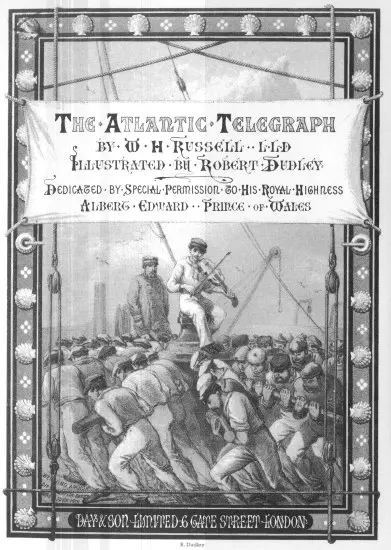
THE CLASSIC COLLECTION · 1865
"The Atlantic Telegraph" by Sir William Howard Russell is a historical account written in the mid-19th century. This work delves into the ambitious project of laying the first telegraph cable across the Atlantic Ocean, chronicling the efforts and challenges faced by the engineers and inventors involved. Russell’s narrative likely emphasizes the technological advancements of the period and the historical significance of this endeavor in connecting Europe and North America. At the start of the narrative, the author provides a background on the history of electrical science and telegraphy, outlining the challenges faced by pioneers in the field. He references early experimental work by notable figures and discusses the evolution of ideas leading up to submarine telegraphy. As the chapter unfolds, Russell introduces characters like Cyrus Field, who plays a pivotal role in advocating for the transatlantic cable, summarizing the project’s origins, obstacles, and the determination of those who believed in the project’s potential to forever alter communication across the oceans. The opening sets a detailed stage for the epic tale of innovation intertwined with human ambition and the quest for connection.
Introduction adapted from the source catalogue; source summaries may be automatically generated.
Free to read · English · 55,317 words · No account needed
MAKE TIME FOR A GOOD BOOK
On by default. Untick to stop anonymous reading totals. Each page counts after 10 seconds in view. How this works.
Anonymous counting is on unless you have switched it off.
7. At 50 minutes signals will be sent to the shore, and for the ordinary signals 5 reversals, 2 minutes each, commencing C to E.
8. Then a repetition of the same tests to be made and continued
without any interval.
9. In case it becomes necessary to speak to shore by speaking instruments, the signal will be given at the 50 minutes, and at the 30 minutes, as in paragraph 5, by sending 8¼ minutes’ reversals, commencing Z to E, and changing over to the speaking instruments, on receiving acknowledgment of call from shore (which will be also 8¼ minutes’ reversals), communication or message to be sent, and when acknowledgment of message and reply (if any) is received, then the system of testing is to be resumed, as if no interruption had taken place.
10. Every 50 nauts. of Cable payed-out will be signalled at the same time (viz., at the 50 mins.), thus, instead of 5 reversals of 2 minutes, 10 reversals of 1 minute will be made commencing Z to E.
11. Every 50 nauts. distance run will be signalled to the shore; the signal will be 2 reversals (commencing Z to E), each 2 minutes’ duration--2 reversals, each 1 minute’s duration, and 2 reversals, each 2 minutes’ duration.
12. Should any defect in signals be perceived, or bad time kept, notice will be given to the shore by signalling at the 50 minutes--thus, by giving 2 reversals of 5 minutes’ duration, commencing Z to E.
13. In sounding, signal will be one current of 10 minutes’
duration, Z to E.
14. Land-in-sight signal will be likewise one current of 10
minutes’ duration, Z to E.
15. Greenwich time will be kept, but a column will be devoted in journals and sheets to ship’s time.
16. After the insulation test is taken, it is to be worked out thus--The same deflection at the 15th minute’s reading will be obtained with the same battery through resistance, and a shunt to the galvanometer. The amount of resistance multiplied by multiplying power of the shunt, and galvanometer multiplied by the length of the Cable, will give the G. p. R. pr. nt.
17. The copper resistance of the Cable will be taken after 5
minutes’ electrification.
18. No change in the instruments, wires, or connections (other than the batteries, if necessary), to be made on any account, unless such instruments, &c., become defective--any necessary change to be made as quickly as possible.
19. Should the rolling of the ship generate a magnetic current of sufficient strength to embarrass the signals, a stronger current for the signals will be put on on shore, and a shunt used with the galvanometer on board, notice to the shore to put on more power will be given by one current of 5 minutes, commencing Z to E, and 5 reversals of 1 minute’s duration.
Your reading position is saved on this browser. Take it to another device with a library code. Reading pages adapt to text, rather than matching a printed edition.
BEHIND THE BOOK
This eBook is for the use of anyone anywhere in the United States and most other parts of the world at no cost and with almost no restrictions whatsoever. You may copy it, give it away or re-use it under the terms of the Project Gutenberg License included with this eBook or online at www.gutenberg.org. If you are not located in the United States, you will have to check the laws of the country where you are located before using this eBook. Read the source licence.
The original source file, including credits and licence, is retained by this library. Request an original-format copy at no charge. Please include the book title and Project Gutenberg identifier #40948.
KEEP YOUR CURIOSITY GOING
Cécile Tormay

Moritz Busch
John L. Ransom
Frances Wright
Cécile Tormay

Mabel Potter Daggett