THE CLASSIC COLLECTION✦An outlaw’s diary: the CommuneCLASSIC FREE BOOKS
An outlaw’s diary: the Commune
Cécile Tormay
THE CLASSIC COLLECTION · 1865
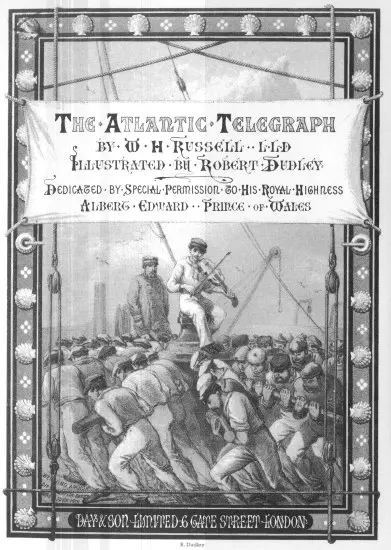
"The Atlantic Telegraph" by Sir William Howard Russell is a historical account written in the mid-19th century. This work delves into the ambitious project of laying the first telegraph cable across the Atlantic Ocean, chronicling the efforts and challenges faced by the engineers and inventors involved. Russell’s narrative likely emphasizes the technological advancements of the period and the historical significance of this endeavor in connecting Europe and North America. At the start of the narrative, the author provides a background on the history of electrical science and telegraphy, outlining the challenges faced by pioneers in the field. He references early experimental work by notable figures and discusses the evolution of ideas leading up to submarine telegraphy. As the chapter unfolds, Russell introduces characters like Cyrus Field, who plays a pivotal role in advocating for the transatlantic cable, summarizing the project’s origins, obstacles, and the determination of those who believed in the project’s potential to forever alter communication across the oceans. The opening sets a detailed stage for the epic tale of innovation intertwined with human ambition and the quest for connection.
Introduction adapted from the source catalogue; source summaries may be automatically generated.
Free to read · English · 55,317 words · No account needed
MAKE TIME FOR A GOOD BOOK
On by default. Untick to stop anonymous reading totals. Each page counts after 10 seconds in view. How this works.
Anonymous counting is on unless you have switched it off.
At 9·40 a.m., just as the buoy had gone over, a boat came alongside from the Terrible, and Mr. Prowse, the First Lieutenant, boarded us to know what we were going to do, to compare latitude and longitude, and to report to Captain Napier the decision arrived at by the gentlemen connected with the management of the Expedition. The Great Eastern had still about 3,500 tons of coal remaining, and the Terrible could wait three days more, and still keep coal enough to enable her to reach St. John’s. At 11·30 the Great Eastern stood down to the second buoy, for the purpose of fixing its exact locality by observation. Soon afterwards the weather grew threatening, and at 2 p.m. we were obliged to put her head to the sea, which gradually increased till the Great Eastern began for the first time to give signs and tokens that she was not a fixture. The Terrible stood on ahead on our port side, and for some time we kept the buoy equi-distant between us. At night, the wind increased to half a gale, and it was agreed on all sides that though the Great Eastern could have paid out the Cable with the utmost ease, she could not have picked up, and certainly could not have kept the grapnel line and Cable under her bows in such weather. But the steadiness of the vessel was the constant theme of praise. During the night she just kept her head to the sea. The Terrible, which got on our port and then on our starboard bow, signalled to us not to come too close, and before midnight her lights were invisible on our port quarter--one funnel down.
Aug. 9th.--Our course was W.N.W. during the night; weather thick and rainy--strong southerly wind; sea running moderately high. At 6 a.m., having run by reckoning 35 miles from the buoy, our course was altered to E.S.E., so as to bring us back to it. The state of the weather delayed the artificers in their work. It rained heavily, the deck was by no means a horizontal plane, and it was doubtful if Mr. Canning and Mr. Clifford, using all possible diligence, could get tackle and machinery in order before the following forenoon, so that it was not necessary to make any great speed. The reputation of the ship was enhanced in the eyes and feelings of her passengers by the manner in which she had behaved in the undoubtedly high breeze and heavy sea. The former was admitted by sailors to be a “gale,” though they seemed to think the force of the wind was affected by the addition of the prefix “summer,” as if it mattered much at what time of the year a gale blows. The latter, when we turned tail and went before it, soon developed a latent tendency in the Great Eastern to obey the rules governing bodies floating on liquids under the action of summer gales. She rolled with a gravity and grandeur becoming so large a ship once in every 11 or 12 seconds; but on descending from the high decks to the saloon, one found no difficulty in walking along from end to end of it without gratuitous balancings or unpremeditated halts and progresses. It was a grey, gloomy, cloudy sea and sky--not a sail or a bird visible. In the forenoon the Terrible came in sight, lying-to with her topsail set, and it was hoped she was somewhere near the buoy. At noon our position was ascertained by observation to be Lat. 51° 29´ 30´, Long. 39° 6´ 0´´. Great Eastern, as soon as she was near enough, asked the Terrible, “Do you see the buoy?” After a time, the answer flew out, “No.” Then she added that she was “waiting for her position,” and that she “believes the buoy to be S.S.E.” of us. Our course was altered S. by E. ½ E, and the look-out men in the top swept the sea on all sides. The Terrible also started on the search. At 3·20 p.m. the two ships were within signalling distance again--sea decreasing, wind falling fast. The Terrible asked, “Did you see buoy?” which was answered in negative, and then inquired if the Great Eastern was going to grapple again, which was replied to in the affirmative--Captain Anderson busy in one cabin and Staff-Commander Moriarty busy in another, working diagrams and calculations, and coming nearer and nearer to the little speck which fancies it is hidden in the ocean: with very good reason, too, for the search after such an object on such a field as the Atlantic, ruffled by a gale of wind, might well be esteemed of very doubtful success. But the merchant captain and the naval staff-commander were not men to be beaten, and in keen friendly competition ran a race with pencils and charts to see who could determine the ship’s position with the greatest accuracy, being rarely a mile apart from each other in the result. The only dubious point related to the buoy itself, for it might have drifted in the gale, it might have gone down at its moorings, or the Cable might have parted. There were strong currents, as well as winds and waves. The moment the weather moderated in the forenoon, the whole body of smiths and carpenters, and workers in iron, metal, and wood, were set to work at the alterations in the machinery for letting out the grapnel and taking it in again. A little army of skilled mechanics were exercising on deck; workshops and forges were established, and some of the many chimneys which rise above the bulwarks of the Great Eastern, and put one in mind of the roofs of the streets seen from the railway approaches to London, began to smoke. The smiths forged new pins for the swivels, and made new shackles and swivels; the carpenters made casings for capstan; ropemakers examined and secured the lengths of wire rope, and a new hawser was bent on to make up for the deficiency of buoy rope. At last, the much-sought-for object was discovered--the buoy was visible some 2 miles distant. The Great Eastern made haste to announce the news to the Terrible, and just as her flags were going aloft, a fluttering of bunting was visible in the rigging of the Terrible, and the signalman read her brief statement that the buoy was where we saw it was, thus proving that both vessels dropped on it at the same time. The finding of the little black point on the face of the Atlantic was a feat of navigation which gave great satisfaction to the worthy performers and the spectators. A little before 5 o’clock the Great Eastern was abreast of the buoy. The Terrible came up on the other side of it, and the Great Eastern and the man-of-war lay-to watching the tiny black ball, which bobbed up and down on the Atlantic swell, intending to stay by it as closely as possible till morning. By dint of energetic exertion, Mr. Canning hoped to have his grapnel and tackle quite ready the moment the ship was in position on the morrow. It was a sight to behold the deck at night--bare-armed Vulcans wielding the sledge--Brontes, Steropes, and Pyracmon at bellows, forge, and anvil--fires blazing--hailing sparks flashing along the decks--incandescent masses of iron growing into shape under the fierce blows--amateurs and artists admiring--the sea keeping watch and ward outside, and the hum of voices from its myriad of sentry waves rising above the clank of hammers which were closing the rivets up of the mail in which we were to do battle with old ocean for the captive he holds in his dismal dungeons below. Will he yield up his prisoner?
Your reading position is saved on this browser. Take it to another device with a library code. Reading pages adapt to text, rather than matching a printed edition.
BEHIND THE BOOK
This eBook is for the use of anyone anywhere in the United States and most other parts of the world at no cost and with almost no restrictions whatsoever. You may copy it, give it away or re-use it under the terms of the Project Gutenberg License included with this eBook or online at www.gutenberg.org. If you are not located in the United States, you will have to check the laws of the country where you are located before using this eBook. Read the source licence.
The original source file, including credits and licence, is retained by this library. Request an original-format copy at no charge. Please include the book title and Project Gutenberg identifier #40948.
KEEP YOUR CURIOSITY GOING
Cécile Tormay

Moritz Busch
John L. Ransom
Frances Wright
Cécile Tormay

Mabel Potter Daggett