THE CLASSIC COLLECTION✦An outlaw’s diary: the CommuneCLASSIC FREE BOOKS
An outlaw’s diary: the Commune
Cécile Tormay
THE CLASSIC COLLECTION · 1865
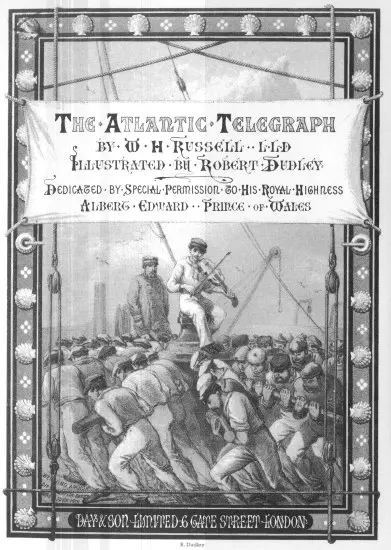
"The Atlantic Telegraph" by Sir William Howard Russell is a historical account written in the mid-19th century. This work delves into the ambitious project of laying the first telegraph cable across the Atlantic Ocean, chronicling the efforts and challenges faced by the engineers and inventors involved. Russell’s narrative likely emphasizes the technological advancements of the period and the historical significance of this endeavor in connecting Europe and North America. At the start of the narrative, the author provides a background on the history of electrical science and telegraphy, outlining the challenges faced by pioneers in the field. He references early experimental work by notable figures and discusses the evolution of ideas leading up to submarine telegraphy. As the chapter unfolds, Russell introduces characters like Cyrus Field, who plays a pivotal role in advocating for the transatlantic cable, summarizing the project’s origins, obstacles, and the determination of those who believed in the project’s potential to forever alter communication across the oceans. The opening sets a detailed stage for the epic tale of innovation intertwined with human ambition and the quest for connection.
Introduction adapted from the source catalogue; source summaries may be automatically generated.
Free to read · English · 55,317 words · No account needed
MAKE TIME FOR A GOOD BOOK
On by default. Untick to stop anonymous reading totals. Each page counts after 10 seconds in view. How this works.
Anonymous counting is on unless you have switched it off.
The feat of seamanship which was accomplished, and the work so nearly consummated, was so marvellous as to render its abrupt and profitless termination all the more bitter. The remarkable difficulty of such a task as Staff-Commander Moriarty and Captain Anderson executed cannot be understood without some sort of appreciation of the obstacles before them. The Atlantic Cable, as we sadly remember, dropped into the unknown abyss on Aug. 2. We had no soundings. In the night the Great Eastern drifted and steamed 25 miles from the end of the Cable--then bore away with a grapnel overboard, and 2,500 fathoms of wire rope attached, and steered so as to come across the course of the Cable at the bottom. On the morning of Aug. 3rd, the increasing strain on the line which towed the grapnel gave rise to hope at first, and finally to the certainty, that the ship had caught the Cable. At 3·20 o’clock, p.m., Greenwich time, when about 900 fathoms of grapnel line had been hauled in, the head of a swivel pin broke, and 1,400 fathoms of line, with grapnels and Atlantic Cable, went down to the bottom. Then the Great Eastern drifted again in a fog whilst preparing for another trial to drag the Cable up from the sea, and on 4th August, with an apparatus devised on board, got doubtful soundings, from which it was estimated that the water was about 2½ miles deep. A buoy placed on a raft, which sunk so deep that only a small flagstaff and black bulb were visible, was let go, with a mushroom anchor and 2½ miles of Cable attached to it, into this profound; but as it was not ready when the Cable broke, the buoy was slipped over at the distance of some miles from the place where the fatal fracture took place, in the hope and belief that the anchor would come up somewhere near the slack caused by the picking-up operations. Still in fog, which shut the Terrible out of sight, the Great Eastern prepared for another attempt. Next day (August 5), with the assistance of the Terrible, she came upon the buoy, and having steamed away to a favourable position, so as to come down on the course of the Cable again, remained drifting and steaming gently, on the look-out for the buoy, which it was very difficult to discover owing to the fog and to the current and winds acting on the ship. The weather did not permit any observations for longitude to be made during the whole of this period. On Aug. 7th we passed the buoy and steered N.W., and at 11·10 a.m., ship’s time, 1·47 p.m., Greenwich time, another grapnel, with 2,500 fathoms of wire rope, was thrown over, and the Great Eastern, with a favourable wind, was let drift down on the course of the Cable, about half way between the buoy and the broken end. At 12·5 ship’s time, the grapnel touched the bottom in 2,500 fathoms water, having sunk, owing to improved apparatus, in half the time consumed in the first operation. In six hours afterwards, the eyes which were watching every motion of the ship so anxiously, perceived the slightest possible indication that the grapnel was holding on at the bottom, and that the ship’s head was coming up towards the northward. It is not possible to describe the joyous excitement which diffused itself over the Great Eastern as, with slowly-increasing certitude, she yielded to the strain from the grapnel and its prize, and in an hour and a-half canted her head from E. by S. ½ S., to E. ¾ North. The screw was used to bring up her bow to the strain, and the machinery of the picking-up apparatus, much improved and strengthened, was set in motion to draw in the grapnel by means of the capstan and its steam power. The strain shown by the indicator increased from 48 cwt. to 66 cwt. in a short time; but the engines did their work steadily till 8·10, when one of the wheels was broken by a jerk, which caused a slight delay. The grapnel-rope was, however, hauled in by the capstan at a uniform rate of 100 fathoms in 40 minutes; but the strain went on gradually increasing till it reached 70 cwt. to 75 cwt. At 11·30 p.m., ship’s time, or 2·5 a.m., Greenwich, 300 fathoms were aboard, and at midnight all those who were not engaged on duty connected with the operation retired to rest, thankful and encouraged. In the words of our signal to the Terrible, all was going on “hopefully.” Throughout our slumbers the clank of the machinery, the shrill whistles to go on ahead, or turn astern, sounded till morning came, and when one by one the citizens of our little world turned up on deck, each felt, as he saw the wheels revolving and the wire rope uncoiling from the drums, that he was assisting at an attempt of singular audacity and success. A moonlight of great brightness, a night of quiet loveliness had favoured the enterprise, and the links of rope had come in one after another at a speed which furnished grounds for hope that if the end of the day witnessed similar progress, the Cable would be at the surface before nightfall.
Your reading position is saved on this browser. Take it to another device with a library code. Reading pages adapt to text, rather than matching a printed edition.
BEHIND THE BOOK
This eBook is for the use of anyone anywhere in the United States and most other parts of the world at no cost and with almost no restrictions whatsoever. You may copy it, give it away or re-use it under the terms of the Project Gutenberg License included with this eBook or online at www.gutenberg.org. If you are not located in the United States, you will have to check the laws of the country where you are located before using this eBook. Read the source licence.
The original source file, including credits and licence, is retained by this library. Request an original-format copy at no charge. Please include the book title and Project Gutenberg identifier #40948.
KEEP YOUR CURIOSITY GOING
Cécile Tormay

Moritz Busch
John L. Ransom
Frances Wright
Cécile Tormay

Mabel Potter Daggett