THE CLASSIC COLLECTION✦An outlaw’s diary: the CommuneCLASSIC FREE BOOKS
An outlaw’s diary: the Commune
Cécile Tormay
THE CLASSIC COLLECTION · 1865
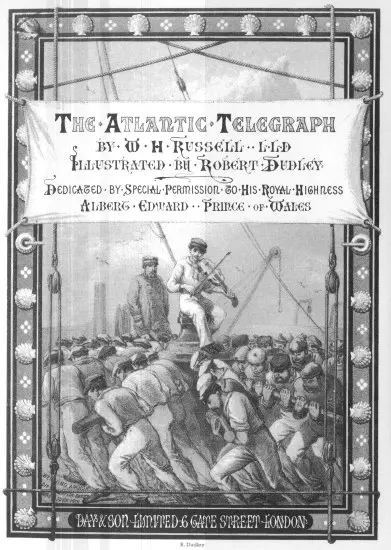
"The Atlantic Telegraph" by Sir William Howard Russell is a historical account written in the mid-19th century. This work delves into the ambitious project of laying the first telegraph cable across the Atlantic Ocean, chronicling the efforts and challenges faced by the engineers and inventors involved. Russell’s narrative likely emphasizes the technological advancements of the period and the historical significance of this endeavor in connecting Europe and North America. At the start of the narrative, the author provides a background on the history of electrical science and telegraphy, outlining the challenges faced by pioneers in the field. He references early experimental work by notable figures and discusses the evolution of ideas leading up to submarine telegraphy. As the chapter unfolds, Russell introduces characters like Cyrus Field, who plays a pivotal role in advocating for the transatlantic cable, summarizing the project’s origins, obstacles, and the determination of those who believed in the project’s potential to forever alter communication across the oceans. The opening sets a detailed stage for the epic tale of innovation intertwined with human ambition and the quest for connection.
Introduction adapted from the source catalogue; source summaries may be automatically generated.
Free to read · English · 55,317 words · No account needed
MAKE TIME FOR A GOOD BOOK
On by default. Untick to stop anonymous reading totals. Each page counts after 10 seconds in view. How this works.
Anonymous counting is on unless you have switched it off.
There was in this little world of ours as much ever-varying excitement, as much elation and depression, as if it were a focus into which converged the joys and sorrows of humanity. When the Great Eastern first became sensible of the stress brought upon her by the grappling iron and rope she shook her head, and kept on her course, disappointing the hopes of those who were watching the dynamometer, and who saw with delight the rising strain. This happened several times. It was for a long time doubtful whether the grapnel held to anything more tenacious than the ooze, which for a moment arrested its progress and then gave way with a jerk as the ship drifted; but in the early morning, the long steady pull made it evident the curved prongs had laid their grip on a solid body, which yielded slowly to the pressure of the vessel as she went to leeward, but at the same time resisted so forcibly as to slew round her bow. The scientific men calculated the force exercised by grapnel and rope alone to be far less than that now shown on the dynamometer. And if the Great Eastern had indeed got hold of a substance in the bottom of the Atlantic at once so tenacious and so yielding, what could it be but the lost Cable?
At 6·40 a.m., Greenwich time, the bow of the ship was brought up to the grapnel line. The machinery was set to work to pull up the 2,500 fathoms of rope. The index of the dynamometer, immediately on the first revolutions of the wheels and drums, rose to 85 cwt. The operation was of course exceedingly tedious, and its difficulty was increased by the nature of the rope, which was not made in a continuous piece, but in lengths of 100 fathoms each, secured by shackles and swivels of large size, and presumably of proportionate strength. It was watched with intense interest. The bows were crowded, in spite of the danger to which the spectators were exposed by the snapping of the wire-rope, which might have caused them serious and fatal injuries. At 7·15 o’clock, a.m., the first 100 fathoms of rope were in, and the great iron shackle and swivel at the end of the length were regarded with some feelings of triumph. At 7·55 a.m. the second length of 100 fathoms was on board, the strain varying from 65 to 75 cwt. At 8·10 a.m., when 400 fathoms had been purchased in and coiled away, the driving spur-wheel of the machinery broke, and the rope snapped, the strain being 90 cwt. at the time. The whole of the two miles of wire rope, grapnel and all, would have been lost, but that the stoppers caught the shackle at the end, and saved the experiment from a fatal termination. The operation was suspended for a short time, in order to permit the damage to be made good, and the rope was transferred to the capstan. The hazardous nature of the work, owing to the straining and jerking of the wire rope, was painfully evinced by the occurrence of accidents to two of the best men on Mr. Canning’s staff--one of whom was cut on the face, and the other had his jaw laid open. At noon nearly half a mile of rope was gathered in. With every length of Cable drawn up from the sea, the spirits of all on board became lighter, and whilst we all talked of the uncertainty of such an accomplishment, there was a sentiment stronger than any one would care to avow, inspiring the secret confidence that, having caught the Cable in this extraordinary manner, we should get it up at last, and end our strange eventful history by a triumphant entry to Heart’s Content. Already there were divers theories started as to the best way of getting the Cable on board, for if Mr. Canning ever saw the bight, the obvious question arose, “What will he do with it?” The whole of our speculations were abruptly terminated at 2·50 o’clock, p.m. As the shackle and swivel of the eleventh length of rope, which would have made a mile on board, were passing the machinery, the head of the swivel pin was wrung off by the strain, and the 1,400 fathoms of line, with grapnel attached, rushed down again to the bottom of the Atlantic, carrying with it the bight of Cable. The shock was bitter and sharp. The nature of the mishap was quite unforeseen. The engineers had calculated that the wire rope might part, or that the Cable itself might break at the bight, but no one had thought of the stout iron shackles and swivels yielding. To add to the gloominess of the situation, the fog, which had so long been hanging round the ship, settled down densely, and obliged the Great Eastern to proceed with extreme caution. But although the event damped, it did not extinguish, the hopes of the engineers. Mr. Canning and Mr. Clifford at once set their staff to bend 2,500 fathoms of spare wire rope to another grapnel, and to prepare a buoy to mark the spot as nearly as could be guessed where the rope had parted, and gone down with the bight of the Cable. The Great Eastern was to steam away to windward of the course of the Cable, and then drift down upon it about three miles west of the place where the accident occurred. Fog whistles were blown to warn the Terrible of our change of position, and at 1·30, ship’s time, the Great Eastern, as she steamed slowly away, fired a gun, to which a real or fancied response was heard soon afterwards. As she went ahead, guns were fired every 20 minutes, and the steam-whistles were kept going, but no reply was made, and she proceeded on her course alone. It was impossible to obtain a noon-day observation, and the only course to be pursued was to steam to windward for 14 or 15 miles, then to lay-to and drift, in the hope of procuring a favourable position for letting go the second grapnel, and catching the Cable once more.
Your reading position is saved on this browser. Take it to another device with a library code. Reading pages adapt to text, rather than matching a printed edition.
BEHIND THE BOOK
This eBook is for the use of anyone anywhere in the United States and most other parts of the world at no cost and with almost no restrictions whatsoever. You may copy it, give it away or re-use it under the terms of the Project Gutenberg License included with this eBook or online at www.gutenberg.org. If you are not located in the United States, you will have to check the laws of the country where you are located before using this eBook. Read the source licence.
The original source file, including credits and licence, is retained by this library. Request an original-format copy at no charge. Please include the book title and Project Gutenberg identifier #40948.
KEEP YOUR CURIOSITY GOING
Cécile Tormay

Moritz Busch
John L. Ransom
Frances Wright
Cécile Tormay

Mabel Potter Daggett