THE CLASSIC COLLECTION✦An outlaw’s diary: the CommuneCLASSIC FREE BOOKS
An outlaw’s diary: the Commune
Cécile Tormay
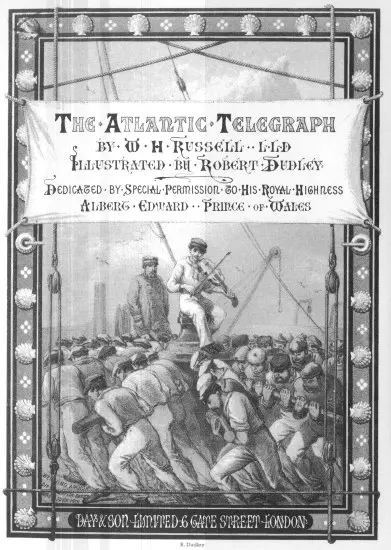
THE CLASSIC COLLECTION · 1865
"The Atlantic Telegraph" by Sir William Howard Russell is a historical account written in the mid-19th century. This work delves into the ambitious project of laying the first telegraph cable across the Atlantic Ocean, chronicling the efforts and challenges faced by the engineers and inventors involved. Russell’s narrative likely emphasizes the technological advancements of the period and the historical significance of this endeavor in connecting Europe and North America. At the start of the narrative, the author provides a background on the history of electrical science and telegraphy, outlining the challenges faced by pioneers in the field. He references early experimental work by notable figures and discusses the evolution of ideas leading up to submarine telegraphy. As the chapter unfolds, Russell introduces characters like Cyrus Field, who plays a pivotal role in advocating for the transatlantic cable, summarizing the project’s origins, obstacles, and the determination of those who believed in the project’s potential to forever alter communication across the oceans. The opening sets a detailed stage for the epic tale of innovation intertwined with human ambition and the quest for connection.
Introduction adapted from the source catalogue; source summaries may be automatically generated.
Free to read · English · 55,317 words · No account needed
MAKE TIME FOR A GOOD BOOK
On by default. Untick to stop anonymous reading totals. Each page counts after 10 seconds in view. How this works.
Anonymous counting is on unless you have switched it off.
It was 10·30 a.m., Greenwich time, when the Cable came in over the bow. We were now in very deep water, but had we been a few miles more to the west we should have been over the very deepest part of the Atlantic Plateau. It was believed the fault was only six miles away, and ere dead nightfall we might hope to have the fault on board, make a new splice, and proceed on our way to Heart’s Content, geographically about 600 miles away. The picking-up was, as usual, exceedingly tedious, and one hour and forty-six minutes elapsed before one mile of Cable was got on board; then one of the engines’ eccentric gear got out of order, and a man had to stand by with a handspike, aided by a wedge of wood and an elastic band, to aid the machinery. Next the supply of steam failed; and as soon then as the steam was got up, there was not water enough in the boiler, and so the picking-up ceased altogether. But at last all these impediments were remedied or overcome, and the operation was proceeded with before noon. Let the reader turn his face towards a window and imagine that he is standing on the bows of the Great Eastern, and then on his right will be the starboard, on his left the port side of the ship. The motion of the vessel was from right to left, and as she drifted, she tugged at the Cable from the right hand side, where he seemed to be anchored in the sea. There was not much rolling or pitching, but the set of the waves ran on her port-bow. There are in the bows of the Great Eastern two large hawse-pipes, the iron rims of which project beyond the line of the stem; against one of these the Cable caught on the left-hand side whilst the ship was drifting to the left, and soon began to chafe and strain against the bow. The Great Eastern could not go astern, lest the Cable should be snapped, and without motion there was no power of steerage. At this critical moment, too, the wind shifted, so as to render it more difficult to keep the head of the ship up to the Cable. As the Cable chafed so much that there was danger of its parting, a shackle, chain, and rope belonging to one of the Cable-buoys were passed over the bows, and secured in a bight below the hawse-pipe to the Cable. These were then hauled so as to bring the Cable to the right-hand side of the bow, the ship still drifting to the left, and the oblique strain on the wires became considerable, but it was impossible to diminish it by veering out, as the length of Cable after it was cut at the stern for the operation of picking-up left little to spare. In the bow there is a large iron wheel with a deep groove in the circumference (technically called a V wheel), by the side of which is a similar but smaller wheel on the same axis. The Cable and the rope together were brought in over the bows in the groove in the larger wheel, the Cable being wound upon a drum behind by the picking-up machinery, which was once more in motion, and the rope being taken in round the capstan. But the rope and Cable did not come up in a right line in the V in the wheel, but were drawn up obliquely. Still, up they came. The strain shown on the dynamometer was high, but was not near the breaking point. The part of the Cable which had suffered from chafing was coming in, and the first portion of it was inboard; suddenly a jar was given to the dynamometer by a jerk, caused either by a heave of the vessel or by the shackle of wire-rope secured to the Cable, and the index jumped far above 60 cwt., the highest point marked on it. The chain shackle and wire-rope clambered up out of the groove of the V wheel, got on the rim, and rushed down with a crash on the smaller wheel, giving a severe shock to the Cable. Almost at the same moment, as the Cable and the rope travelled slowly along through the machinery, just ere they reached the dynamometer the Cable parted, flew through the stoppers, and with one bound leaped over intervening space and flashed into the sea. The shock of the instant was as sharp as the snapping of the Cable itself. No words could describe the bitterness of the disappointment. The Cable gone! gone for ever down in that fearful depth! It was enough to move one to tears; and when a man came with the piece of the end lashed still to the chain, and showed the tortured strands--the torn wires--the lacerated core--it is no exaggeration to say that a feeling of pity, as if it were some sentient creature which had been thus mutilated and dragged asunder by brutal force, moved the spectators. Captain Moriarty was just coming to the foot of the companion to put up his daily statement of the ship’s position, having had excellent observations, when the news came. “I fear,” he said, “we will not feel much interested now in knowing how far we are from Heart’s Content.” However, it was something to know, though it was little comfort, that we had at noon run precisely 116·4 miles since yesterday; that we were 1,062·4 miles from Valentia, 606·6 miles from Heart’s Content; that we were in Lat. 51° 25´, Long. 39° 6´, our course being 76° S. and 25° W. But instant strenuous action was demanded! Alas! action! There around us lay the placid Atlantic smiling in the sun, and not a dimple to show where lay so many hopes buried. The Terrible was signalled to, “the Cable has parted,” and soon bore down to us, and came-to off our port beam. After brief consideration, Mr. Canning resolved to make an attempt to recover the Cable. Never, we thought, had alchemist less chance of finding a gold button in the dross from which he was seeking aurum potabile, or philosopher’s stone. But, then, what would they say in England, if not even an attempt, however desperate, were made? There were men on board who had picked up Cables from the Mediterranean 700 fathoms down. The weather was beautiful, but we had no soundings, and the depth was matter of conjecture; still it was settled that the Great Eastern should steam to windward and eastward of the position in which she was when the Cable went down, lower a grapnel, and drift down across the course of the track in which the Cable was supposed to be lying. Although all utterance of hope was suppressed, and no word of confidence escaped the lips, the mocking shadows of both were treasured in some quiet nook of the fancy. The doctrine of chances could not touch such a contingency as we had to speculate upon. The ship stood away some 13 or 14 miles from the spot where the accident occurred, and there lay-to in smooth water, with the Terrible in company. The grapnel, two five-armed anchors, with flukes sharply curved and tapering to an oblique tooth-like end--the hooks with which the giant Despair was going to fish from the Great Eastern for a take worth, with all its belongings, more than a million, were brought up to the bows. One of these, weighing 3 cwt., shackled and secured to wire buoy rope, of which there were five miles on board, with a breaking strain calculated at 10 tons, was thrown over at 3·20, ship’s time, and “whistled thro’” the sea, a prey to fortune. At first the iron sank slowly, but soon the momentum of descent increased, so as to lay great stress on the picking-up machinery, which was rendered available to lowering the novel messenger with warrant of search for the fugitive hidden in mysterious caverns beneath. Length flew after length over cog-wheel and drum till the iron, warming with work, heated so as to convert the water thrown upon the machinery into clouds of steam. The time passed heavily. The electricians’ room was closed; all their subtle apparatus stood functionless, and cell, zinc, and copper threw off superfluous currents in the darkened chamber. The jockeys had run their race, and reposed in their iron saddles. The drums beat no more, their long réveillée ended in the muffled roll of death; that which had been broken could give no trouble to break, and man shunned the region where all these mute witnesses were testifying to the vanity of human wishes. All life died out in the vessel, and no noise was heard except the dull grating of the wire-rope over the wheels at the bows. The most apathetic would have thought the rumble of the Cable the most grateful music in the world.
Your reading position is saved on this browser. Take it to another device with a library code. Reading pages adapt to text, rather than matching a printed edition.
BEHIND THE BOOK
This eBook is for the use of anyone anywhere in the United States and most other parts of the world at no cost and with almost no restrictions whatsoever. You may copy it, give it away or re-use it under the terms of the Project Gutenberg License included with this eBook or online at www.gutenberg.org. If you are not located in the United States, you will have to check the laws of the country where you are located before using this eBook. Read the source licence.
The original source file, including credits and licence, is retained by this library. Request an original-format copy at no charge. Please include the book title and Project Gutenberg identifier #40948.
KEEP YOUR CURIOSITY GOING
Cécile Tormay

Moritz Busch
John L. Ransom
Frances Wright
Cécile Tormay

Mabel Potter Daggett