THE CLASSIC COLLECTION✦An outlaw’s diary: the CommuneCLASSIC FREE BOOKS
An outlaw’s diary: the Commune
Cécile Tormay
THE CLASSIC COLLECTION · 1865
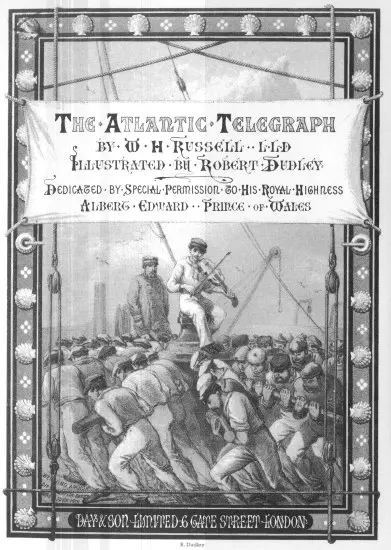
"The Atlantic Telegraph" by Sir William Howard Russell is a historical account written in the mid-19th century. This work delves into the ambitious project of laying the first telegraph cable across the Atlantic Ocean, chronicling the efforts and challenges faced by the engineers and inventors involved. Russell’s narrative likely emphasizes the technological advancements of the period and the historical significance of this endeavor in connecting Europe and North America. At the start of the narrative, the author provides a background on the history of electrical science and telegraphy, outlining the challenges faced by pioneers in the field. He references early experimental work by notable figures and discusses the evolution of ideas leading up to submarine telegraphy. As the chapter unfolds, Russell introduces characters like Cyrus Field, who plays a pivotal role in advocating for the transatlantic cable, summarizing the project’s origins, obstacles, and the determination of those who believed in the project’s potential to forever alter communication across the oceans. The opening sets a detailed stage for the epic tale of innovation intertwined with human ambition and the quest for connection.
Introduction adapted from the source catalogue; source summaries may be automatically generated.
Free to read · English · 55,317 words · No account needed
MAKE TIME FOR A GOOD BOOK
On by default. Untick to stop anonymous reading totals. Each page counts after 10 seconds in view. How this works.
Anonymous counting is on unless you have switched it off.
As I have said, the gale did not in the least affect the ship. She went on through the heavy sea steady as an island, running out the Cable at the rate of 7 knots an hour; and when the wind shifted to N.N.W. our course was altered to N.W. by W. ½ W., through a sea which fell as rapidly as it had risen. The crisis was now at hand. I was aroused about 8 o’clock a.m., Greenwich time (ship’s time being more than two hours earlier), by the slowing of the engines, and on looking out of my port saw, from the foam of the paddles passing ahead, that the ship was moving astern. In a moment afterwards I stood in the Testing-Room, where Mr. de Sauty, the centre of a small group of electricians, among whom was Professor Thomson, was bending over the instruments, surrounded by his anxious staff. The chronometer marked 8·6 a.m., Greenwich time. In reply to my question as to what was wrong, Professor Thomson whispered, “Another bad fault.” This was indeed surprising and distressing.
In order to make the history of the day consecutive, I will relate as closely as possible what occurred. Mr. Field went on duty in the tank in the early morning, relieving M. Jules Despescher. Some twenty minutes before the fault was noticed, whilst Mr. Field was watching, a grating noise was heard in the tank as the coil flew out over the flakes. One of the men exclaimed, “There goes a piece of wire.” The word was passed up through the crinoline shaft to the watcher. But he either did not hear what was said, or neglected to give any intimation, as the warning never reached Mr. Temple, who was on duty at the stern at the time. At 8 a.m., Greenwich time, being the beginning of an hour, and therefore the time when in regular series the electricians on board the Great Eastern began to send currents to the shore, the gentleman engaged in watching the galvanometer, saw the unerring index light quiver for an instant and glide off the scale. The fact was established that instead of meeting with the proper resistance, and traversing the whole length of the Cable to the shore, a large portion of the stream was escaping through a breach in the gutta percha into the sea. If the quantity of the current escaping had been uniform, the electricians could calculate very nearly the distance of the spot where the injury had taken place. In the present instance, however, the tests varied greatly, and showed a varying fault. When the current is sent through a wire from one pole it produces an electro-chemical action on the wire, and at the place of the injury, which leads to a deposit of a salt of copper in the breach, and impedes the escape of electricity; and when the opposite current is returned, the deposit is reduced, and hydrogen gas formed, a globule of which may rest in the chink, and, by its non-conducting power, restore the insulation of the Cable for a time. The fault in the present instance was so grave that it was resolved to pick up the Cable once more, till we cut it out, and re-spliced it. How far away it was no one could tell precisely; but from a comparison of time it was imagined that the faulty part was not far astern, and that it was in the portion of Cable which went over at 8 o’clock in the morning, or a little before it; and although the time was not accurately fixed when Mr. Field heard it, the grating noise was supposed to arise from some cause connected with the fault. Had the engineers foreseen what subsequently occurred they might have resolved to go on, and take the chance of working through the fault. Professor Thomson has since given it as his opinion that the fault could have been worked through, and that the Cable could have transmitted messages for a long time at the rate of four words a minute--making an amply remunerative return. Mr. de Sauty also entertained the belief that the Cable could have worked for several months, at all events. But it does not appear that Mr. Canning had any reason to act on the views of these gentlemen, and it was quite sure, when the end was landed in Heart’s Content, Mr. Varley could not have given his certificate that the Cable was of the contract standard. Neither Mr. Varley nor Mr. Professor Thomson had any power to interfere, or even to express their opinions, and electricians and engineers are generally inclined to regard with exclusive attention their own department in the united task, and to look to it solely.
Your reading position is saved on this browser. Take it to another device with a library code. Reading pages adapt to text, rather than matching a printed edition.
BEHIND THE BOOK
This eBook is for the use of anyone anywhere in the United States and most other parts of the world at no cost and with almost no restrictions whatsoever. You may copy it, give it away or re-use it under the terms of the Project Gutenberg License included with this eBook or online at www.gutenberg.org. If you are not located in the United States, you will have to check the laws of the country where you are located before using this eBook. Read the source licence.
The original source file, including credits and licence, is retained by this library. Request an original-format copy at no charge. Please include the book title and Project Gutenberg identifier #40948.
KEEP YOUR CURIOSITY GOING
Cécile Tormay

Moritz Busch
John L. Ransom
Frances Wright
Cécile Tormay

Mabel Potter Daggett