THE CLASSIC COLLECTION✦An outlaw’s diary: the CommuneCLASSIC FREE BOOKS
An outlaw’s diary: the Commune
Cécile Tormay
THE CLASSIC COLLECTION · 1865
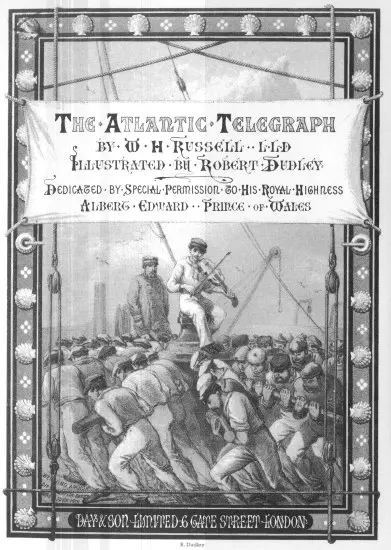
"The Atlantic Telegraph" by Sir William Howard Russell is a historical account written in the mid-19th century. This work delves into the ambitious project of laying the first telegraph cable across the Atlantic Ocean, chronicling the efforts and challenges faced by the engineers and inventors involved. Russell’s narrative likely emphasizes the technological advancements of the period and the historical significance of this endeavor in connecting Europe and North America. At the start of the narrative, the author provides a background on the history of electrical science and telegraphy, outlining the challenges faced by pioneers in the field. He references early experimental work by notable figures and discusses the evolution of ideas leading up to submarine telegraphy. As the chapter unfolds, Russell introduces characters like Cyrus Field, who plays a pivotal role in advocating for the transatlantic cable, summarizing the project’s origins, obstacles, and the determination of those who believed in the project’s potential to forever alter communication across the oceans. The opening sets a detailed stage for the epic tale of innovation intertwined with human ambition and the quest for connection.
Introduction adapted from the source catalogue; source summaries may be automatically generated.
Free to read · English · 55,317 words · No account needed
MAKE TIME FOR A GOOD BOOK
On by default. Untick to stop anonymous reading totals. Each page counts after 10 seconds in view. How this works.
Anonymous counting is on unless you have switched it off.
Monday, July 31st.--We have been passing over the valley in the Atlantic which is more than two miles deep. With the morning came the news that all had gone well during the night. Some had got up an hour after midnight to watch the transfer of the coil from the after to the fore tank, which was looked forward to with interest, as it was supposed to be attended with some little difficulty. But they were agreeably disappointed; the operation was effected with the utmost facility. At 3·30 o’clock a.m. the ship was stopped, to permit the transfer to be made. At 3·50 a.m. the Cable was running out of the fore hold, passing down the trough, and going out over the stern as she steamed ahead again. The Great Eastern was now near a fatal spot--somewhere below us lay the bones of three Atlantic Cables.
But all during the forenoon, engineers and electricians, agreed in the most favourable statements respecting the Cable and its progress. At 9 a.m. (Greenwich time) 868 miles had been run out, and 770 miles made from land. In the forenoon Mr. Canning brought to trial the coils in which the peccant part that had wrought such mischief existed. The Court was held at the door of the Testing-Room. Mr. de Sauty acted as judge. The jury consisted of cells, wires, and galvanometers. The accused cable, cut in junks, was subjected to a silent examination, and many fathoms were pronounced not guilty, flake by flake, till at last the criminal was detected and at once carried off by Mr. Canning. The process of examination was conducted in Mr. Clifford’s cabin, to which a few anxious spectators were admitted. The core was laid bare by untwisting the strands of Manilla covered with iron, and before a foot of it was uncovered an exclamation literally of horror escaped our lips! There, driven right through the centre of the coil so as to touch the inner wires, was a piece of iron wire, bright as if cut with nippers at one end and broken off short at the other. It was tried with the gauge, and found to be of the same thickness as the wire used in making the protecting cover of the Cable. On examining the strands a mark of a cut was perceived on the Manilla where the wire had entered, but it did not come through on the other side. In fact, it corresponded in length exactly with the diameter of the Cable, so that the ends did not project beyond the outer surface of the covering. Now here was at once, we thought, demonstration of a villanous design. No man who saw it could doubt that the wire had been driven in by a skilful hand. And as that was so, was it not likely that the former fault had been caused in a similar manner, and that it was not the result of accident? Then, again, it was curious that the former fault occurred when the same gang of men were at work in the tank. It was known there were enemies to the manufacturers of the Cable; whispers went about that one of the cablemen had expressed gratification when the first fault occurred. It was a very solicitous moment, and Mr. Canning felt a great responsibility. He could not tell who was guilty, and in trying to punish them or him he might disgust the good men on whom so much depended. He at once accepted an offer made by the gentlemen on board the ship to take turn about in doing duty in the tank and superintending the men engaged in paying-out the Cable. Then he caused the cablemen to be summoned at the bows, and showed them the coil and the wire. After they had examined it curiously, he asked the men what they thought of the injury, and they one and all, without hesitation, expressed their opinion that it must have been done on purpose by some one in the tanks. Lynch law was talked of, and if the man could have been pounced upon, and left to the mercy of his fellows, he would have fared ill that day. Nor was the feeling of anger and indignation diminished by the knowledge that the punishment awarded by law for offences of such a character was a paltry fine and short imprisonment. The men who were engaged in the tank at the time of the occurrence were transferred to other duties, and the volunteer inspectors established a roster, and began their course of duty--one going on for two hours at a time, and being relieved in order, so that night and day the men engaged in paying-out the Cable were under the eyes of very vigilant watchmen. It was a painful thing to have to do, but the men admitted it was not only justifiable but necessary, and declared they were very glad the measure was adopted. It was fondly hoped that this surveillance would save us from a recurrence of the delay to which the expedition had been subjected, and ulterior steps were postponed till the shore was reached, when it was intended to institute a rigid inquiry. At noon our position was, Lat. 52° 9´ 20´´, Long. 31° 53´. Length of Cable payed-out since yesterday 134 miles: total length paid out, 903 miles. Distance, from Valentia, 793 miles; from Heart’s Content, 871·9 miles. We had crossed the centre of the arc of the great circle.
Your reading position is saved on this browser. Take it to another device with a library code. Reading pages adapt to text, rather than matching a printed edition.
BEHIND THE BOOK
This eBook is for the use of anyone anywhere in the United States and most other parts of the world at no cost and with almost no restrictions whatsoever. You may copy it, give it away or re-use it under the terms of the Project Gutenberg License included with this eBook or online at www.gutenberg.org. If you are not located in the United States, you will have to check the laws of the country where you are located before using this eBook. Read the source licence.
The original source file, including credits and licence, is retained by this library. Request an original-format copy at no charge. Please include the book title and Project Gutenberg identifier #40948.
KEEP YOUR CURIOSITY GOING
Cécile Tormay

Moritz Busch
John L. Ransom
Frances Wright
Cécile Tormay

Mabel Potter Daggett