THE CLASSIC COLLECTION✦An outlaw’s diary: the CommuneCLASSIC FREE BOOKS
An outlaw’s diary: the Commune
Cécile Tormay
THE CLASSIC COLLECTION · 1865
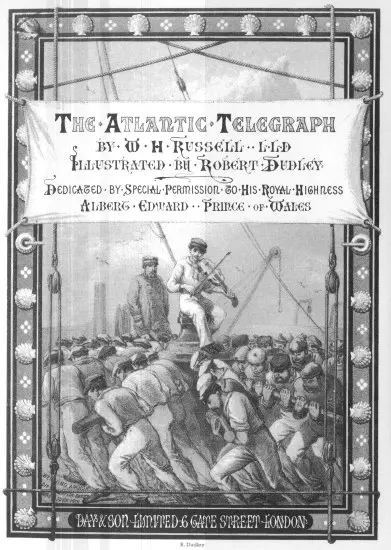
"The Atlantic Telegraph" by Sir William Howard Russell is a historical account written in the mid-19th century. This work delves into the ambitious project of laying the first telegraph cable across the Atlantic Ocean, chronicling the efforts and challenges faced by the engineers and inventors involved. Russell’s narrative likely emphasizes the technological advancements of the period and the historical significance of this endeavor in connecting Europe and North America. At the start of the narrative, the author provides a background on the history of electrical science and telegraphy, outlining the challenges faced by pioneers in the field. He references early experimental work by notable figures and discusses the evolution of ideas leading up to submarine telegraphy. As the chapter unfolds, Russell introduces characters like Cyrus Field, who plays a pivotal role in advocating for the transatlantic cable, summarizing the project’s origins, obstacles, and the determination of those who believed in the project’s potential to forever alter communication across the oceans. The opening sets a detailed stage for the epic tale of innovation intertwined with human ambition and the quest for connection.
Introduction adapted from the source catalogue; source summaries may be automatically generated.
Free to read · English · 55,317 words · No account needed
MAKE TIME FOR A GOOD BOOK
On by default. Untick to stop anonymous reading totals. Each page counts after 10 seconds in view. How this works.
Anonymous counting is on unless you have switched it off.
The day had been foggy or rather hazy. Light grey sheets of drizzling cloud flew over the surface of the sea, and set men talking of icebergs and Arctic storms; but towards evening the wind fell, and a cold clammy vapour settled down on ship and sea, bringing with it a leaden calm; so that the waves lost their tumbled crests, and slept at last in almost unmurmuring slumber. But the big ship slept not. The clank and beat of machinery ceased never, and the dull mill-like clatter of Cable apparatus seemed to become more active as the night wore on. The forge fires glared on her decks, and there, out in the midst of the Atlantic, anvils rang and sparks flew; and the spectator thought of some village far away, where the blacksmith worked, unvexed by Cable anxieties and greed of speedy news. As the blaze shot up, ruddy, mellow, and strong, and flung arms of light aloft and along the glistening decks, and then died into a red centre, masts, spars, and ropes were for the instant touched with a golden gleaming, and strange figures and faces were called out from the darkness--vanished--glinted out again--rushed suddenly into foreground of bright pictures, which faded soon away--flickered--went out--as they were called to life by its warm breath, or were buried in the outer darkness! Outside us all was obscurity; but now and then vast shadows, which moved across the arc of lighted fogbank, were projected far away by the flare; and one might well pardon the passing mariner whose bark drifted him in the night across the track of the great ship, if, crossing himself and praying with shuddering lips, he fancied he beheld a phantom ship freighted with an evil crew, and ever after told how he had seen the workshops of the Inferno floating on the bosom of the ocean. It was indeed a most wondrous and unearthly sight! The very vanes on the mastheads, the ring-bolts in the bulwarks and decks, the blocks and the cordage, were touched with such brightness that they shone as if on fire; whilst the whole of the fore part of the ship was in darkness; and on looking aft, it appeared as though the stern were on fire, or that blue lights were being burned every moment. For hour after hour, the work of “picking-up” went on. The term is objectionable; it rather indicates a brisk, lively process--a bird picks up a worm--a lady picks up a pin--a sharper picks up a flat--but the machine working at the bows of the Great Eastern assuredly was not in any one way engaged in brisk or lively work. Most doggedly at times did the Cable yield. As if it knew its home was deep in the bed of the Atlantic, and that its insulation and all the objects of its existence would be gained and bettered by remaining there, it strained against the power which sought to pull it forth; and the dynamometer showed that the resistance of the rigid cord was equivalent to 2½ tons. At times, again, it came up merely with coy reluctance, and again became sullen as though it were already troubled by the whims of two worlds and partook of their fancies. No trace was visible of its having touched the bottom for the 2½ miles which were hauled in, but the men observed signs of animal life on it, and certain creatures which they called “worms” were detached and fell on deck, a specimen of which I sought for in vain. As the Cable was hauled in, the men who coiled it aft, and guided it through the machinery, felt it carefully with their hands to detect any “fault” or injured part, and the line of large ship’s lanterns hung up along the deck showed how carefully they did their work. It was 5·40 p.m., Greenwich time, or about 3·40 p.m., ship’s time, when the end of the Cable came in board; but it was not till six hours and ten minutes had elapsed (9·50 p.m., ship’s time) that the part of the Cable where the mischief lay was picked up. The defective portion was found at the very part of the Cable which was going over the stern when the ocean galvanometer indicated “dead earth.” It was at once cut out, and reserved to be examined by Mr. Canning. The necessary steps were next taken to test the rest of the Cable. The shore end was spliced and jointed to a fresh end of the Cable from the after tank. These operations were finished before midnight; but it was not judged expedient to resume the process of paying-out till the morning. As yet no one knew the nature of the injury to the Cable. No one could account for the hitch; but it certainly did not affect any one’s belief in success. Mr. Field, to whom such accidents are never discouraging, remarked pleasantly during the crisis of picking-up, “I have often known Cables to stop working for two hours, no one knew why, and then begin again. Most likely it’s some mistake on shore.” What can discourage a believer? It was even comfort to him to remember that this very day eight years ago, a splice was made in the first Atlantic Cable, very much in the same place. But to all it had been a most trying day. And when night came, and some retired to the rest they had won so well, there, constant on the paddle-box, stood Captain Anderson, watching the course and conduct of his ship.
Your reading position is saved on this browser. Take it to another device with a library code. Reading pages adapt to text, rather than matching a printed edition.
BEHIND THE BOOK
This eBook is for the use of anyone anywhere in the United States and most other parts of the world at no cost and with almost no restrictions whatsoever. You may copy it, give it away or re-use it under the terms of the Project Gutenberg License included with this eBook or online at www.gutenberg.org. If you are not located in the United States, you will have to check the laws of the country where you are located before using this eBook. Read the source licence.
The original source file, including credits and licence, is retained by this library. Request an original-format copy at no charge. Please include the book title and Project Gutenberg identifier #40948.
KEEP YOUR CURIOSITY GOING
Cécile Tormay

Moritz Busch
John L. Ransom
Frances Wright
Cécile Tormay

Mabel Potter Daggett