THE CLASSIC COLLECTION✦An outlaw’s diary: the CommuneCLASSIC FREE BOOKS
An outlaw’s diary: the Commune
Cécile Tormay
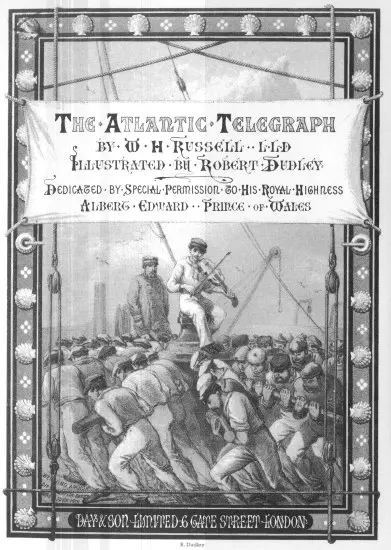
THE CLASSIC COLLECTION · 1865
"The Atlantic Telegraph" by Sir William Howard Russell is a historical account written in the mid-19th century. This work delves into the ambitious project of laying the first telegraph cable across the Atlantic Ocean, chronicling the efforts and challenges faced by the engineers and inventors involved. Russell’s narrative likely emphasizes the technological advancements of the period and the historical significance of this endeavor in connecting Europe and North America. At the start of the narrative, the author provides a background on the history of electrical science and telegraphy, outlining the challenges faced by pioneers in the field. He references early experimental work by notable figures and discusses the evolution of ideas leading up to submarine telegraphy. As the chapter unfolds, Russell introduces characters like Cyrus Field, who plays a pivotal role in advocating for the transatlantic cable, summarizing the project’s origins, obstacles, and the determination of those who believed in the project’s potential to forever alter communication across the oceans. The opening sets a detailed stage for the epic tale of innovation intertwined with human ambition and the quest for connection.
Introduction adapted from the source catalogue; source summaries may be automatically generated.
Free to read · English · 55,317 words · No account needed
MAKE TIME FOR A GOOD BOOK
On by default. Untick to stop anonymous reading totals. Each page counts after 10 seconds in view. How this works.
Anonymous counting is on unless you have switched it off.
Measures were at once taken to make a new splice and joint, rejecting the Cable picked up, a good deal of which had been strained in the process. Signals were made to the fleet that the enemy had been detected, at 9 a.m., and the Terrible replied, “I congratulate you.” First a splice was made in the Cable where it had been cut, for the purpose of testing between the after and fore tanks, and all admired the neatness and strength with which it was performed--the conducting wires soldered and lapped over--the gutta percha heated and moulded on the junction; and, finally, the strands carried over the core and secured. During the operation the Hawk returned to Valentia with our letters, and with the good news, which, however, must have been anticipated by the Cable itself. The splice and joint of the end of Cable towards the shore and the end from the after tank was next made. Then these splices were carefully tested and found perfect, and the stream of electricity was once more sent direct to Valentia. After a detention of some twelve hours, the paying-out machinery was again put in action, and the Cable glided out rapidly astern. All seemed to go well. About half a mile of wire had been paid out, when suddenly all communication between the shore and ship ceased altogether! From great contentment there was sudden blank despair! The operators were in consternation. The news spread from end to end of the ship, which again lay in restless quiet on the waters. The faces of the most cheerful became overcast--gloomy forebodings filled men’s minds all at once. Why had the Hawk been sent back? Why were not more tests made before she left? Away worked the electricians in their room, connecting and disconnecting, putting in and taking out stops--intensifying and reducing currents. Not a sign! Not a shadow of a sign! Mr. de Sauty suggested they had got hold of the wrong wires, and professors opined that the operators had done wrong in spending time over the splice between the two tanks at the critical moment when they should have been watching the signals from the shore. Anxious groups gathered round the Testing-Room, and the bolder popped in their heads, as if they could learn anything from the dumb mute wires and the clicking of the chronometers, or from the silent operators who bent over the instruments. At 3·15 p.m. the Cable between the two tanks was again cut, and examination was made to make sure no error had been made in the communications. Again the wearisome energy of the picking-up apparatus was to be called into play--once more the Cable was to be shackled and thrown overboard, and hauled up to the bows and pulled out of the water. Such a Penelope’s web in 24 hours, all out of this single thread, was surely disheartening. The Cable in the fore and the main tanks answered to the tests most perfectly. But that Cable which went seaward was sullen, and broke not its sulky silence. Even the gentle equanimity and confidence of Mr. Field were shaken in that supreme hour, and in his heart he may for a moment have sheltered, though he did not nurture, the thought that the dream of his life was indeed but a chimæra. Who could bear up against a life of picking-up? And our paying-out seemed to have such an undue share of the reverse process attached to it! But there was a change in the fortunes of the ship and of its freight. The index light suddenly reappeared on its path in the Testing-Room, and the wearied watchers were gladdened by the lighting of the beacon of hope once more. Again there was one of those mutations to which the flesh of submarine telegraph layers is born heir, and after a few moments of breathless solicitude, it was announced that the signals between the ship and the shore had been restored, and that every instant developed their strength. Mr. de Sauty came out of the Testing-Room to inform Professor Thomson of the fact, and Mr. Canning’s operations at the bows of the ship for picking up were most gratefully suspended by the intelligence that the machinery would not be required. At 4·15 p.m. the ship steamed on ahead again, and the Terrible and Sphinx were signalled to come on, 37 hours and 10 minutes having been lost by the fault, and consequent detentions. Our position, at noon was found to be, Lat. 51° 58´, Long. 12° 11´; total distance from Valentia, 66½ miles; total Cable payed-out 74 miles (per centage of slack being 14 miles), distance from Heart’s Content, 1,596 miles. The communication with shore continued to improve, and was, in the language of telegraphers, O. K. The alternations of hope and fear to which we had been exposed were now pleasantly terminated for the evening, and the saloon became the scene of joyous and animated conversation, and of a good deal of scientific discussion, till the approach of midnight.
Your reading position is saved on this browser. Take it to another device with a library code. Reading pages adapt to text, rather than matching a printed edition.
BEHIND THE BOOK
This eBook is for the use of anyone anywhere in the United States and most other parts of the world at no cost and with almost no restrictions whatsoever. You may copy it, give it away or re-use it under the terms of the Project Gutenberg License included with this eBook or online at www.gutenberg.org. If you are not located in the United States, you will have to check the laws of the country where you are located before using this eBook. Read the source licence.
The original source file, including credits and licence, is retained by this library. Request an original-format copy at no charge. Please include the book title and Project Gutenberg identifier #40948.
KEEP YOUR CURIOSITY GOING
Cécile Tormay

Moritz Busch
John L. Ransom
Frances Wright
Cécile Tormay

Mabel Potter Daggett