THE CLASSIC COLLECTION✦An outlaw’s diary: the CommuneCLASSIC FREE BOOKS
An outlaw’s diary: the Commune
Cécile Tormay
THE CLASSIC COLLECTION · 1865
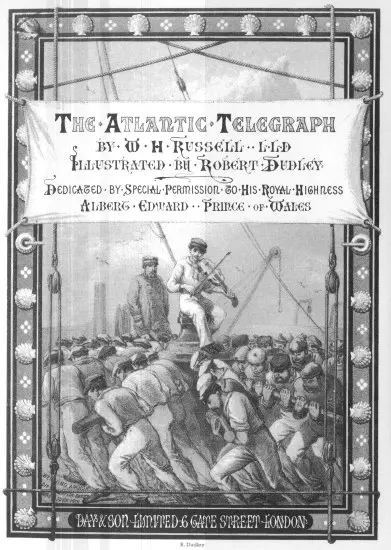
"The Atlantic Telegraph" by Sir William Howard Russell is a historical account written in the mid-19th century. This work delves into the ambitious project of laying the first telegraph cable across the Atlantic Ocean, chronicling the efforts and challenges faced by the engineers and inventors involved. Russell’s narrative likely emphasizes the technological advancements of the period and the historical significance of this endeavor in connecting Europe and North America. At the start of the narrative, the author provides a background on the history of electrical science and telegraphy, outlining the challenges faced by pioneers in the field. He references early experimental work by notable figures and discusses the evolution of ideas leading up to submarine telegraphy. As the chapter unfolds, Russell introduces characters like Cyrus Field, who plays a pivotal role in advocating for the transatlantic cable, summarizing the project’s origins, obstacles, and the determination of those who believed in the project’s potential to forever alter communication across the oceans. The opening sets a detailed stage for the epic tale of innovation intertwined with human ambition and the quest for connection.
Introduction adapted from the source catalogue; source summaries may be automatically generated.
Free to read · English · 55,317 words · No account needed
MAKE TIME FOR A GOOD BOOK
On by default. Untick to stop anonymous reading totals. Each page counts after 10 seconds in view. How this works.
Anonymous counting is on unless you have switched it off.
At noon on July 15th the Great Eastern, in charge of Mr. Moore, Trinity pilot, drawing 34 ft. 4 in. forward, and 28 ft. 6 in. aft, got up her anchor, and at midnight on July 16th was off the Lizard. On Monday, 17th, she came up with the screw steamer Caroline, freighted with 27 miles of the Irish shore end of the Cable, weighing 540 tons, and took her in tow. Then a gale set in, which gave occasion to the Great Eastern to show her fine qualities as a sea-boat when properly handled. Even those who were most prejudiced or most diffident, admitted that on that score no vessel could behave better. This trial gave every one, from Captain Anderson down, additional reason to be satisfied with the fitness of the great ship for the task on which she was engaged. Next day, Tuesday, July 18th, she encountered off the Irish coast a strong gale with high westerly sea, through which she ran at the rate of six knots an hour. The Caroline, which rolled so heavily and pitched so vigorously as to excite serious apprehensions, broke the tow rope in the course of the day, and ran for Valentia harbour, where she arrived safely, piloted by the Great Eastern; and the Great Eastern, passing inside the Skelligs, stood in close to Valentia Lighthouse, and sent a boat ashore to communicate. H.M.S. Terrible, Captain Napier, and H.M.S. Sphinx, Captain V. Hamilton, were visible in the offing, having sailed at the end of the previous week from Queenstown for the rendezvous, outside Valentia. Captain Anderson having fired a gun to announce his arrival, steamed for Berehaven, in Bantry Bay, and anchored inside the island on Wednesday morning, July 19th, in 17 fathoms. Here the Great Eastern lay, preparing for her great errand--perhaps, as it may prove, her exclusive “mission,”--on Thursday, 20th, Friday, 21st, and Saturday, 22nd July, whilst the Caroline was landing the shore end of the Cable in Foilhummerum Bay in Valentia. During her stay in Bantry Bay, many visitors, high and low, came on board the Great Ship, but it was believed all over the country that she was going to Foilhummerum. The greater portion of those anxious to see her made the best of their way to that secluded spot, to which there was once more attached an interest of a civilised character; for, if country legends be true, there must have been some regard paid to Foilhummerum Bay by no less a person than Oliver Cromwell, testified yet by the grey walls of a ruined fort, and traces of a moat and outer wall, on the greensward above the point which forms the northern entrance to the lonely bay. This crisp greensward, glistening with salt, lies in a thin crust over the cliffs, which rise sheerly from the sea some three or four hundred feet; and for what Oliver Cromwell or any one else could have erected a fortalice thereon, may well baffle conjecture, unless the builder, having a far-reaching mind, saw the importance of watching the most westerly portion of Europe, or anticipated the day when Valentia would be recognised as one of the landmarks created by the necessities of commercial and social existence. Taking advantage of the shelter afforded by a gradual descent inland of the soil, a few cabins have been placed by the natives--half-fishermen, half-husbandmen--Archytas-like, spanning land and sea, and making but poor subsistence from their efforts on both. The little bay, which is not much above a mile in length, contracts from a breadth of half so much, into a watery cul-de-sac, terminated by steep banks of shale, earth, and high cliff, furrowed by watercourses; and on the southernmost side it is locked in by the projecting ledges of rock forming the northern entrance to the Port Magee channel. It is so guarded from wind and sea, that on one side only is it open to their united action, but as the entrance looks nearly west, the full roll of the Atlantic may break in upon it when the wind is from that point; and indeed there is not wanting evidence that the wild ocean swell must tumble in there with frightful violence. Jagged fragments of masts and spars are wedged into the rocks immovably by the waves, and the cliffs are gnawed out by the restless teeth of the hungry water into deep caves. But then a sea from that point would run parallel with the line of the Cable, and would sweep along with and not athwart its course, so that the strands would not be driven to and fro and ground out against the bottom. Except for a couple of hundred feet near the shore at the top of this cove, indeed, the bottom is sandy, and the rocks inside the sand line were calculated to form a protection to the Cable, once deposited, as the greater part of its course lay through a channel which had been cleared of the boulders with the intention of rolling them back again at low water, to cover in the shore end. Lieutenant White, and the hardy and hard-working sailors of the Coastguard Station at Valentia, had been indefatigable in sounding and buoying out a channel from the beach clear out to sea, within which the Caroline was to drop the Cable. A few yards back from the cliff, at the head of the cove, the temporary Telegraph Station reared its proportions in imitation of a dwarf Brompton boiler--a building of wood much beslavered with tar and pitch, of exceeding plainness, and let us hope of corresponding utility. Inside were many of the adjuncts of comfort, not to speak of telegraphic luxury, galvanometers, wires, batteries, magnets, Siemens’s and B. A. unit cases, and the like, as well as properties which gave the place a false air of campaigning. A passage led from end to end, with rooms for living and sleeping in to the right and left, and an instrument room at the far extremity. Here, on a narrow platform, were the signal and speaking apparatus connected with the wires from the end of the Cable, which was secured inside the house. Outside the wires were carried by posts in the ordinary way to the station at Valentia, whence they were conveyed to Killarney, and placed in communication with the general Telegraphic system over the world. The Telegraphic staff and operators were lodged in primitive apartments like the sections of a Crimean hut, and did not possess any large personal facility for enjoying social intercourse with the outer world, although so much intelligence passed through their fingers. But Foilhummerum may in time become a place with something more real than a future. If vessels from the westward do not like to make their number outside, there is nothing to prevent their running into Valentia for the purpose, at all events. On the plateau between the station and the cliff, day after day hundreds of the country people assembled, and remained watching with exemplary patience for the Big Ship. They came from the mainland across Port Magee, or flocked in all kinds of boats from points along the coast, dressed in their best, and inclined to make the most of their holiday, and a few yachts came round from Cork and Bantry with less rustic visitors. Tents were soon improvised by the aid of sails, some cloths of canvas, and oars and boathooks, inside which bucolic refreshment could be obtained. Mighty pots of potatoes seethed over peat fires outside, and the reek from within came forth strongly suggestive of whisky and bacon. Flags fluttered--the Irish green, with harp, crown surmounted; Fitzgerald, green with its blazon of knight on horse rampant, and motto of “Malahar aboo”--faint suspicion of Stars and Stripes and Union Jack, and one temperance banner, audaciously mendacious, as it flaunted over John Barleycorn. Nor was music wanting. The fiddler and the piper had found out the island and the festive spot, and seated on a bank, played planxty and jig to a couple or two in the very limited circle formed in the soft earth by plastic feet or ponderous shoemasonry, around which, sitting and standing, was a dense crowd of spell-bound, delighted spectators. In the bay below danced the light canvas-covered canoe or coracle in which the native fishermen will face the mountain billows of the Atlantic when no other boat will venture forth; and large yawls filled with country people passed to and fro, and the bright groupings of colour formed on the cliffs and on the waters by the red, scarlet, and green shawls of the women and girls, lighted up the scene wonderfully.
Your reading position is saved on this browser. Take it to another device with a library code. Reading pages adapt to text, rather than matching a printed edition.
BEHIND THE BOOK
This eBook is for the use of anyone anywhere in the United States and most other parts of the world at no cost and with almost no restrictions whatsoever. You may copy it, give it away or re-use it under the terms of the Project Gutenberg License included with this eBook or online at www.gutenberg.org. If you are not located in the United States, you will have to check the laws of the country where you are located before using this eBook. Read the source licence.
The original source file, including credits and licence, is retained by this library. Request an original-format copy at no charge. Please include the book title and Project Gutenberg identifier #40948.
KEEP YOUR CURIOSITY GOING
Cécile Tormay

Moritz Busch
John L. Ransom
Frances Wright
Cécile Tormay

Mabel Potter Daggett