THE CLASSIC COLLECTION✦An outlaw’s diary: the CommuneCLASSIC FREE BOOKS
An outlaw’s diary: the Commune
Cécile Tormay
THE CLASSIC COLLECTION · 1865
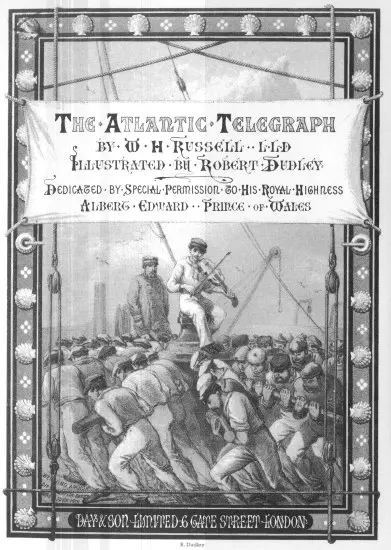
"The Atlantic Telegraph" by Sir William Howard Russell is a historical account written in the mid-19th century. This work delves into the ambitious project of laying the first telegraph cable across the Atlantic Ocean, chronicling the efforts and challenges faced by the engineers and inventors involved. Russell’s narrative likely emphasizes the technological advancements of the period and the historical significance of this endeavor in connecting Europe and North America. At the start of the narrative, the author provides a background on the history of electrical science and telegraphy, outlining the challenges faced by pioneers in the field. He references early experimental work by notable figures and discusses the evolution of ideas leading up to submarine telegraphy. As the chapter unfolds, Russell introduces characters like Cyrus Field, who plays a pivotal role in advocating for the transatlantic cable, summarizing the project’s origins, obstacles, and the determination of those who believed in the project’s potential to forever alter communication across the oceans. The opening sets a detailed stage for the epic tale of innovation intertwined with human ambition and the quest for connection.
Introduction adapted from the source catalogue; source summaries may be automatically generated.
Free to read · English · 55,317 words · No account needed
MAKE TIME FOR A GOOD BOOK
On by default. Untick to stop anonymous reading totals. Each page counts after 10 seconds in view. How this works.
Anonymous counting is on unless you have switched it off.
Mr. Crampton, who had already accepted the contract for laying the cable between England and France, and had given up much of his time to the study of the subject, adopted this idea, and in 1851 he and several gentlemen associated for the purpose laid the cable between Dover and Calais, where it has since remained in perfect order, constituting the great channel of electrical communication between England and the Continent. It was made by Wilkins & Weatherly, Newall & Co., Küper & Co., and Mr. Crampton. The exertions of the last-named eminent engineer in laying the first cable under water, and his devotion to an object towards which he largely contributed in money, are only known to a few, and have never been adequately acknowledged.
The success of that form of cable having been thus completely established, several lines of a similar character were laid during the following years between England and Ireland and parts of the Continent: one, 18 miles long, across the Great Belt, made by Newall & Co.; one from Dover to Ostend, by the same makers and by Küper & Co.; one from Donaghadee to Portpatrick, by Newall & Co.; one from Holyhead to Howth; and one from Orfordness to the Hague.
The superiority of a line with wire-rope cover to other descriptions of cable was illustrated in 1853. At that period the Electric and International Telegraph Company determined upon laying down four wires between England and the Continent, but they rejected the heavy cable, and adopted the suggestion of their engineer to use four separate cables of light wire. The cost of maintaining these light cables from injury by anchors, &c., was so great that they were picked up, and heavy cables of great strength were substituted, which have given no trouble or anxiety, and have always been in good order.
The Old World had twelve lines of submarine cable laid ere the United States turned their attention to the uses of such forms of telegraph. Italy had been connected with Corsica by a line 110 miles long, and Denmark had joined one of her little islands to the other, ere the Great Republic gave a thought to the matter. But there were excuses for such indifference. The Telegraphic system, to which Morse, Bain, House, and others, had given such development, although the first line was not constructed till 1844, extended rapidly all over the vast extent of the Atlantic and Gulf States. The people were on the same continent, the land was all their own, their greatest rivers could be traversed by wires; and so it was that, whilst Mr. Morse was engaged in protecting his patents, and the Americans, self-contained, were not looking beyond the limits of their shores, a British North American Province took the first step which was made at the other side of the Atlantic to lay down a submarine cable. In 1851-2 a project was started in Newfoundland, to run a line of steamers between Galway and St. John’s in connection with a telegraph to Cape Ray, where a submarine Cable was to be laid to Cape Breton, and thence the news was to be carried by means of another cable from New Brunswick to Prince Edward’s Island. The Roman Catholic Bishop of Newfoundland is stated to have been the original proposer of a scheme for connecting the island with the United States, but the credit of actually laying down the first submarine cable at the other side of the Atlantic belongs to Mr. F.N. Gisborne, an English engineer. He had been previously engaged in the telegraph department at Montreal, and had some knowledge of the subject, but he happened to be in London at the time of Brett’s success. On his return to America he applied himself to get up a Company for the purpose of facilitating telegraphic communication between Europe and the United States. After much difficulty the Company was formed, and an Act was passed by the Legislature of Newfoundland, in 1852, conferring the important privileges upon it, in event of the completion of the project in Newfoundland, which are now possessed by the Atlantic Telegraph Company. Mr. Gisborne was superintendent and engineer of the Company, and he set to work with energy to construct a road from St John’s to Cape Ray, over a barren and resourceless tract of 400 miles, and made a survey of the coast line, during which he was exposed to great hardships. He succeeded at last in laying an insulated cable, made by Newall & Co., from New Brunswick to Prince Edward’s Island across the Straits of Northumberland, 11 miles long, in 22 fathoms of water; but was not successful in a similar attempt to connect Newfoundland with Cape Breton. Meantime the Company became involved in pecuniary difficulties, and Mr. Gisborne, early in 1854, on the suspension of the works, proceeded to New York, where he hoped to find money to enable him to carry out the telegraphic scheme among the keen speculators and large-pursed merchants. Through an accidental conversation at the hotel in which he was staying, he obtained an interview with Mr. Cyrus Field. He laid his plans before that gentleman, who had no desire to resume an active career, having just returned from travelling in South America, with the intention of enjoying the fortune his industry and sagacity had secured ere he had arrived at the middle term of life. But Mr. Field listened to Mr. Gisborne with attention, and then began to think over the project--“To lay these submarine cables so as to connect Newfoundland with Maine?--Good. To run a line of steamers from St. John’s to Galway?--Certainly. It would shorten the time of receiving news in New York from Europe four or five days.” And so the brain worked and thought. Then suddenly, “But if a cable can be laid in the bed of these seas--if the Great Atlantic itself could be spanned?” Here was an idea indeed. Deep and broad seas had been traversed in Europe, but here was one of the great oceans of the world, of depth but faintly guessed at, and of nigh 2000 miles span from shore to shore! Would it be within the limits of human resources to let down a line into the watery void, and to connect the Old World with the New? What a glorious thought! Was it a vision, or was it one of those inspirations from which originate grand enterprises and results which change the destinies of the world? Mr. Field terminated his reflections that night by an eminently practical measure. Ere he retired to rest he sat down and wrote two letters,--one to Lieut. Maury, U.S.N., to ask his opinion concerning the possibility of laying down a cable in the bottom of the Atlantic; the other to Professor Morse, to inquire whether he thought it practicable to send an electric current through a wire between Europe and America. Lieut Maury, in answering in the affirmative, wrote, “Curiously enough, when your letter came I was looking over my letter to the Secretary of the Navy on that very subject.” And, in fact, on the 22nd February, 1854, Lieut. Maury made a long communication to Mr. Dobbin, Secretary, United States Navy, from the Observatory, Washington, respecting a series of deep-sea soundings made by Lieut. Berryman, U.S.N., brig Dolphin, from Newfoundland to Ireland, in connection with researches on the winds and currents, carried on for the National Observatory. It is obvious that Lieut. Maury, as well as many others probably, had thought of the same idea as Mr. Field. He says, “The result is highly interesting, in so far as the bottom of the sea is concerned, upon the question of a submarine telegraph across the Atlantic;” and he goes on to make it the subject of a special report, in which occur the following passages;--
Your reading position is saved on this browser. Take it to another device with a library code. Reading pages adapt to text, rather than matching a printed edition.
BEHIND THE BOOK
This eBook is for the use of anyone anywhere in the United States and most other parts of the world at no cost and with almost no restrictions whatsoever. You may copy it, give it away or re-use it under the terms of the Project Gutenberg License included with this eBook or online at www.gutenberg.org. If you are not located in the United States, you will have to check the laws of the country where you are located before using this eBook. Read the source licence.
The original source file, including credits and licence, is retained by this library. Request an original-format copy at no charge. Please include the book title and Project Gutenberg identifier #40948.
KEEP YOUR CURIOSITY GOING
Cécile Tormay

Moritz Busch
John L. Ransom
Frances Wright
Cécile Tormay

Mabel Potter Daggett