THE CLASSIC COLLECTION✦An outlaw’s diary: the CommuneCLASSIC FREE BOOKS
An outlaw’s diary: the Commune
Cécile Tormay
THE CLASSIC COLLECTION · 1865
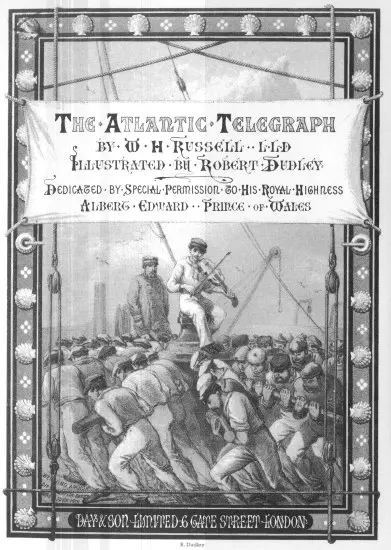
"The Atlantic Telegraph" by Sir William Howard Russell is a historical account written in the mid-19th century. This work delves into the ambitious project of laying the first telegraph cable across the Atlantic Ocean, chronicling the efforts and challenges faced by the engineers and inventors involved. Russell’s narrative likely emphasizes the technological advancements of the period and the historical significance of this endeavor in connecting Europe and North America. At the start of the narrative, the author provides a background on the history of electrical science and telegraphy, outlining the challenges faced by pioneers in the field. He references early experimental work by notable figures and discusses the evolution of ideas leading up to submarine telegraphy. As the chapter unfolds, Russell introduces characters like Cyrus Field, who plays a pivotal role in advocating for the transatlantic cable, summarizing the project’s origins, obstacles, and the determination of those who believed in the project’s potential to forever alter communication across the oceans. The opening sets a detailed stage for the epic tale of innovation intertwined with human ambition and the quest for connection.
Introduction adapted from the source catalogue; source summaries may be automatically generated.
Free to read · English · 55,317 words · No account needed
MAKE TIME FOR A GOOD BOOK
On by default. Untick to stop anonymous reading totals. Each page counts after 10 seconds in view. How this works.
Anonymous counting is on unless you have switched it off.
The solution of this question must therefore be found in adding mechanical strength externally to the core, by surrounding it with such materials and in such a manner as to relieve it from all that strain which it will unavoidably meet in depositing it in its required position. In the case of the original Atlantic Cable this was attempted by first surrounding the core with tarred hemp, which in its turn was enveloped spirally by eighteen strands of iron wire; each strand consisting of seven No. 22½ gauge wires. The entire weight of the Cable so formed was, in air 20 cwt. per knot, and in water 13·3 per knot. Being capable of bearing its own weight in about five miles perpendicular depth of water, and the greatest depth on the route being two-and a half miles, its strength was calculated at about as much again as was absolutely requisite for the work. This was thought at the time to be a sufficient margin, and certainly in 1858, owing to the greatly improved machinery employed, this Cable was payed-out with great facility and without undue strain, although portions of it had been lost by breaking during several previous attempts in the same summer. Subsequent investigation and experience, however, led to the conclusion, that in respect, not only to its mechanical properties, but especially with regard to its relative specific gravity, and to other points in its construction, the Cable of 1858 was very imperfect; and, with a view to ensure every practicable improvement in the structure of their new line, the promoters of the undertaking, so soon as they found themselves in funds, during 1863, issued advertisements with a view to stimulate inquiry into the subject, inviting tenders for Cables suitable for the proposed work. The specimens that were sent in, as the result of this public appeal, were submitted to the scientific advisers of the Company, who, after careful experiments with all the specimens, unanimously recommended the Atlantic Company to adopt the principle of the Cable proposed by Glass, Elliot, & Co., whose experience and success in this description of work are well known. The Committee, however, stipulated that they should settle the actual material of which the Cable was to be ultimately composed, and that these should be carefully and separately experimented on before finally deciding upon it; and in consequence of this stipulation upwards of one hundred and twenty different specimens, being chiefly variations of the principle adopted by the Committee, were manufactured and subjected to very severe experiment, as were also the various descriptions and quantities of iron, hemp, and Manilla proposed as components of these respective Cables. The result of it all was that the Committee recommended the Cable that was adopted as being, in their opinion, “the one most calculated to insure success in the present state of our experimental knowledge respecting deep-sea Cables,” taking care at the same time, by enforcing a stringent specification and constant supervision, to guard against any possible laxity in the details of its construction. The Cable so decided on weighed 35¾ cwt. per knot in air, but in water it did not exceed 14 cwt., being only a fraction heavier in that medium than the old Cable, though bearing more than twice the strain--the breaking strain of the new Cable being 7 tons 15 cwt. In water it was capable of bearing eleven miles of its own length perpendicularly suspended, and consequently had a margin of strength of more than four and a-half times that which was absolutely requisite for the deepest water. The core having been received from the gutta percha works, and carefully tested to note its electrical condition, was first taken to receive its padding of jute yarn, whereby the gutta percha would be protected against any pressure from the external iron sheath, which latter succeeded the jute. On former occasions this padding of jute had been saturated in a mixture of tar before being applied to the gutta percha; but experience had shown that this proceeding might lead to serious fallacies as to the electrical state of the core, cases having been repeatedly found where faults existed in the core itself--amounting to an almost total loss of insulation--which, however, were only discovered after being submerged and worked through, owing to the partial insulation conferred for a time upon the bad place by means of the tarred wrapping. The Atlantic core, therefore, was wrapped with jute which had been simply tanned in a solution of catechu, in order to preserve it from decay, and as fast as the wrapping proceeded the wrapped core was coiled into water, in which, not only at this stage, but ever afterwards until finally deposited in the sea, the Cable, complete or incomplete, was stored, and the water being able to freely pass through the tarred jute to the core, the least loss of insulation was at once apparent by the facility offered by the water to conduct away to earth the whole or a portion of the testing current.
Your reading position is saved on this browser. Take it to another device with a library code. Reading pages adapt to text, rather than matching a printed edition.
BEHIND THE BOOK
This eBook is for the use of anyone anywhere in the United States and most other parts of the world at no cost and with almost no restrictions whatsoever. You may copy it, give it away or re-use it under the terms of the Project Gutenberg License included with this eBook or online at www.gutenberg.org. If you are not located in the United States, you will have to check the laws of the country where you are located before using this eBook. Read the source licence.
The original source file, including credits and licence, is retained by this library. Request an original-format copy at no charge. Please include the book title and Project Gutenberg identifier #40948.
KEEP YOUR CURIOSITY GOING
Cécile Tormay

Moritz Busch
John L. Ransom
Frances Wright
Cécile Tormay

Mabel Potter Daggett