
The lost dirigible
Ralph Henry Barbour
THE CLASSIC COLLECTION · 1904
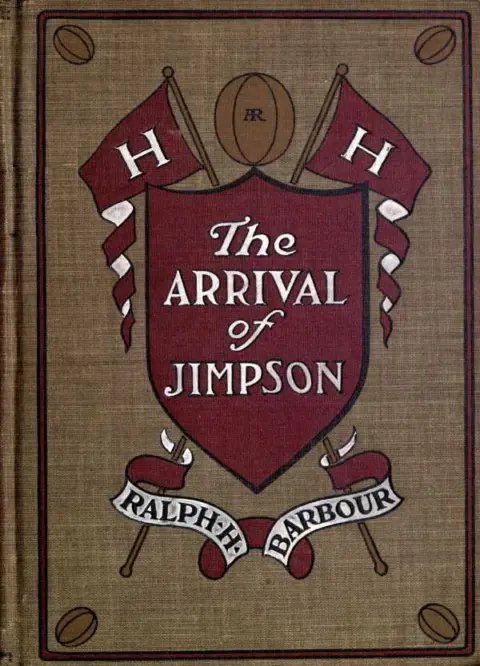
"The Arrival of Jimpson, and Other Stories for Boys about Boys" by Ralph Henry Barbour is a collection of short stories written in the early 20th century. The book addresses themes relevant to young boys, particularly focusing on school life, sports, and the challenges of adolescence. The opening story features the character Jimpson, who is a freshman football player trying to make his mark amid the excitement and pressures of a college football game. The opening of the book sets the stage for the story of Jimpson and his battle for recognition in a team dominated by more experienced players. Amid a fervent atmosphere filled with cheers and anticipation, the narrative explores Jimpson's feelings of exclusion as he prepares for a pivotal game against Yale. Despite being overlooked by his peers, Jimpson's determination and potential are highlighted, foreshadowing his chance to prove himself. The story captures the spirit of youthful camaraderie, the thrill of competition, and the internal struggles of a young boy seeking acceptance.
Introduction adapted from the source catalogue; source summaries may be automatically generated.
Free to read · English · 47,166 words · No account needed
MAKE TIME FOR A GOOD BOOK
On by default. Untick to stop anonymous reading totals. Each page counts after 10 seconds in view. How this works.
Anonymous counting is on unless you have switched it off.
“And then what?” asked Stowell, quietly.
“Chick’s” grin faded out a little.
“Why--er--that’s all, I guess. I ordered two pairs of the funny things
and came away.”
Clinton and Hazlett were still chuckling. “Chick” looked from them to Stowell doubtfully and began to wonder what ailed the latter’s sense of humor.
“Knitting!” murmured Clinton, “think of it!”
“Yes,” said Stowell, suddenly, “that’s awfully funny, ‘Chick.’ Funniest thing I’ve heard for a long while. Do you know--” the tone made his friend stare in surprise--“I think you’ve got one of the most delicate humorous perceptions I’ve ever met up with. You have, indeed. Only you, ‘Chick,’ could have seen all the exquisite humor in the situation you’ve described. You ought to be proud of yourself.”
Clinton and Hazlett had ceased their chuckles and were looking over at their host, their faces reflecting the surprise and uneasiness upon “Chick’s.”
“Here’s a poor duffer,” went on Stowell, “without money; father dead; mother takes boarders to make a living; wants to go to college and learn to be something a little better than a backwoods lumberman. He gets enough money together somehow--I think you said they borrowed it, ‘Chick’?”
That youth nodded silently.
“Yes, borrowed enough to pay the tuition fee. And then he’s thrown on his own resources to make enough to buy himself things to eat. I suppose even these backwoods beggars have to eat once in a while, Clint? And having learned how to knit blue-woolen mittens--awfully funny looking things, they are--he just goes ahead and knits them, rather than starve to death, and tries to sell them to a lot of superior beings like you and me here, not knowing in his backwoods ignorance that we only wear Fownes’s or Dent’s, and that we naturally look down on fellows who----”
“Oh, dry up, old man,” growled “Chick.” “I haven’t been saying anything against the duffer. Of course he’s plucky and all that. You needn’t jump on a fellow so.”
“Yes, he has got grit, and that’s a fact,” Clinton allowed. “Only, of course, knitting--well, it’s a bit out of the ordinary, eh?”
“I suppose it is,” answered Stowell. “In fact ‘Mittens’ is a bit out of the ordinary himself. He’s----”
There was a knock at the door, and, in response to Stowell’s invitation, Shult, tall, ungainly, tow-haired, freckle-faced, entered and paused in momentary embarrassment as his blue eyes lighted on Reeves.
“Hello, Shult; come in,” called Stowell. “Have you brought those
mittens?”
Shult had, and he undid them carefully, and crossing the study, handed
them to their purchaser.
Your reading position is saved on this browser. Take it to another device with a library code. Reading pages adapt to text, rather than matching a printed edition.
Ralph Henry Barbour
Ralph Henry Barbour

Ralph Henry Barbour

Ralph Henry Barbour
BEHIND THE BOOK
This eBook is for the use of anyone anywhere in the United States and most other parts of the world at no cost and with almost no restrictions whatsoever. You may copy it, give it away or re-use it under the terms of the Project Gutenberg License included with this eBook or online at www.gutenberg.org. If you are not located in the United States, you will have to check the laws of the country where you are located before using this eBook. Read the source licence.
The original source file, including credits and licence, is retained by this library. Request an original-format copy at no charge. Please include the book title and Project Gutenberg identifier #45689.
KEEP YOUR CURIOSITY GOING
Coulson Kernahan

Maurice Baring
Frances Wright
Cécile Tormay

Frederic Jesup Stimson

W. H. P. (William Henry Pope) Jarvis